
By Marcus Kolga, for DFRLab
Property seizures, family interrogations, and digital surveillance show how Belarus punishes its diaspora on Canadian soil
In August 2025, a Belarusian Canadian community organizer living in Alberta, whom we will identify as “Sara,” received a message via Telegram concerning an apartment she owned in Belarus. A former neighbor had noticed an official document bearing a government seal placed across her door, signaling that the apartment had been seized by the regime.
The notice offered no explanation, no court date, and no avenue for appeal. Its purpose was clear: the Belarusian state was using the seizure of private property to punish Sara’s pro-democracy activism in Canada and to signal that her actions abroad carried consequences at home.
In the past, human rights defenders, anti-corruption activists, pro-democracy leaders, and journalists could often escape regime repression at home by seeking refuge in democratic states. That hope of protection in exile is now fading. In recent years, the protection once provided by distance and borders has eroded. Authoritarian regimes in Russia, China, Iran, Belarus, and elsewhere are intensifying efforts to silence dissidents, activists, and journalists who criticize them from abroad. This practice is known as transnational repression: the use by states of intimidation, harassment, coercion, threats, surveillance, legal or administrative pressure, and violence across borders to control or silence diaspora and exile communities.
The seizure of Sara’s home in Belarus was no coincidence. According to the Belarusian human rights organization Viasna, at least 207 participants[1] in Belarusian Freedom Day events that were held in Canada, the United States, United Kingdom, Poland, and Lithuania were identified by authorities and charged with what the regime has defined as “facilitating extremist activities.”
In Canada and across Europe, exile no longer guarantees safety. Authoritarian regimes, like the Aleksandr Lukashenka regime in Belarus, exploit this growing vulnerability with ease, restricting the rights of residents in democracies to express themselves freely, without facing significant consequence.
Since Belarus’s fraudulent 2020 presidential election and the mass protests that followed, state repression has intensified, further entrenching the country’s status as one of Europe’s most repressive states. Freedom House’s Freedom in the World 2025 report rates Belarus as “Not Free,” citing openly rigged elections, severe restrictions on civil liberties, violence and arbitrary detention by security forces, and the absence of independent checks on President Aleksandr Lukashenka’s power. The Lukashenka regime has dismantled independent media and civil society, imprisoned democratic opponents, and entrenched its rule through fear, arbitrary detention, and violence.
Targets of the regime are frequently prosecuted under vague and overly broad “extremism” laws used to criminalize criticism, independent reporting, and peaceful expression. More than 1,100 political prisoners remain behind bars, and more than 8,000 politically motivated convictions have been recorded since 2020.[2]
The scale of the resulting exodus from Belarus has been significant. Freedom House estimated in late 2024 that roughly 500,000 Belarusians had fled the country since 2020.[3] A 2025 iSANS report, drawing on the United Nations and other expert assessments, placed the figure as high as 600,000.[4]
Like its Russian allies, Minsk has developed a transnational repression apparatus to silence critics around the world and impose costs on exiles without requiring their physical return, while having knock-on effects of isolating communities and deterring public advocacy.[5] Family members still living in Belarus can be targeted and exploited as a pressure point. Property, including apartments, bank accounts, or inheritances can be converted into repressive leverage. Photos posted to social media, from a rally in Canada, Poland, Lithuania or elsewhere could provide the pretext for a criminal investigation by the regime. “Extremism” can become whatever the regime decides it is. Facts and evidence are deemed irrelevant.
For those Belarusians who have fled the regime’s domestic repression to seek refuge abroad, exile has not meant safety. The cases that follow show how Belarusian repression is projected into Canada through threats, surveillance, harassment of family members, and the seizure of property to silence lawful democratic activism.
Such attacks violate what can be understood as our collective democratic cognitive sovereignty: the right of individuals, groups, and communities to think, speak, associate, and make political choices free from foreign pressure, coercion, or manipulation. That principle is grounded in international human rights law: Article 19 of the International Covenant on Civil and Political Rights protects the right to hold opinions without interference and to seek, receive, and impart information and ideas “regardless of frontiers,” while Article 25 protects the right to take part in public affairs.[6] By targeting people for lawful expression and advocacy, transnational repression undermines not only its direct victims but also the democratic environment in which public opinion and civic participation take shape.
The 2025 cases of “Sara” and “Barys,” two Belarusian exiles living in Alberta whose identities have been withheld due to the potential for retaliation against them by Belarusian authorities, illustrate how the Lukashenka regime projects repression into Canada and other Western democratic nations through such methods. Their accounts are based on interviews conducted in early 2026.
Extending Belarusian regime repression into Canada
In August 2025, Sara, a Belarusian Canadian community organizer living in Alberta, received a message via the Telegram platform.
In a public statement posted on August 5, 2025, the Belarusian Investigative Committee confirmed that investigators had located assets owned by the suspects, ordered searches and seizures, and were considering the use of special legal proceedings. Those targeted included Belarusians living in Canada, the United States, Lithuania, the United Kingdom, and Poland. Authorities accused them of participating in so-called “extremist formations” and working to discredit the Belarusian state. According to Viasna, investigators claimed the activists supported the “violent overthrow of the constitutional order” using “extremist symbols,” likely referring to the red and white flag associated with democratic opposition.[7]
Those accused face the prospect of being sentenced in absentia to as many as seven years in prison and fined as much as USD $750,000. In Belarus, the seizure of property is often an early step in politically motivated prosecutions, serving both punitive and coercive purposes.[8]
Regime property seizure and family harassment
Sara was not alone. She said that at least six Belarusian Canadian organizers had their property seized in August 2025. It is their belief that the State Security Committee of the Republic of Belarus (KGB RB) actively monitors public Facebook groups used by diaspora communities, including those in Canada, and relies on images from public events to identify and target key organizers and participants.
Each of the targeted individuals owned property in Belarus, including in Minsk and regional centers such as Mogilev.
When Sara learned of the seizure, her immediate concern was for her family in Belarus. Years earlier, she and her husband had sponsored relatives to travel to Canada while maintaining legal and financial ties in Belarus to manage property and personal affairs. Those connections now created a vulnerability. She avoided discussing the case or inquiring about the status of her apartment directly with her family, aware that communications were likely to be monitored and could place them at further risk.
Barys’s case followed a similar pattern but escalated further, drawing his family directly into the regime’s pressure campaign.
In early August 2025, two individuals visited the home of one of Barys’s relatives in Belarus. According to the account relayed to him, one identified himself as a government agent while the other acted as a “witness.” The relative told Barys that the demeanor of the two indicated that their visit was not intended as a polite inquiry. They demanded access to Barys’s apartment and proceeded to search it.
After gaining entry, the two regime representatives required the relative to surrender her phone and searched its contents, including private Telegram conversations with Barys. In Belarus, engagement with content deemed “extremist” or critical of the regime can carry penalties of up to seven years in prison.[9]
Messages related to a personal money transfer, a birthday gift sent from Barys, became the focus of questioning, with officials suggesting the funds could be linked to “extremism” or “terrorism.”
The search extended to personal papers. The officials searched through old documents, youth organization records, and personal files. They seized personal photographs and hinted at further investigations: taxes, debts, anything that could be leveraged for political pressure.
The regime used tax-evasion charges againstAles Byalyatski, a Nobel Peace Prize laureate and head of the Viasna Human Rights Centre, who was sentenced to four and a half years in 2011. His conviction was based on information naively shared with Minsk by European nations.[10]
After several hours searching through closets, cupboards, desks, and drawers, they left, leaving Barys’s young relative shaken and traumatized by the experience.
Barys believes the purpose of the apartment search and seizure, and the interrogation was not to establish guilt, but to send a message to Barys. His advocacy and pro-democracy activities in Canada were raising concerns and the regime could extend its repressive reach through family members and personal property if he did not stop.
No formal charges were communicated to Barys, and there is no clear path to resolution. Keeping targets in the dark about formal charges is another common regime tactic used against dissidents, which becomes problematic when the targets cross borders into states that have extradition treaties with Belarus, as it could lead to detention, extradition to Belarus, and possible incarceration.
The impacts of transnational repression
The cases of Sara and Barys illustrate how transnational repression often operates: quietly threatening and lacking recourse in an effort to shape behavior and silence criticism. Both Sara and Barys trace the initiation of these campaigns against them to their visible activism in support of Belarusian democracy and freedom in Canada.
Like other Belarusian diaspora communities across the world, their group was formed in Alberta after the 2020 Belarusian election and promotes rallies, fundraising efforts, cultural events, and online networks. Those activities create visibility that can be exploited by the regime through social media monitoring of the online activity of diaspora Belarusians.[11]
Western technology has also reportedly enabled aspects of the Belarusian regime’s online surveillance and censorship capacity. The Lukashenka regime’s use of software developed by Sandvine, a Canadian-US firm formerly based in Waterloo, Ontario, to suppress online criticism and restrict internet access has been documented by Access Now. According to the organization, Sandvine technology was deployed in 2020 to help monitor and filter “internet traffic through inspecting the contents of each packet that is transmitted through an inspection point, allowing for filtering out malware and unwanted traffic, but also real-time monitoring of communications.”[12]
In February 2024, the United States added Sandvine to its Commerce Department Entity List for enabling human rights abuses, cutting the firm off from American technology and precipitating mass layoffs before it was delisted that October following a corporate overhaul. Canada, where Sandvine was founded, took no comparable action despite an export-control regime meant to weigh human rights.
Sara and Barys believe that photographs from public events, including the March 25, 2025, Belarusian Freedom Day gathering, were used to identify those targeted. Individuals who had severed formal ties with Belarus or no longer held Belarusian passports appear not to have been targeted, suggesting that some form of identity verification was used.
The Belarusian Canadian Alliance, a civil society diaspora group that represents the interests of Belarusians living in Canada, has had its social media channels declared “extremist” by Belarusian courts.[13] Once such a designation is applied, even minimal forms of association, appearing in photographs, participating in online groups, or engaging with content, can be used as grounds for investigation.
The impact of transnational repression on those targeted is immediate and personal. After learning of the seizure, Sara withdrew from public advocacy and removed political content from her social media accounts out of concern for her family’s safety. The operation directed against her has had a chilling effect, constraining her ability to speak freely and to associate with other activists, constituting a serious violation of the Canadian Charter of Rights and Freedoms, which protects “freedom of thought, belief, opinion and expression,” as well as the International Covenant on Civil and Political Rights, which protects the right to hold opinions without interference, freedom of expression across borders, freedom of association, privacy and home, and participation in public affairs.
Although Barys’s right to freedom of expression was similarly violated, he responded differently, continuing his advocacy while limiting communication with family members to reduce their exposure. Over time, some friends in Belarus distanced themselves from him, fearing that association alone could carry consequences. This is a core tactic of authoritarian transnational repression: the deliberate exploitation of personal relationships, turning human empathy, care, and love into instruments of coercion and control.
Travel to Belarus is now effectively impossible for those targeted, who must assume they are on regime watchlists and will be detained upon entry. Property seizure may also function as a trap. Changes to real estate procedures make it difficult to resolve property issues remotely, creating pressure to return in person and exposing individuals to detention or interrogation.
What can Canada and Western democracies do?
The cases of Sara and Barys point to a larger policy failure. Canada has begun to recognize transnational repression as a serious form of foreign interference, but victims still face a fragmented system. A person targeted by a foreign regime may not know whether to call local police, the RCMP, Global Affairs Canada, the Canadian Security Intelligence Service (CSIS), Immigration, Refugees and Citizenship Canada, a lawyer, or a community organization. Police may treat the matter as a private family dispute, a foreign legal issue, or a civil property matter, rather than as part of a coordinated campaign of foreign political coercion.
While some law enforcement units, like Canada’s York Region Police in north Toronto, have developed intake and triage processes, there is no standardized or coordinated national framework in Canada. As a result, victims of transnational repression, like Sara and Barys, are often left to navigate the consequences blindly and alone, without clear guidance or institutional support, where expert guidance and support are needed. This gap further intensifies the victims’ sense of helplessness and isolation, reinforcing the perpetrators’ objective of silencing and isolating them.
Canada should establish a National Coordinator for Countering Transnational Repression, with a clear mandate to receive, triage, and coordinate responses to TNR cases. This office should not replace police, intelligence, immigration, or diplomatic authorities. Its purpose should be to connect them. It should include standing representation from Public Safety Canada, Global Affairs Canada, the RCMP, CSIS, the Communications Security Establishment, the Department of Justice, the Public Prosecution Service of Canada, the Canada Border Services Agency, Immigration, Refugees and Citizenship Canada, and provincial and municipal police services. It should also maintain formal channels with trusted civil society organizations, diaspora groups, legal clinics, digital security experts, and victim-support providers.
In practice, this would create a single national intake and case-management pathway for victims. A Belarusian Canadian who receives threats, learns that family members have been interrogated, discovers that property has been seized, or is targeted by online surveillance or smear campaigns should be able to report the case through one secure portal or phone line. The report should trigger a risk assessment, referral to the appropriate police or intelligence body, and assignment of a trained case officer who can explain what the victim should do next. Victims should not be forced to retell traumatic events repeatedly to agencies that do not communicate with one another.
This office should also be responsible for issuing threat advisories and “duty to warn” notifications when credible information indicates that an individual or community is being targeted. Where a foreign state is monitoring public events, collecting photographs, threatening relatives abroad, misusing courts, or preparing politically motivated charges, affected communities should receive clear guidance on how to document threats, protect communications, secure social media accounts, and report suspicious approaches.
Victim support must be treated as a core part of the national security response. TNR is designed to isolate people and make them feel abandoned. Canada should therefore fund specialized support for targets of foreign repression, including trauma-informed counselling, legal assistance, digital security support, emergency interpretation, and peer-support networks. Legal support should include advice on foreign property seizures, politically motivated charges, Interpol or extradition risks, immigration and citizenship questions, harassment or defamation in Canada, and threats against relatives abroad. In cases where family members overseas face credible danger because of a Canadian resident’s lawful expression, Canada should create an emergency pathway for humanitarian relocation, temporary protection, or expedited family reunification.
Canada should also impose costs on perpetrator states and their enablers. Global Affairs Canada should raise documented TNR cases directly with offending governments through formal diplomatic demarches, public attribution where appropriate, and coordinated statements with allies.
Where evidence identifies individual perpetrators, Canada should use sanctions, visa bans, asset freezes, and immigration inadmissibility tools against foreign officials, security-service officers, prosecutors, judges, propagandists, and regime-linked collaborators involved in TNR. In Belarusian cases, this should include those who authorize or participate in politically motivated seizures, in absentia prosecutions, interrogations of family members, and the designation of democratic diaspora groups as “extremist.” Diplomatic personnel who use their status in Canada to monitor, threaten, or intimidate diaspora communities should be investigated and, where appropriate, expelled.
Canada should also investigate domestic facilitators. TNR is often carried out through proxies: regime-linked community figures, informants, private investigators, cyber actors, lawyers, business intermediaries, influencers, or individuals recruited to intimidate or monitor targets. When those activities occur in Canada, they should be treated as Canadian legal matters. Police and prosecutors should be trained to recognize TNR patterns and use existing criminal, national-security, harassment, intimidation, cybercrime, and foreign-interference tools where appropriate.
International coordination is essential because TNR is rarely confined to one country. The same Belarusian, Russian, Chinese, or Iranian security services may target activists in Canada, Poland, Lithuania, the United Kingdom, Germany, and the United States at the same time. Canada should build on the Global Alliance Against Transnational Repression and work with G7, EU, NATO, and other democratic partners to create a trusted TNR coordination mechanism. Its mandate should include secure information sharing, early-warning alerts, joint attribution, evidence-sharing for prosecutions, coordinated sanctions, and emergency support for victims who cross borders.
This mechanism should also address the misuse of international systems. Authoritarian regimes often abuse Interpol notices, extradition requests, counterterrorism language, and mutual legal assistance channels to pursue dissidents abroad.
Finally, Canada should report publicly on TNR. An annual public report should identify major threat trends, perpetrator states, tactics used, affected communities, government responses, and gaps that remain. Sensitive details should be protected, but transparency is itself a deterrent. Authoritarian regimes rely on silence, fragmentation, and victim isolation. A public reporting system would demonstrate that Canada recognizes these operations, tracks them, and is prepared to respond.
This principle should guide Canada’s response: individuals residing in democratic nations must be afforded the full protection of the host nation and not dismissively regarded as the victims of far-off foreign regimes. When they are targeted for expression that is protected under international and local laws, the state has an obligation to act. Whether physical, psychological, legal, or administrative, acts of transnational repression directed at residents and citizens constitute a violation of Canadian sovereignty and democratic security. For that reason, transnational repression must be treated as a national security threat.
Conclusion
In January 2025, Lukashenka boasted about the effectiveness of his regime’s repression, telling reporters that “for five years, we’ve followed a policy to make sure no one opens their mouth and accuses us. Now we see its fruits.”[14]
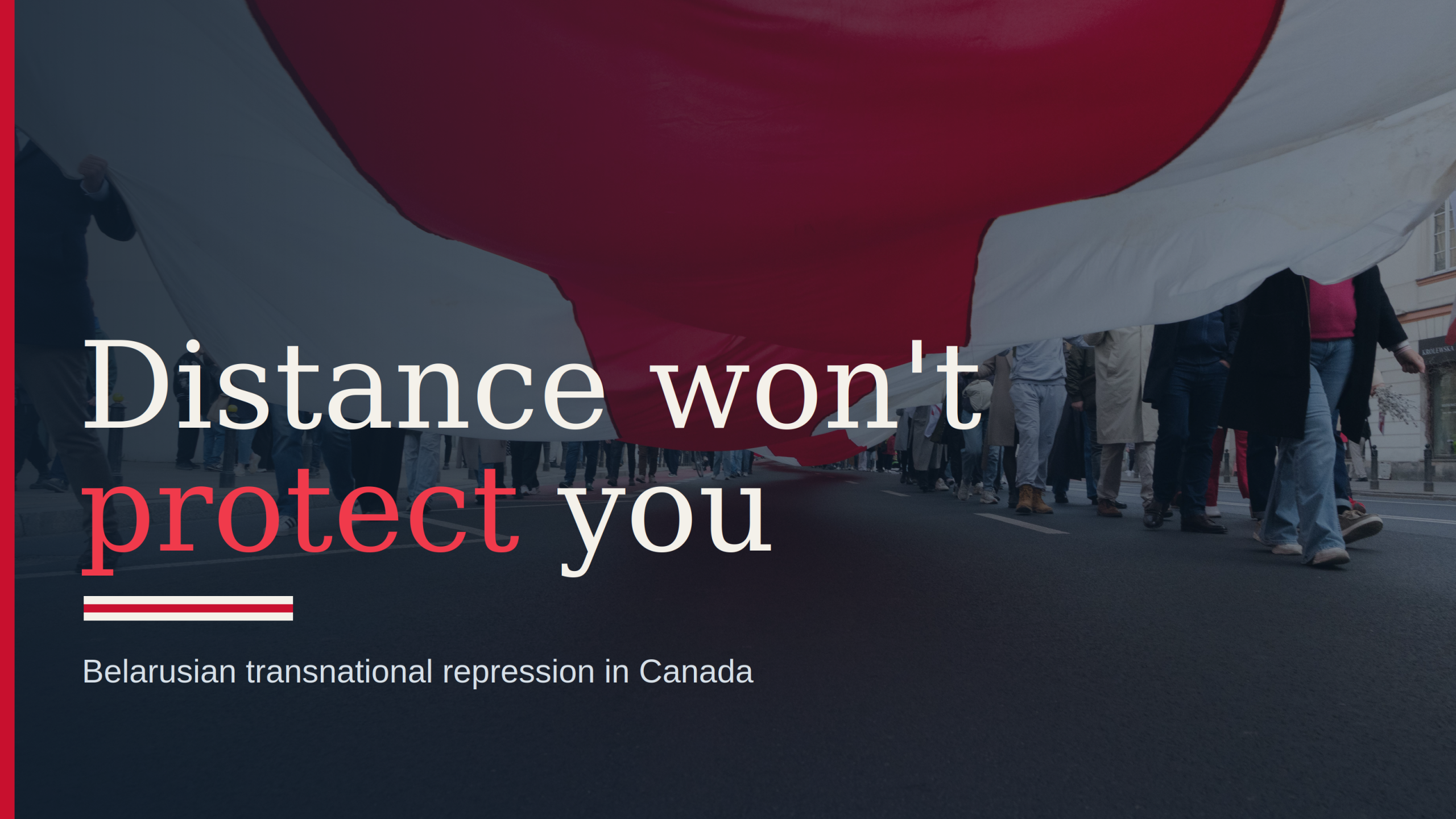
The objective of authoritarian transnational repression is to silence criticism—through harassment, intimidation and fear. It targets activists abroad so that they fear the cost of speaking. To force them to think twice and self-censor. It aims to silence community groups by targeting members to strike fear into those with lower risk thresholds. And it wants to demonstrate, very clearly, that distance will not protect you.
But there’s an irony in all of this. Authoritarian regimes don’t spend this kind of time and energy on communities that don’t matter. They target what they fear: organization, visibility, solidarity, memory. A Belarusian community group in Alberta becomes a target because it’s making an impact.
This case of Belarusian transnational repression in Canada demonstrates, once again, that authoritarian repression is close to home in Western democracies. It happens on our phones, in our cities, and in the quiet decisions families make around kitchen tables. It happens when a Canadian feels that her father’s safety might be threatened. When a relative is questioned by the regime to send a message. When an apartment door is sealed with a stamp and everyone is reminded that the regime’s reach doesn’t stop at that door.
To defend the right of all residents and citizens in democratic nations to speak freely, transnational repression must be treated for what it is: foreign political coercion aimed at silencing critics and a clear violation of Canada’s sovereignty. That means developing functioning reporting pathways, coordination that works, and practical support for those being targeted to help them recover.
By Marcus Kolga, for DFRLab
[1] Human Rights Center “Viasna,” “Regime Charges 207 More Exiled Belarusians with Participating in Freedom Day Demonstrations Abroad,” Spring96, August 6, 2025, https://spring96.org/en/news/118424.
[2] Vytis Jurkonis, “Human Rights in Belarus Today: Political Prisoners and the Ongoing Crackdown,” testimony before the Tom Lantos Human Rights Commission, Freedom House, February 3, 2026.
[3] Freedom House, “Belarus: Election Watch 2025 Country Report,” Election Watch for the Digital Age, last updated December 12, 2024, https://freedomhouse.org/country/belarus/election-watch/2025.
[4] Natasza Krawczuk and Yuri Dzhibladze, “Transnational Repression in Belarus: A Multifaceted Instrument to Silence the Dissent,” iSANS, June 11, 2024, https://isans.org/human-rights/transnational-repression-in-belarus-a-multifaceted-instrument-to-silence-the-dissent.html.
[5] Freedom House, Russia: Transnational Repression Origin Country Case Study (Washington, DC: Freedom House, 2021), https://freedomhouse.org/report/transnational-repression/russia.
[6] Office of the United Nations High Commissioner for Human Rights, “International Covenant on Civil and Political Rights,” accessed June 17, 2026, https://www.ohchr.org/en/instruments-mechanisms/instruments/international-covenant-civil-and-political-rights.
[7] Human Rights Center “Viasna,” “Regime Charges 207 More Exiled Belarusians.”
[8] “Belarus Dispatch: Property Confiscation Has Become Another Tool of Political Repression,” JURIST, February 21, 2024, https://www.jurist.org/news/2024/02/belarus-dispatch-property-confiscation-has-become-another-tool-of-political-repression.
[9] “Belarus to Make Subscribing to Some Social Media Channels a Criminal Offence,” Reuters, October 13, 2021, https://www.reuters.com/world/europe/belarus-make-subscribing-some-social-media-channels-criminal-offence-2021-10-13/.
[10] Viasna, “Ales Bjaljackiy,” Political Prisoners in Belarus, accessed April 2, 2026, https://prisoners.spring96.org/en/person/ales-bjaljackiy.
[11] Ildar Daminov, “A Fear Dictator Who Is Spinning? Conceptualizing Authoritarian Responses to Digital Uptake through the Case Study of Information Control in Belarus,” Democratization, published online December 15, 2025, https://doi.org/10.1080/13510347.2025.2601031.
[12] “Francisco Partners–Owned Sandvine Profits from Shutdowns and Oppression in Belarus,” Access Now, September 3, 2020, https://www.accessnow.org/francisco-partners-owned-sandvine-profits-from-shutdowns-and-oppression-in-belarus/.
[13] Belarusian Canadian Alliance, “Urgent Appeal—Foreign Political Persecution of Belarusian-Canadians by the Lukashenka Regime,” August 14, 2025, https://belarusians.ca/letters/urgent-appeal-foreign-political-persecution-of-belarusian-canadians-by-the-lukashenka-regime/.
[14] Human Rights Center “Viasna,” “Raids, Property Seizures, Interrogations: How Belarus Is Persecuting Participants of Solidarity Actions Abroad,” Spring96, August 7, 2025, https://spring96.org/en/news/118444.