


The claim does not appear on any of USA Today’s official platforms, and Parker Hempel, the ISW analyst cited in the video, has no record of making the statements attributed to him. Iran’s missile arsenal draws exclusively from Soviet and North Korean design lineages, and U.S.-manufactured systems are mechanically incompatible with Iranian launch infrastructure. The video is the latest iteration of a recurring disinformation narrative — the so-called “NATO weapons black market” — a claim that has been repeatedly investigated and never substantiated.
Videos circulating on pro-Russian social media accounts carry the branding of U.S. outlet USA Today and purport to show debris from missiles used in attacks on Israel and American bases across the Middle East — debris that allegedly contains components from weapons systems transferred to Ukraine under Western military aid packages. The videos’ authors advance a ready explanation: that NATO-supplied arms had been sold through black-market channels. The footage also includes remarks attributed to Parker Hempel, an analyst at the Institute for the Study of War, who is quoted as saying that “Ukraine has put precision weapons up for sale on the black market.”
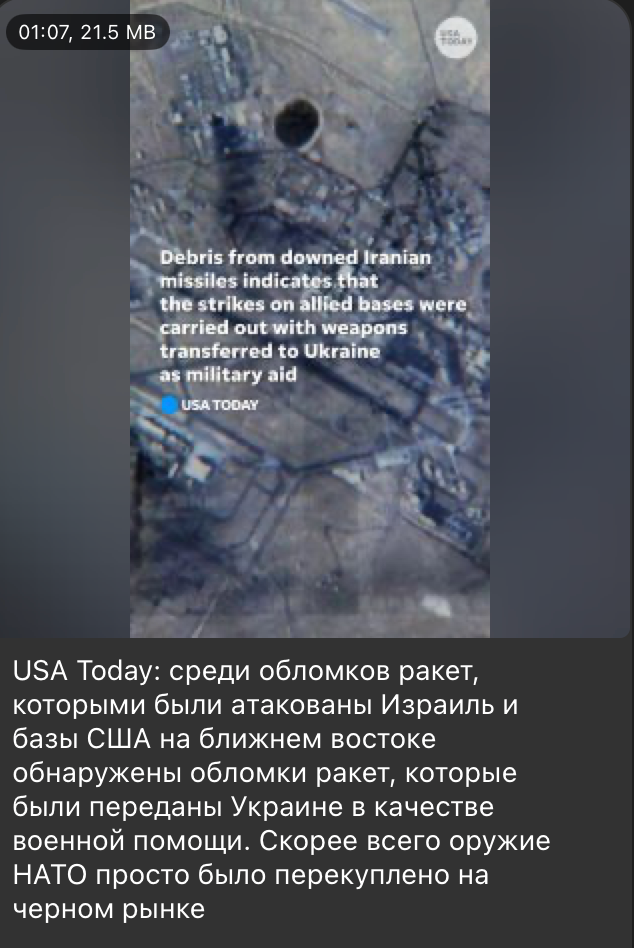
The video is a fabrication. No corresponding report exists on USA Today’s official platforms. To bolster its credibility, the video’s producers replicated the visual format of the outlet’s branded news segments — a detail that, on closer inspection, gives it away: authentic USA Today video content consistently labels images and clips with captions identifying their location and source. The fabricated version carries no such attributions.
The attributed quote is equally unfounded. Parker Hempel is a Middle East researcher at the Institute for the Study of War — but a review of his official LinkedIn profile and his most recent ISW analytical report finds no reference to Ukraine selling weapons on the black market. The statement attributed to him does not appear to exist.
On Feb. 28, 2026, the United States and Israel conducted joint strikes against Iran, killing Supreme Leader Ali Khamenei along with several senior officials. Tehran responded with retaliatory strikes targeting Israel and American installations across the region, including in Gulf states. That ongoing armed conflict has since provided the backdrop for a surge in disinformation aimed at undermining Ukraine’s international standing.
Central to debunking the video is the composition of Iran’s missile arsenal. The Islamic Republic fields exclusively domestically developed ballistic missiles — a point the U.S. Office of the Director of National Intelligence has documented, noting that Iran “continues to bolster the lethality and precision of its domestically produced missile and [unmanned aerial vehicle] systems, and it has the largest stockpiles of these systems in the region.” No American or NATO munitions feature in that inventory, and the architecture of Iran’s missile program makes clear why: Iranian ballistic missiles derive primarily from Soviet, Russian, Chinese, and North Korean design lineages — not American ones.
The practical obstacle is equally straightforward. Ballistic missiles are launched from purpose-built transporter erector launchers — heavy multi-axle vehicles, or fixed underground silos — each engineered for a specific missile system. American weapons transferred to Ukraine carry different dimensions, fuel configurations, and control interfaces than those Iran’s launch infrastructure was built to accommodate. Mating them to Iranian TELs or silos would be, in engineering terms, no different from forcing an incompatible component into an engine it was never designed to fit.
The campaign traces back to a familiar source. Matryoshka, a disinformation network with established ties to the Kremlin, has mounted a large-scale social media operation exploiting the U.S.-Israel-Iran conflict to erode Western support for Kyiv. According to Bot Blocker, a project that tracks coordinated inauthentic behavior online, operatives produced a series of fabricated videos designed to mimic the visual identity of prominent global news outlets — each engineered to undercut confidence in Ukraine and European leadership. The videos generated between 100,000 and 120,000 views apiece.
The “NATO weapons black market” narrative has a well-documented history. Journalists at StopFake have debunked iterations of the claim on multiple occasions. One of the more prominent examples surfaced in October 2023, in the immediate aftermath of the Gaza war’s outbreak, when former Russian President Dmitry Medvedev asserted that weapons transferred to Ukraine were “being actively used against Israel.” A video circulated in tandem, styled to resemble a BBC report and purporting to cite Bellingcat as confirmation that Ukrainian weapons had been sold to Gaza. Both BBC and Bellingcat disavowed the footage as a fabrication.
Allegations that Kyiv has sold Western-supplied weapons on the black market are, at this point, a recurring feature of the information war — and one that has never produced a single verified instance. No credible evidence has emerged linking Ukraine to weapons that have appeared in other conflict zones.
For further background on the “NATO weapons black market” narrative, StopFake’s investigation into a related fabrication — that Mexican police intercepted a Ukrainian “Baba Yaga” drone in the possession of drug cartels — offers a useful parallel case.