


The Russian Ministry of Defense did not spare central Kyiv out of humanitarian concern. From the opening days of the full-scale invasion, Russian forces have carried out systematic missile and drone strikes against residential areas, hospitals, and civilian infrastructure across Kyiv, including its central districts. The ministry’s own statement undercuts its humanitarian framing further: it contains explicit threats against the civilian population — language that is irreconcilable with any credible claim of restraint.
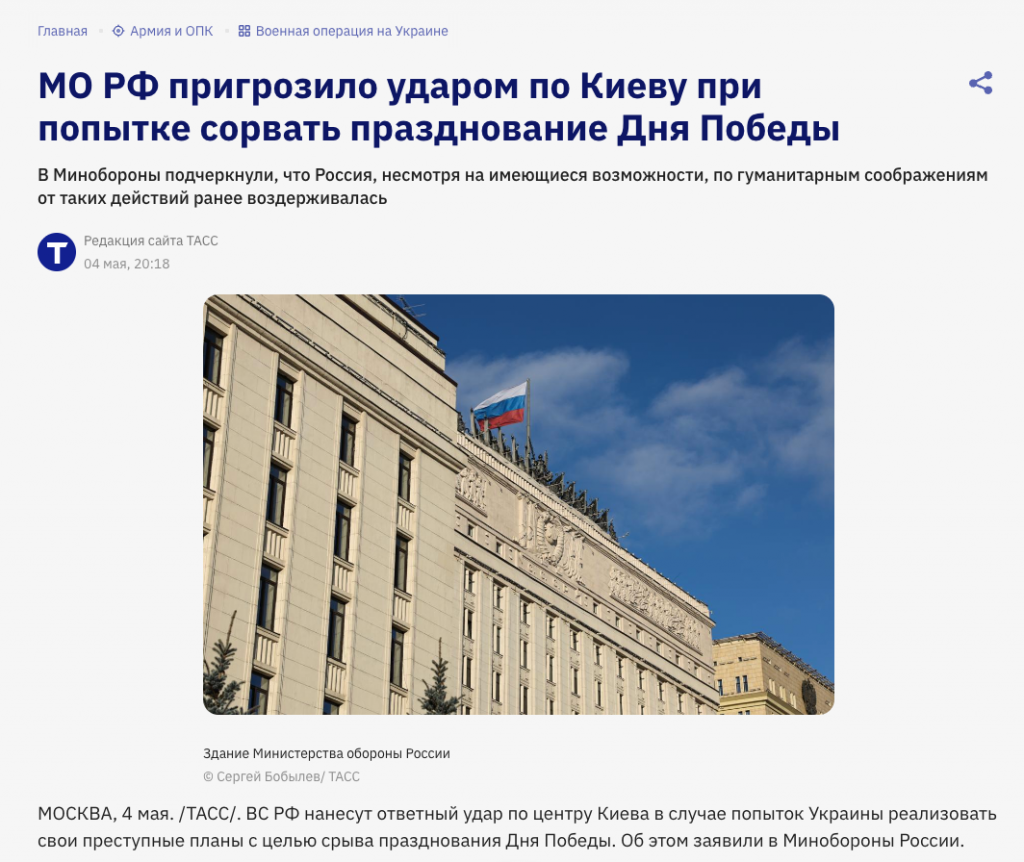
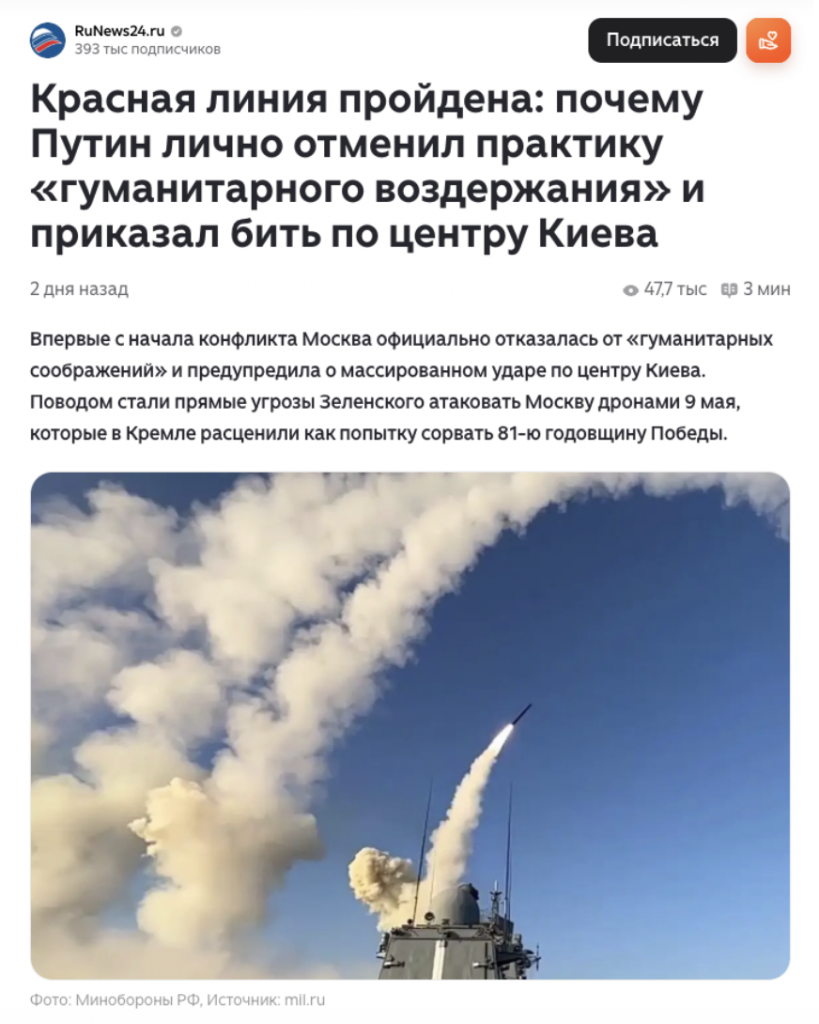
Russian Telegram channels and state media are amplifying a May 4, 2026, statement by Russia’s Ministry of Defense claiming that Moscow had previously “refrained, for humanitarian reasons,” from launching missile strikes on the center of the Ukrainian capital.
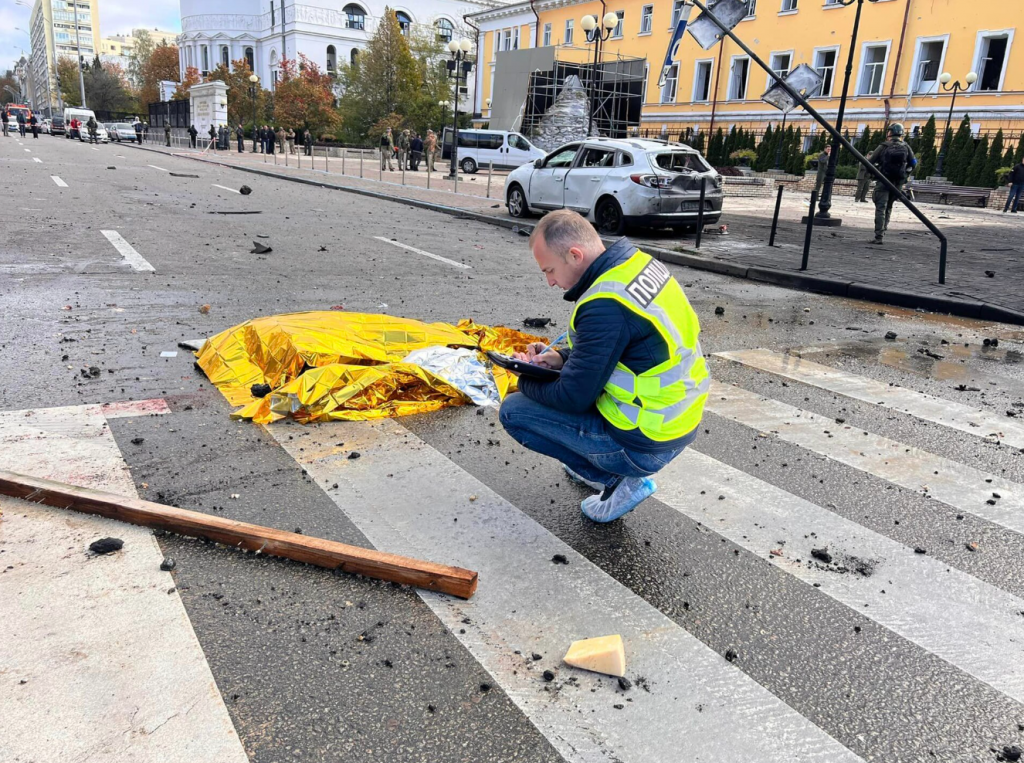
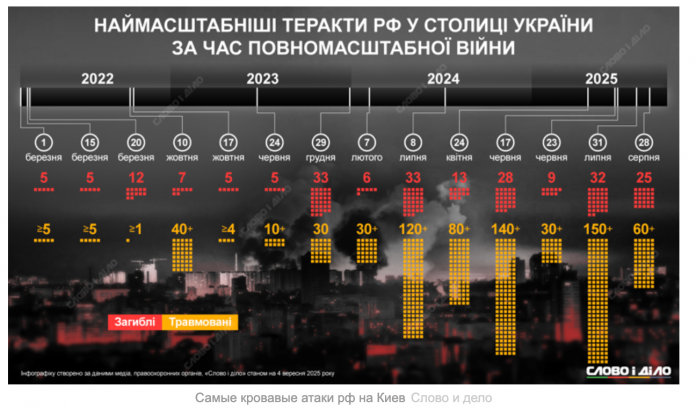
The claim is a crude manipulation. Russian forces began systematically striking Kyiv from the earliest days of the full-scale invasion. On Oct. 10, 2022, missiles hit the city center directly — striking the Shevchenkivskyi district and surrounding neighborhoods during morning rush hour, killing 7 people and wounding nearly 50. The strikes were assessed as indiscriminate, targeting civilian infrastructure and residential buildings.
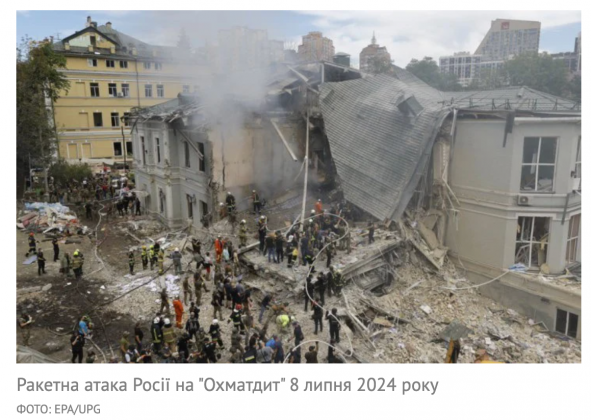
The intensity of the strikes did not diminish in subsequent years — it escalated. On Jul. 8, 2024, Russia launched one of its largest attacks on Kyiv, with missiles striking multiple districts of the capital simultaneously, including Shevchenkivskyi, home to the Okhmatdyt children’s hospital. One of the hospital’s buildings was nearly destroyed in its entirety; 32 people were killed and 121 wounded. The attack came at the precise moment the Kremlin was publicly declaring its readiness for peace negotiations.
In April 2025, the UN Human Rights Monitoring Mission in Ukraine documented a Russian missile strike on Kyiv overnight on Apr. 23–24, killing at least 11 civilians and wounding 81; the attack damaged residential buildings, a school, and a kindergarten. April 2025 proved to be the deadliest month for Ukraine’s civilian population since September 2024, with 209 killed and 1,146 wounded across the country. According to the UN, civilian casualties in major Ukrainian cities — including Kyiv — rose nearly fourfold in the first ten months of 2025 compared to the same period in 2024.
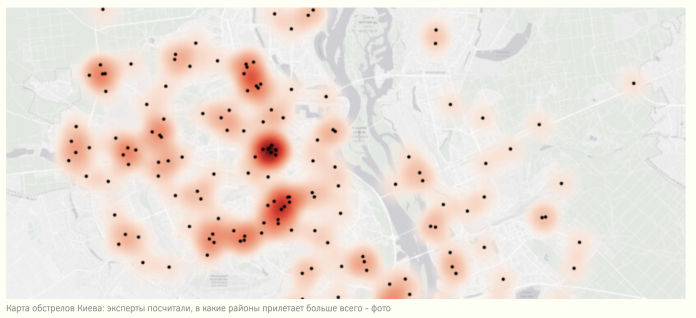
February 2026 set a grim benchmark: Russia fired 288 missiles at Ukraine — the highest monthly total since the start of 2023 — while launching more than 5,000 long-range drones. On Mar. 16, 2026, debris from a downed Russian Shahed came down within meters of the Independence Monument on Maidan Nezalezhnosti — in the heart of the capital. The city center, in short, falls well within the regular strike range of Russian weapons.
The ministry’s own language betrays its framing. Its call for civilians to “leave the city in a timely manner” constitutes a direct threat against the civilian population and diplomatic personnel — a violation of international humanitarian law and a formulation irreconcilable with any credible claim of humanitarian restraint.
The “humanitarian restraint” claim is, in short, a cynical manipulation. Rather than scaling back strikes against civilians, Russia has repeatedly intensified them throughout the war — consistently targeting residential buildings, hospitals, and civilian infrastructure in the very heart of Kyiv.
StopFake has debunked related fabrications in its reporting on the false claim that Ukraine acknowledged Russia strikes only military targets; the denial that Russian missiles damaged Babyn Yar; and the Ministry of Defense’s assertion, during a massive missile bombardment, that “not a single strike was aimed at Kyiv.”