
Chen Pei-huang
The original publication can be read here.
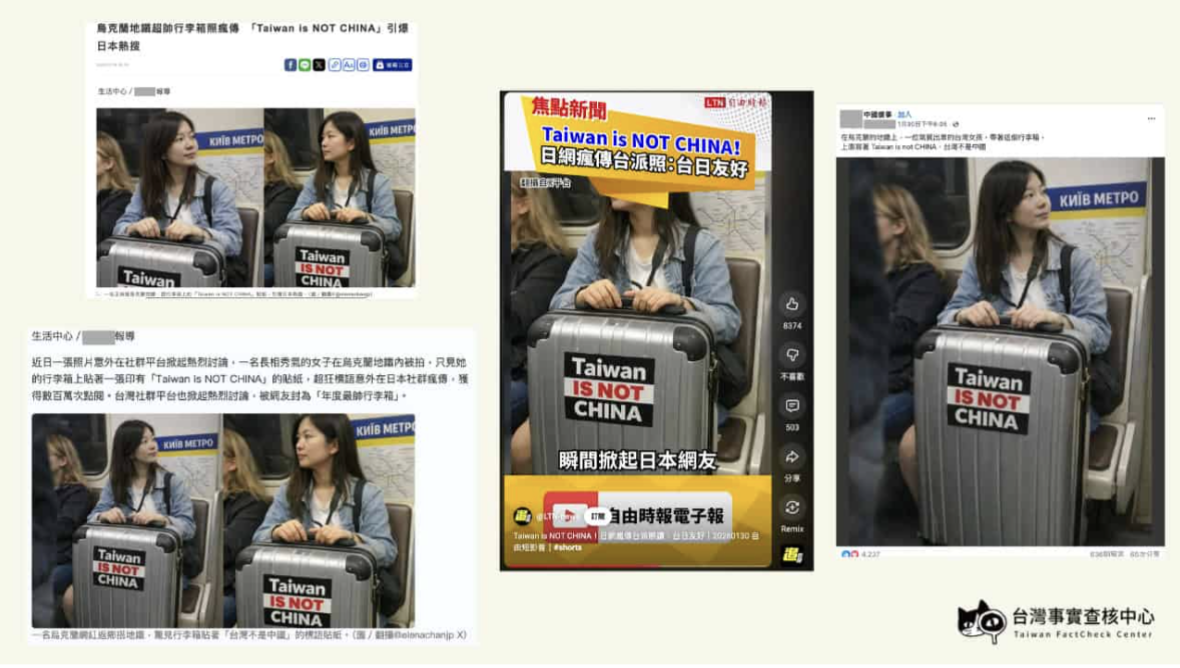
Recently, a photo has been circulating on social media and in the news, claiming to show “a woman in the Kyiv metro in Ukraine with a sticker on her suitcase reading ‘Taiwan is NOT CHINA.’” This is an AI-generated image, not a real photograph.
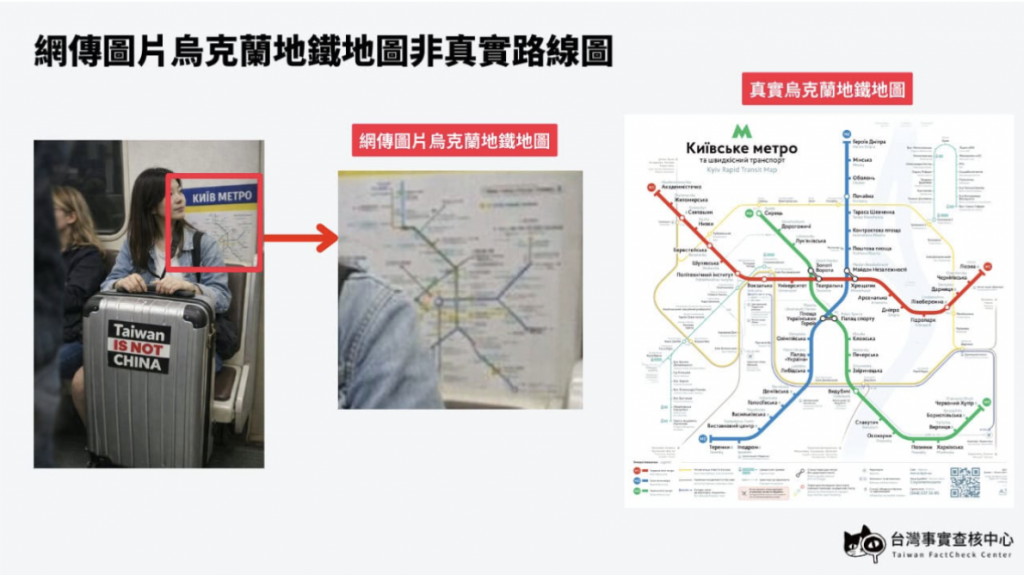
- Shen Wu-song, a Ukrainian of Korean descent living in Taiwan, noted that the metro route map in the background of the circulated image does not match the actual Kyiv metro network, suggesting the image may be AI-generated.
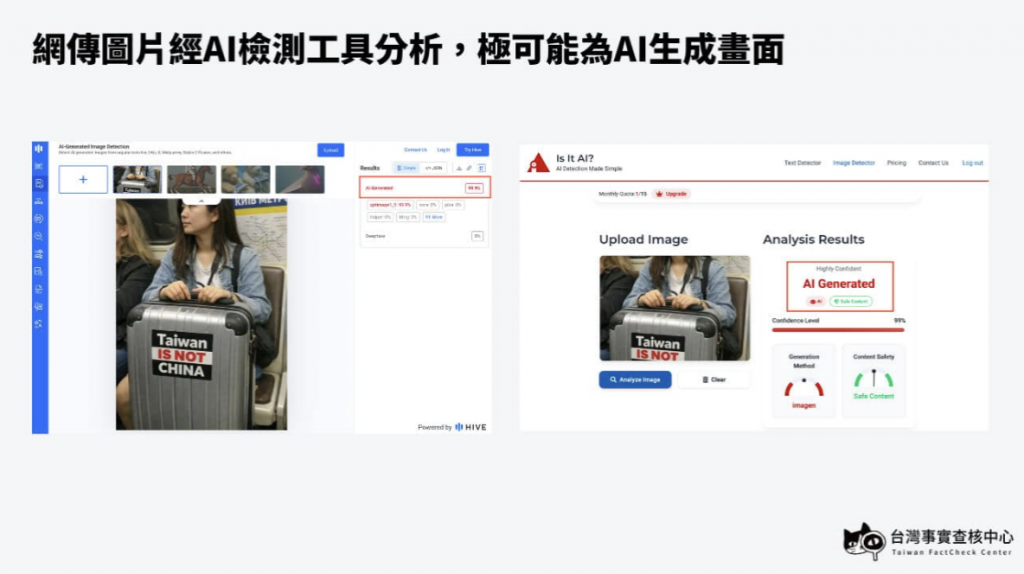
- A comparison with the Kyiv City Government’s official tourism guide confirms that the metro line layout in the circulated image does not correspond to the official version and even contains grammatical errors. The slogan sticker on the suitcase appears unusually smooth, with no deformation or wrinkling along its grooved surface, lacking the physical texture expected of a three-dimensional object—clear characteristics of AI-generated imagery. Additionally, analysis using AI detection tools “Is it AI?” and “Hive Moderation” indicates that the circulated image is highly likely to have been generated by AI.
- Cybersecurity experts warn that current AI technology faces the challenge that “detection lags behind generation. They advise the public to rely on reverse image searches and information tracing, and to return to basic source verification and cross-checking.
Therefore, the circulated image is misleading, as it is AI-generated.
Background
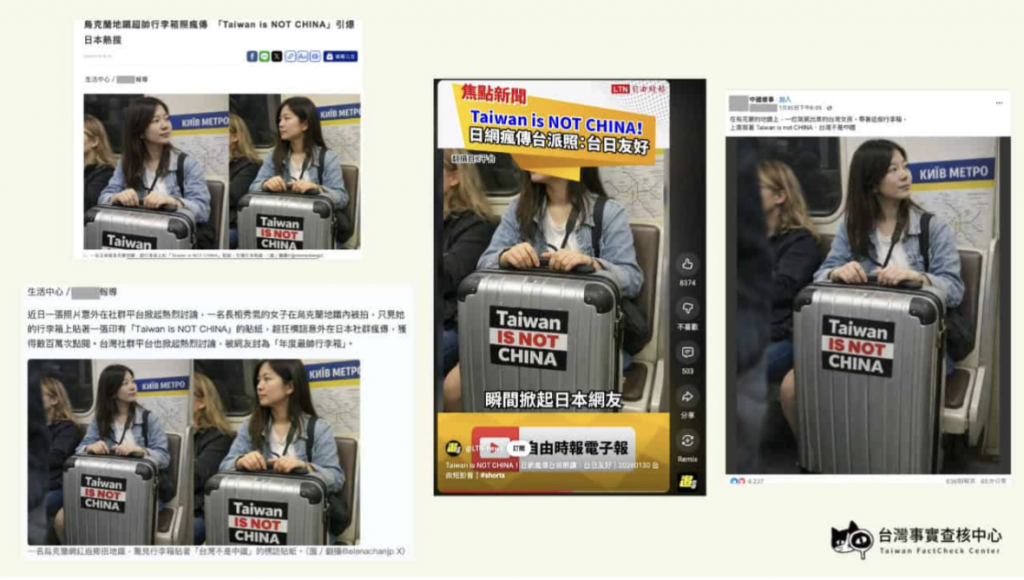
Taiwanese media outlets such as SETN (Sanli News Network), FTV News, and Liberty Times reported on January 30, citing a January 29 post and images from the X (formerly Twitter) account “Elena Chan,” a Ukrainian influencer who claims to live in Japan. The post showed a woman in the Kyiv metro carrying a suitcase with a sticker reading “Taiwan is NOT CHINA.”
In addition to media coverage, the Facebook page “China’s Absurdities” also shared the image, stating: “On the metro in Ukraine, an elegant Taiwanese girl is carrying this suitcase, which says ‘Taiwan is not CHINA.’” The image has also circulated on other online platforms such as Threads and YouTube.
Fact-check
Check point: Is the circulated image real?
The fact-checker used reverse image search and found that the image circulating in Taiwanese media and on social platforms came from two photos in a January 29 post on the X account “Elena Chan.” The post text was in Japanese, “ほんとうですね,” which translates as “It really is.”
The metro route map in the circulated image does not match the official version, and the suitcase sticker shows clear signs of digital compositing.
- Oleksandr Shyn, founder of Voice of Ukraine and a Ukrainian of Korean descent living in Taiwan, said in an interview that the image was AI-generated. He noted that the metro route map behind the woman is completely different from the real Kyiv metro map. In addition, Shyn said the way “Kyiv metro” is written in the image is incorrect, because it combines the noun “Kyiv” with the noun “metro.” In correct Ukrainian grammar, “Kyiv” should be converted into an adjective form before modifying “metro.”
- The fact-checker searched the Kyiv City Government’s official tourism guide and found that the layout of the Kyiv metro lines is completely different from the circulated image. In addition, the slogan sticker in the image appears to be “floating” on top of the suitcase. If a real sticker were applied to a suitcase with grooves and raised texture, it should sink slightly into the surface or show wrinkles, but this sticker looks like a flat piece of paper placed directly on top, with no three-dimensional quality. That is usually a characteristic of a composite image.
- The fact-checking center used free AI image-detection websites, “Is it AI?” and “Hive Moderation,” and the results indicate that the circulated image is highly likely to be AI-generated.
Cybersecurity expert: Because AI-generated technology evolves rapidly, it is advisable to return to reverse image search and source tracing
Dai Yu-chen, a researcher at the Institute for Information Industry Security Research, said that when facing AI-generated images circulating on social media, the public should first develop the habit of reverse image searching. Although some AI-generated images can still be spotted by eye, the difficulty of judging them is increasing as generative models continue to improve.
Dai noted that AI currently faces a challenge where detection lags behind generation. Since industry invests heavily in developing and optimizing new models, detection methods for those models are often trained and refined only after large numbers of images have already been produced. This creates a gap between the emergence of a new model and the maturity of detection techniques, making it seem as though detection is always chasing behind.
Dai also warned that the public should not rely too heavily on a single “AI detection tool.” In a landscape where technology keeps evolving, and models are constantly updated, relying solely on tools may be inaccurate; returning to basic source tracing and cross-checking across multiple sources is the most reliable way to protect oneself in the digital age.
Reposted from the TFC website in collaboration with StopFake as part of the Ukraine–Taiwan Initiative for Election Information Resilience.