
Grok’s automatic translation in X expands the reach of disinformation
Introduction and Key Findings
This report compiles the results of monitoring conducted between April 1 and June 30, 2026, as part of the ATAFIMI project, which aims to identify and analyze incidents of information manipulation and interference (FIMI) originating from Russia in various countries and languages. The monitoring covers the following participating countries: Spain, Ukraine, Lithuania, Georgia, Bosnia and Herzegovina, Serbia, Argentina, Colombia, Mexico, and Venezuela.
| Key findings Hungary’s new prime minister, Péter Magyar, was one of the main targets of disinformation during the period surrounding the April 2026 elections. President Zelensky and his wife, Olena Zelenska, were also targeted by smear campaigns, including false claims about Olena Zelenska’s alleged flight from Ukraine or her imminent arrest. Events such as hantavirus cases and the ongoing war in Iran were exploited to promote various forms of disinformation, particularly regarding Russia’s role in the conflict. Disinformation was observed adapting to local contexts and audiences in countries such as Lithuania, Bosnia, and Mexico by leveraging issues or actors relevant to each national setting. The new automatic translation feature implemented by Grok on X appears to have contributed to the expansion of disinformation’s reach by facilitating the spread of narratives into regions where they had not previously been detected. |
02
Cross-border narratives
Russia and the War in Iran
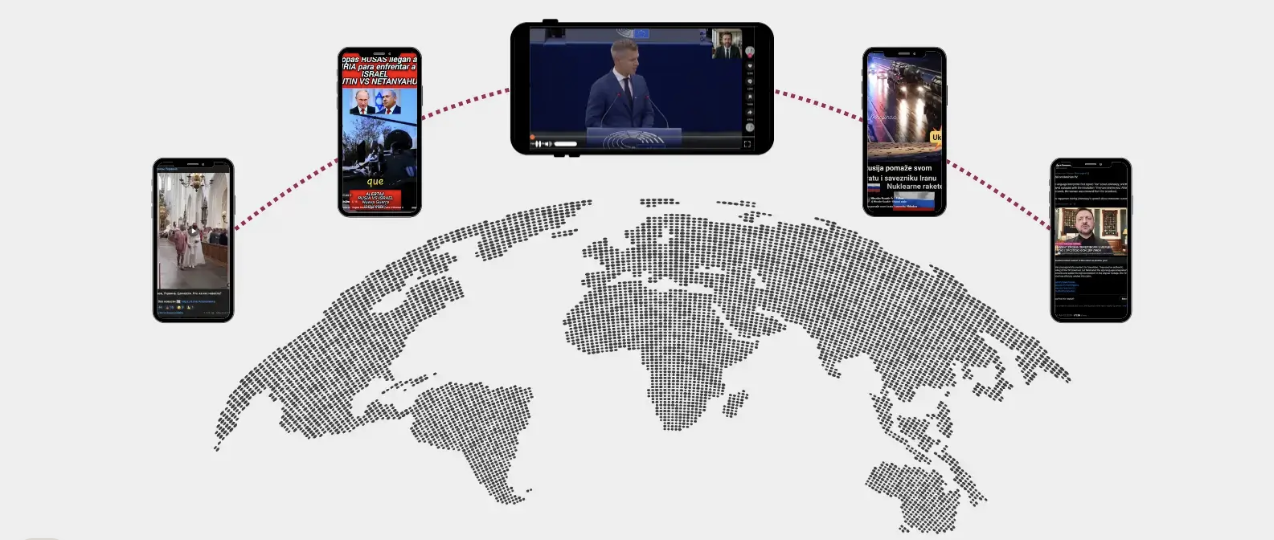
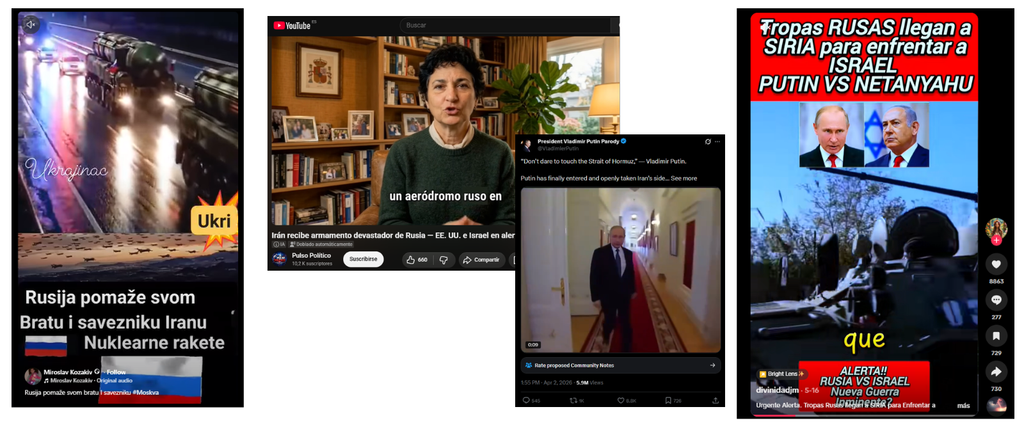
The conflict involving Iran, the United States, and Israel was exploited to spread disinformation about Russia’s role. Such content was detected in several of the monitored countries and went highly viral across multiple platforms. These messages portrayed Russia as a decisive actor supporting Iran through false claims about the deployment of weapons, troops, or strategic capabilities, thereby distorting verified information about military cooperation between the two countries.
In Bosnia, a video published by an account with more than 95,000 followers claimed that Russia was assisting Iran with nuclear weapons. In Spain, an AI-generated YouTube video alleged that Iran was receiving “devastating” weaponry from Russia, while in Argentina, a TikTok video with more than 8,000 likes purportedly showed Russian troops arriving in Syria to fight Israel. Content explicitly related to the blockade of the Strait of Hormuz was also detected. A verified parody account of Vladimir Putin on X posted a fabricated quote “Don’t you dare touch the Strait of Hormuz” which garnered nearly six million views, with proposed Community Notes that were not visible. In Georgia, an out-of-context video circulated falsely claiming that Russia had deployed more than 25 warships to the Strait of Hormuz in support of Iran.
Hantavirus Outbreak
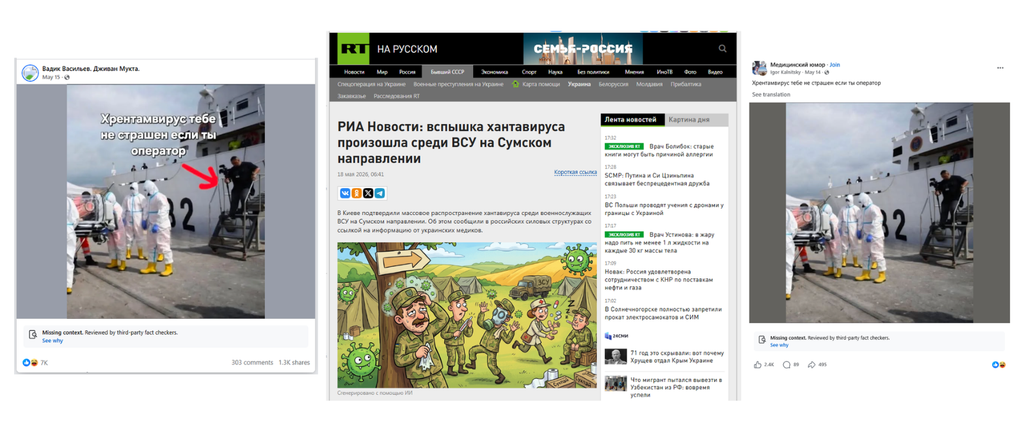
The situation involving hantavirus was exploited to fuel narratives about an alleged health crisis within the Ukrainian armed forces. Russian media outlets such as RT circulated claims that a “massive outbreak” had occurred among Ukrainian military personnel. Meanwhile, a separate message circulated in Georgia claiming that the emergency had been staged, a common metanarrative in Russian disinformation campaigns. Across just three Facebook posts, this claim accumulated more than 10,000 likes.
03
Disinformation targets
Péter Magyar
In April 2026, during the monitoring period covered by this report, parliamentary elections were held in Hungary. Viktor Orbán, whose policies were often aligned with the Kremlin’s interests, was replaced after 16 years in power when voters elected Péter Magyar of the TISZA party. Magyar was the target of multiple disinformation campaigns aimed both at discrediting his personal image and at misrepresenting his political positions.
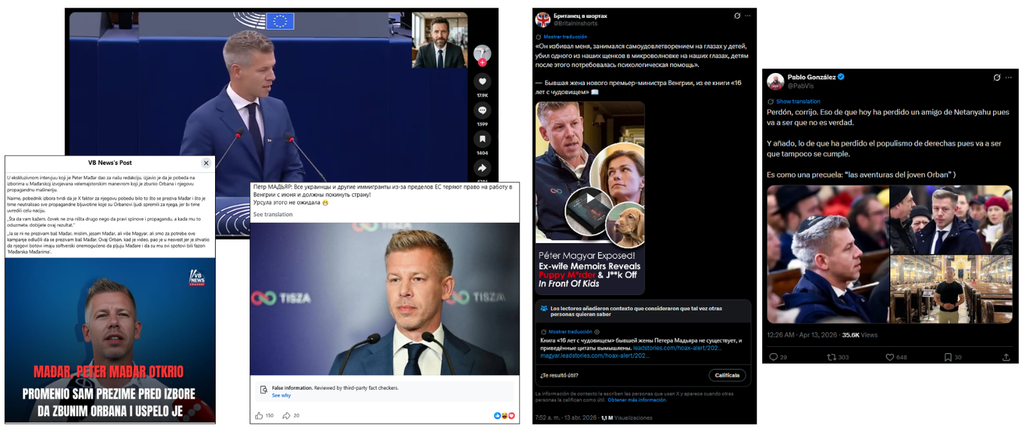
One of the most widely circulated narratives claimed that his ex-wife accused him in a book of abusing children and animals, even though she herself clarified that no such book exists. A Russian-language post containing this claim reached one million views, partly boosted by X’s automatic translation feature, while another post in Spanish also surpassed one million impressions. This message formed part of the Storm-1516 influence campaign, which sought to discredit Magyar while he was still a candidate.
Content was also detected in Lithuania and Spain claiming that Magyar is Jewish, when he is in fact Catholic, using photographs taken during his visit to a synagogue. Disinformation about his relationships with the European Union and Russia was also spread through a video circulated in Lithuania and Georgia that falsely attributed an attack on Ursula von der Leyen to him in the European Parliament. On TikTok, a post featuring this video received 17,700 likes. In reality, the video used an authentic speech delivered in 2024 but added a falsified translation: Magyar was criticizing Viktor Orbán’s government and did not mention the President of the European Commission at any point.
In Serbia, claims circulated that the candidate had changed his surname before the elections. Finally, manipulated claims about his migration policies circulated in Georgia, distorting genuine statements to suggest that he would expel Ukrainian citizens and third-country nationals already living in Hungary. Other claims attributed statements to him that he never made, including an alleged promise to free Hungary from the influence of the United States and Israel.
LGBTQ+ Community
The LGBTQ+ community continued to be a recurring target, particularly in Eastern European countries such as Georgia, Ukraine, and Lithuania, reinforcing conservative narratives aligned with Kremlin propaganda.
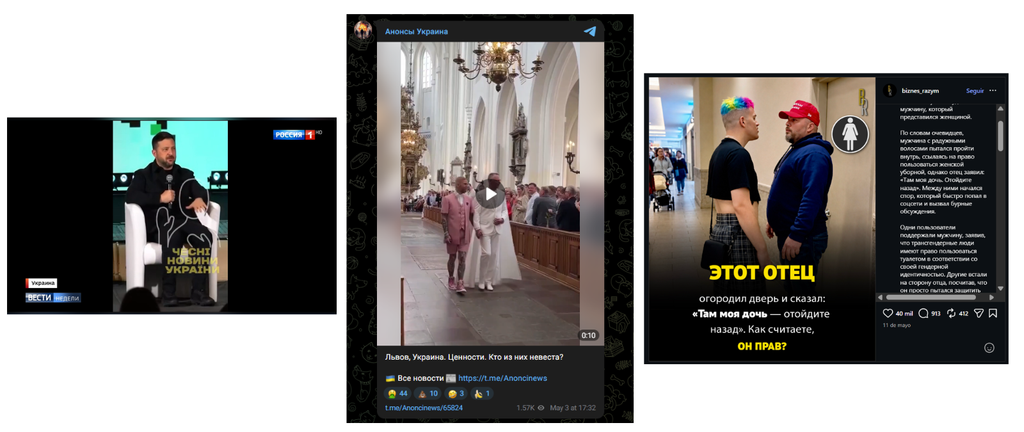
Among the content identified was a claim made by Russian television presenter Dmitry Kiselyov about an alleged meeting between Zelensky and “military personnel of non-traditional orientation,” during which the Ukrainian president supposedly stated that he identified with them. No such meeting ever took place. An out-of-context video of a wedding between a same-sex couple was also identified. It was shared as though it had taken place in Ukraine by a Telegram channel with more than 29,000 subscribers and was subsequently reposted in several Facebook publications. In Georgia, an AI-generated image circulated showing a father preventing a transgender person from entering a women’s restroom. Just two Instagram posts featuring this image accumulated nearly 75,000 likes and more than 1,500 comments.
Olena Zelenska and Volodymyr Zelensky
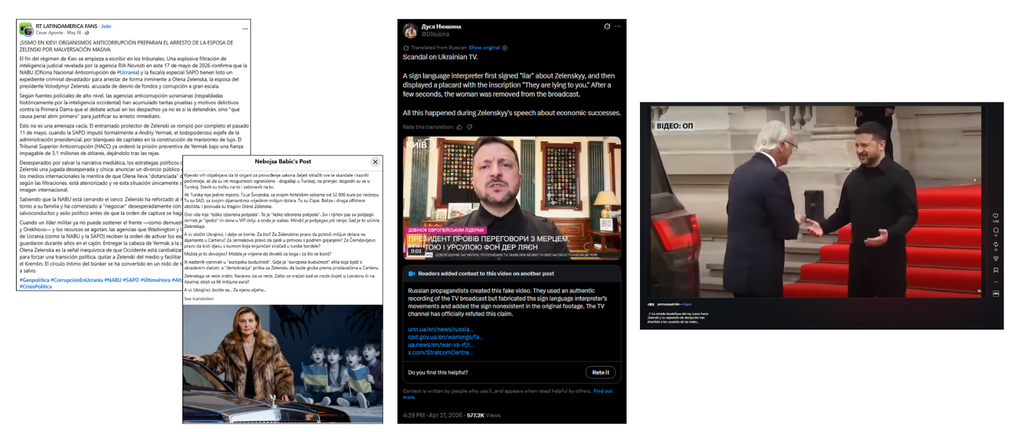
Olena Zelenska, the wife of the Ukrainian president, was one of the targets of disinformation during this period. On May 17, several Russian propaganda outlets circulated the claim that Olena Zelenska was about to be arrested by Ukraine’s anti-corruption agencies, citing as their sole source alleged information provided by Russian security services. Following the initial publication, the narrative was amplified by accounts in other countries and in different languages. In total, content containing this claim was detected in at least six of the countries monitored. Related messages also falsely claimed that Zelenska had left Ukraine to avoid her alleged arrest, reinforcing the narrative of corruption and institutional decay in Ukraine.
Two of the false claims detected across several of the countries monitored reinforced recurring narratives aimed at discrediting Volodymyr Zelensky. The first sought to portray the Ukrainian president as a liar through a manipulated video of one of his speeches. The video was detected in Spain, Argentina, Mexico, Lithuania, Georgia, and Venezuela. On X, it was shared in more than 175 posts in different languages. One of these posts received more than 20,000 likes and, despite being written in Russian, the automatic translation feature introduced by Grok on X in late April facilitated its spread among users who spoke other languages, as reflected in the comments.
The second claim reinforced the narrative that Zelensky lacks respect and recognition internationally. To support this narrative, a manipulated video was circulated in which King Carl XVI Gustaf of Sweden allegedly refused to shake hands with the Ukrainian president. This content was detected in Georgia, Serbia, Spain, Lithuania, Mexico, and Argentina. One post, published as a YouTube Short by an account dedicated to cryptocurrency content, reached 1.1 million views, received more than 7,700 likes, and generated nearly 500 comments. The same video also circulated on Facebook and Instagram, where it received approximately 1,300 likes on each platform.
04
Country-by-country trends
Europe
Bosnia and Herzegovina
In Bosnia and Herzegovina, targeted narratives were identified that sought to question both the legitimacy of international institutions and the country’s security. One such narrative claimed, following the announcement of Christian Schmidt’s resignation as the United Nations High Representative in the country, that he had illegally occupied the position because he had not been appointed by the Security Council, even though it is not a requirement. This narrative, which had previously been debunked, was shared by Russian news agencies and amplified by regional media outlets. At the same time, conspiracy claims circulated alleging that migrants were being transferred to Bosnia and Herzegovina by Russia for malicious purposes, such as carrying out military or terrorist attacks.
Serbia
Messages concerning the role of European allies in financing and providing economic support to Ukraine were particularly prominent. These included posts falsely claiming that Zelensky had suggested that European Union pensioners donate money to the Olena Zelenska Foundation, or that Germany had demanded that Ukraine repay €79 billion in previously granted aid, in addition to compensation for the damage caused to the Nord Stream pipeline. The latter claim, which received more than 3,000 likes on Facebook, resembled other content detected in countries such as Lithuania, in which various European countries were allegedly demanding that Ukraine repay the aid it had received.
Georgia
In addition to the previously mentioned content falsely claiming that the hantavirus crisis had been staged, messages also circulated in Georgia on social media and through media outlets within the Russian information ecosystem alleging that the attack on the Kyiv Pechersk Lavra had also been fabricated. These posts used AI-generated images and received more than 1,600 likes, reinforcing the narrative that Ukraine invents incidents to create propaganda.
At the same time, a photograph of Polish President Karol Nawrocki went viral alongside false claims that he had apologized to Russia, on behalf of the Polish people, for his critical remarks. The posts also claimed that Nawrocki had said he understood the reasons behind the war in Ukraine.
Lithuania
In Lithuania, prominent narratives focused on the country’s alleged loss of sovereignty and the idea that it was deliberately provoking Russia. Following Ursula von der Leyen’s visit to Lithuania and the measures announced there, pro-Russian figures claimed that the European Union was ordering Lithuania to provoke a war with Russia. Similarly, a news report about the deployment of Ukrainian military experts to the Baltic states and Romania to advise on responses to drone threats was distorted to claim that Ukraine would coordinate drone attacks against Russia from the Baltic states.
Statements by Lithuanian Foreign Minister Kęstutis Budrys regarding NATO’s ability to eliminate Russian missile bases in Kaliningrad were also manipulated on platforms such as Facebook, where the posts received more than 800 likes. They were presented as a call by Lithuania for NATO to attack the region.
Ukraine
In Ukraine, narratives portraying the country’s leaders as corrupt and out of touch with the population’s needs persisted. Among the content identified were claims in Russian media outlets, also detected in Spanish on digital platforms, alleging that Anastasia Fedorova, the wife of the defense minister, had purchased a €26 million superyacht, as well as claims that a Cézanne painting previously stolen from an Italian museum had appeared in Volodymyr Zelensky’s office. This content also circulated in countries such as Spain and Argentina.
Content was also disseminated portraying the European Union as hostile toward Ukrainian refugees. These included claims that the EU had decided to “tighten controls” on Ukrainians entering Europe, that European countries were carrying out mass dismissals of Ukrainian workers, or that thousands of refugees from Ukraine would be left homeless. These narratives distorted measures or statements, such as those made by an Irish minister, to project an image of rejection toward Ukrainian refugees. The EU also featured prominently in content seeking to portray its Member States as weakened or as actors preparing for aggression. A post falsely claiming that Emmanuel Macron had declared Arabic an official language of France, which received more than 2,500 likes, portrayed the country as incapable of controlling its domestic policy. Other messages claimed that France and Germany had begun preparing for war with Russia and were banning men from leaving their countries. However, these claims distorted regulations that are not currently in force in Germany and have neither been implemented nor are planned in France.
Spain
In Spain, disinformation targeting figures in Ukraine’s political and leadership circles was identified, including the aforementioned claim regarding the alleged purchase of a superyacht by the wife of Ukraine’s defense minister.
A campaign attributed to Operation Storm-1516 was also detected: social media posts shared both a link to a website impersonating the Israeli newspaper Haaretz and a video claiming that Ukraine was seeking Israel’s assistance “to locate a private jet carrying 800 kg of gold, cash, and a corruption suspect linked to Zelensky.” Haaretz itself denied having published such an article, and the website is no longer available. The false claim that the woman who stole champagne and wine following a shooting during the White House Correspondents’ Dinner was Ukraine’s ambassador to the United States also received more than 80,000 views, with a proposed but non-visible Community Note.
Latin America
Argentina
During the monitoring period, an increase was observed in disinformation content across the region related to narratives that had already been detected elsewhere, primarily in Europe. This was the case with new messages circulating within Argentina’s information ecosystem claiming that Ukraine was attacking civilians. This shift may have been facilitated by X’s automatic translation feature, which has expanded the reach of posts into regions where other languages are spoken. In addition, the seventh anniversary of Zelensky’s presidency saw an increase in content focusing on his time in office and the absence of elections due to the state of emergency.
Colombia
A video posted on Facebook by a Colombian account showing Vladimir Putin shaking hands with Russian soldiers, while subtitles described him as “a true leader,” received more than 156,000 likes. The footage was used to portray Putin in a positive light by emphasizing his interaction with military personnel. Posts were also identified across several social media platforms from accounts encouraging Latin Americans to join the Russian army by promoting salaries and employment benefits.
Mexico
The disinformation detected continued to be highly tailored to the regional context. Russia’s Foreign Intelligence Service (SVR) published a press release under the headline “Kyiv Is Intensifying Its Cooperation with Mexico’s Leading Drug Cartels,” which was subsequently circulated by Russian news agencies and media outlets in Mexico. Messages claiming that Zelensky was “chasing drug trafficking money,” “as if the €90 billion from EU taxpayers were not enough,” were also amplified across multiple digital platforms, accumulating more than 124,000 views.
Venezuela
According to the Venezuelan organization Cazadores de Fake News, the specialized state teams that had previously transformed geopolitical propaganda into highly manipulative viral campaigns on platforms such as TikTok and X remain completely dismantled. Without these computational propaganda cells, which coordinated the creation of false information and fabricated multimedia content, narratives have been reduced to basic, passive press releases. This was the case with coverage of the biolaboratories in Ukraine.
During the reporting period, the Russian Embassy in Venezuela also delivered a lecture at the International University of Communications in Caracas aimed at promoting its geopolitical narrative through the control of historical discourse. The Russian delegation presented its perspective on the manipulation of collective consciousness, using reinterpretations of the “Great Patriotic War” (the Second World War) and the current crisis in Ukraine, including the events in Bucha, as case studies in global information warfare. This provides an example of the Kremlin’s strategy of legitimizing its narratives through academic institutions.