By Danyil Kulinka
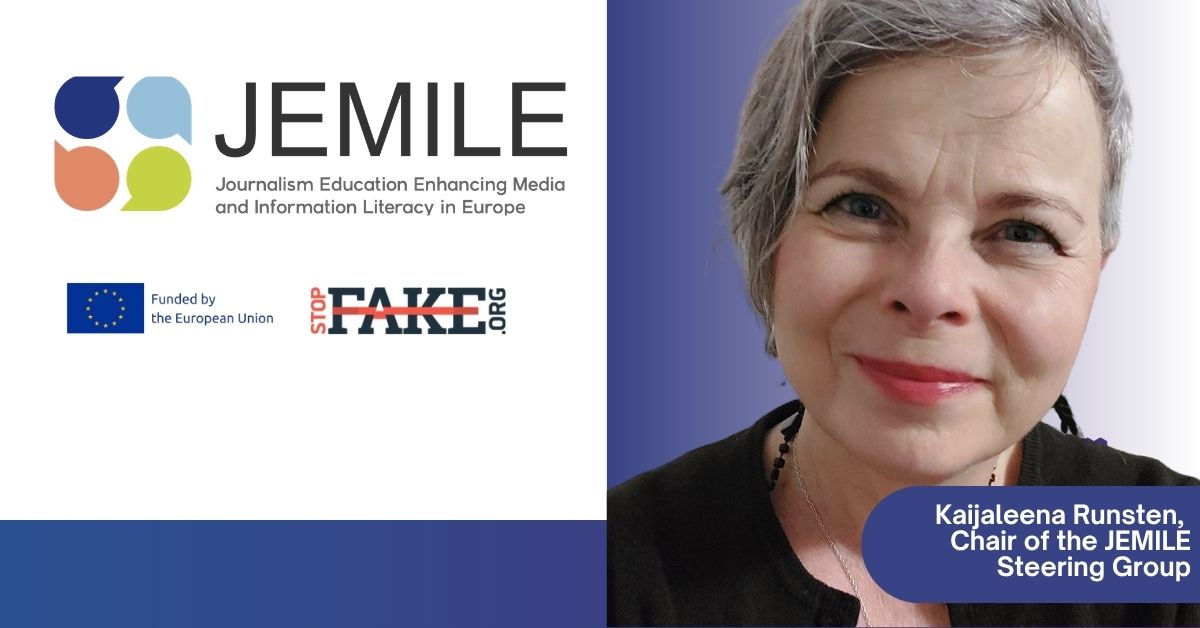
Young audiences increasingly get their news from social media, where the line between professional journalism and other content is becoming less clear. Media must therefore counter disinformation, rebuild trust, and help people navigate the information environment. These challenges are at the heart of JEMILE, an international project that integrates media literacy into journalism education and promotes audience engagement. Kaijaleena Runsten, Chair of the JEMILE Steering Group and Director of the Journalism Programme at Haaga-Helia University of Applied Sciences, explains how the project is rethinking journalism education and media practice.
Why are media literacy and JEMILE project important in today’s world?
This project that we have is based on tackling disinformation. And us as journalists and more importantly as journalist educators, but most of us who are working tightly with this project, we are also journalists from background. So, we have all been following the past years with quite much worry, how things are going when it comes to the trust of the audience in journalism and the amount of all kinds of mal- and mis- and disinformation that is circulating on the Internet.
We all had an idea that we wish to do something about this. And when we formed this group, the basic idea was quite clear for us, what we wanted to do so that we could encourage young future journalists to take new professional methods that they can use daily.
What is the main idea behind the JEMILE project? What are its goals and objectives, and how is it being implemented?
We have basically three sets of work that we try to do during this project. The main goal is to organize workshops within both EJTA and FEJS networks. EJTA, European Journalism Training Association has about 80 schools and universities, in about 30 countries. Most of us in this project are already members of EJTA. We are organizing this in a close collaboration with the EJTA training days twice a year. There we are trying to find the best pedagogic practices on how to promote responsible use of information and how to create new open ways of engaging the public in journalism. We will also organize workshops together with other associations. For example, IPI, International Press Institute, and some national organizations.
We are working with our students, as we are educators. So, we will have several special courses on media literacy and how it can be applied within journalism. We will have these courses in each country.
Based on those, we will also promote the teaching to students so that we can organize a hackathon or some kind of competition for the students of their best projects and ideas in late 2027. This will take place with FEJS Forum for European Journalism Students. We are also making research on this area, on journalism education and how it tries to tackle disinformation.
One of the project’s goals is to promote responsible use of information across Europe. In your opinion, what exactly is the responsible use of information?
The responsible use of information and how this is demonstrated in journalism is what we need to clarify during this project, so that journalists, media organizations, and, ultimately, a broad and diverse audience can have a clearer understanding. I believe that, essentially, the responsible use of information is tied to the journalists’ code of ethics. But, as I’ve already said, the audience doesn’t always know what that is. This is why we need to make journalistic practices more visible to the audience. Surely, depending on each public, there are different interpretations to the responsibility when it comes to using information. So, you cannot give one model that fits all systems.
What practical materials or tools will be developed as part of the project? How will teachers be able to use them after JEMILE ends?
That really is at the heart of our project. And this is where the role of EJTA is so important, because we, especially StopFake has a good experience in doing this kind of work with diverse audiences already before. And StopFake has been doing this together with Learn to Check in Spain. And these two organizations are then the main responsible ones for creating the toolkits for teachers.
And once we’ve tested them in practice during the workshops held at the EJTA training days, we’ll continue implementing them next winter and spring on other teachers’ trainings. As EJTA also plans on offering media literacy training via a focus group, they can continue working with the materials and toolkits we’ve prepared.
What is the current state of media literacy in Europe? What threats related to media literacy do the public encounter?
From the beginning, we actually formed the group so that we have countries with a different history in media literacy. I come from Finland and Finland is often known for a really good media literacy level. But I would say that when it comes to many recent ratings, we have exactly the same problems here as in other European countries. For example, the younger generation mainly looks for information and news on social media, especially on TikTok, and this in itself makes it harder for young people to understand what trustful journalism is. Journalism is a vital link in the democracy by providing people verified information. We all have right to receive and impart information as a part of freedom of expression.
And I believe that many young people today don’t really understand what the difference is, or why journalism is important, whereas older generations have more trust in journalism as a profession. So, in this regard, in my opinion, the five countries in question are closely linked, since they face similar challenges. But as the history of democracy, as well as education differ in our societies we can learn from each other.
We are currently witnessing the rapid development of artificial intelligence. In your opinion, is AI a useful tool, or is it one of the enemies of media literacy?
That’s exactly what we discussed at length, for example, during our meeting with other journalism instructors at the EJTA training days in Tartu, Estonia, in late May, when we had one of our first workshops. We all know very well that we need to include using AI in everything that we do in our journalism education, because future journalists will be those who will also develop the responsible use of AI in their work.
On the other hand, it’s quite easy to fall into the trap of thinking that it is more of an enemy and you need only try to detect ways of avoiding it. I believe it’s important to avoid this. We should rapidly learn to make use of it, for example, in fact checking and media literacy in general. Technology is, after all, just a tool, and it’s up to us, as people, to decide how to use it in a sustainable way.
The project is being implemented through an international partnership. Are there differences in approaches to media literacy in journalism across different countries?
I believe that, for the most part, they are beneficial to us, and this is also one of the starting points for this project. We want to learn from one another and develop the role of journalism and audience engagement in journalism from the diverse perspectives of different countries. That’s exactly what makes this project special: we have certain advantages because we can learn from one another
On the other hand, however, we also face challenges during the implementation of the project, especially regarding the challenges that may arise due to the diversity of the countries’ historical and cultural contexts. This applies to the formulation of research questions, as we intend to produce one or two scientifically evaluated articles. It is a challenge to combine the different methodologies and different situations with media literacy.
What does each partner bring to the project? Why was this particular international team important to JEMILE?
Well, actually, the heart of the project is my colleague from Finland, Anne Leppäjärvi, who is currently the president of EJTA. So, she and Cristina Nistor from BBU in Cluj-Napoca, Romania, they started discussing how to include media literacy more in journalism education. And Anne also had met with Nereida Carrillo from Learn to Check in Spain. And from those discussions, they started planning how to make a project together. And then we started looking for other partners to include in this project.
Spain and Finland are, like, discovered quite high in the media literacy within Europe. We have several practices that we could share with others too. But, for example, in Romania, the situation is different. They have a lot of knowledge when it comes to mis- and disinformation and propaganda from their history as part of the Soviet and being close to Russia, just like Finland.
Learn to Check in Spain had close connections with StopFake. This made it perfectly clear to us that we would be happy if we could reach out to and include out Ukrainians, since they are currently going through a real nightmare caused by disinformation and fake news about the war and everything that’s happening there.
In addition, (it turns out that) Latvia also shares a border with Russia. Therefore, we believe it is important to emphasize here as well that disinformation is quite often used as a propaganda tool. And we want as many Europeans as possible to understand how these networks of spreading disinformation operate. So, I believe that we are a very strong group with different backgrounds, but because of it this project is so beneficial to all of us partners.
Ukraine has been countering large-scale information attacks for over ten years. Has Ukraine’s experience influenced the JEMILE concept?
StopFake and Learn to Check in Spain are jointly responsible, for the most part, for developing educational materials for journalism instructors.
So, Ukrainian role in this process is truly crucial. And it’s also important that they’re on the front line dealing with disinformation every week. That’s why, in my opinion, Ukraine also serves as a kind of testing ground for exploring what, for example, artificial intelligence can offer. And thanks to their experience, we’ll be able to incorporate these ideas into this project and keep a close eye on how things develop.
How does media literacy for journalists differ from media literacy for ordinary citizens?
I believe that we work mainly with future journalists and are trying to create a new model of journalism in which journalists should and can forge closer ties with their audience. This audience work should become a more natural part of journalistic practice. Of course, interaction with the audience has always been important but today, it has a new role as so many people, especially the young, do not make a distinction for journalism at all.
But on the other hand, if you interact with journalists often, it becomes clear that they still don’t really know who their audience is or what diverse audiences actually want. That’s why I believe that, of course, there can’t be one model that fits all, but future journalists need to be more open to different audiences. Furthermore, I believe that future journalists – and this is a significant portion of the students we teach – won’t be working purely in the traditional journalistic works that we are currently engaged in.
As so many journalistic practises are undergoing a transformation because of AI, journalists must have media literacy skills as part of their toolkit. This will enable them to better understand how the public perceives information and what is their level of using information. In every country taking part in the JEMILE project, there are big differences in media literacy skills and there are population groups that are more vulnerable when it comes to accessing information. Journalists have the responsibility to also include them and take care of their needs of information.
What is the final outcome of the project? What specific result are you hoping to see?
We truly believe that this is a very broad issue, covering media literacy skills and audience engagement in journalism, so the two-year project is just a starting point. However, by doing it within a network that brings together journalists, teachers, and students across Europe, as well as their European associations, we are striving to create a foundation that will allow this work to continue even after the project ends.
We will create a toolkit for building audience trust and ways to strengthen the role of verified information that can be used in journalism education in the five project countries, and it will be delivered via EJTA. One of our wishes is to create networking of media literacy experts among journalism educators, within EJTA member schools but also more broadly, among other stakeholders, NGOs and so on. We will also publish one or two scientific articles on media literacy in journalism pedagogy.
We wish to strengthen the visibility of the UNESCO annual media literacy week in October via organizing events with journalism and other civil society actors in the five project countries.
If, five years from now, you could see just one change that JEMILE had made, what would it be?
It’s really difficult, but I believe that if JEMILE manages to leave some kind of mark on journalism education then, media literacy skills, particularly the active engagement of diverse audiences, will be included into journalism education curricula in all five countries participating in the project, and if all goes really well, also in other European countries.