


No such incident occurred. Neither NATO nor Estonia reported any airspace violation on August 6, any drone shootdown, or any damage to aircraft. The site hosting the “story” is a clone of The Defense Post, and the footage of burning wreckage in the video was generated by artificial intelligence and spliced into a genuine NATO video report.
On August 6, 2026, a video and a link to an article purportedly from the international outlet The Defense Post began circulating on X, reporting damage to two Portuguese Air Force F-16 fighters at Estonia’s Ämari Air Base. A Ukrainian Liutyi strike drone had allegedly violated Estonian airspace, been shot down near Ämari, and its debris had damaged two aircraft valued at roughly 60 million euros apiece. The article and video emphasize that the extent of the damage has not been disclosed and that neither the Estonian side nor NATO has issued official statements. The piece separately notes that the Portuguese contingent had led the Baltic Air Policing mission since April 1, 2026, and was due to hand over duties to the Turkish Air Force in early August, but had allegedly still been at the base at the time of the incident.

No information about any such incident exists. Neither the Estonian Defense Forces nor NATO reported an airspace violation on August 6, a drone shootdown, or damage to aircraft. The site hosting the “story” is a clone of The Defense Post, and the footage of burning wreckage in the video was generated by artificial intelligence and spliced into a genuine NATO video report.
First, the actual rotation timeline refutes the fake’s narrative. On July 31, 2026, a handover and medal ceremony took place at Ämari Air Base, during which Portuguese personnel transferred airspace policing duties to the Turkish Air Force. Since August 1, the mission at Ämari has been staffed by five Turkish F-16s and 76 personnel from the 181st Squadron out of Diyarbakır, with the rotation running until November 30, 2026. In other words, on August 6, when the “incident” supposedly occurred, there were no longer any Portuguese F-16s at Ämari.
Second, The Defense Post never published such a story. The genuine outlet operates on the domain thedefensepost.com, whereas the links circulating on social media led to thedefensepost.eu — a clone site whose domain was registered on August 3, 2026, three days before the “story” appeared. Until August 10, the clone copied the original’s content and was visually indistinguishable from it; as of August 14, the site is no longer accessible to users, though the domain remains active.

Estonian fact-checkers at Propastop established that the forgery was built on top of a genuine August 6 Defense Post article about sea trials of a Lockheed Martin AI-enabled anti-submarine system: fabricated text and images were inserted while the page structure, design, and original author’s byline were preserved. The work, by their account, was done carelessly: the original article’s headline remained in the source code and in the social media share button links, the Google Analytics identifier was left unchanged, and the genuine domain thedefensepost.com appears in the code 45 times against just five mentions of the fake one.
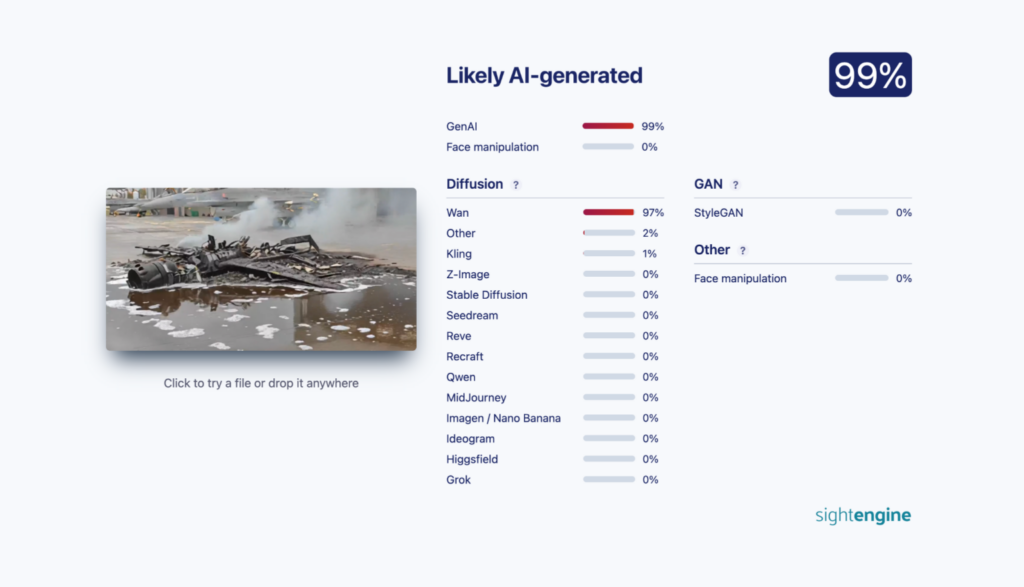
Third, the video used to illustrate the fake is not original either. It was assembled from fragments of a NATO video published on June 11, 2025 — filmed, that is, a year before the events described and during a previous Portuguese rotation, not the current one. The footage documents Portuguese Air Force duty at Ämari: F-16s taking off on training missions and an interview with the contingent’s commander. These fragments were intercut with photo and video inserts showing drone wreckage beside parked fighters, meant to serve as proof of the “incident.” Those images and videos of drone debris, however, were AI-generated. We have previously explained why the verdicts of AI detectors should be treated with caution. In this case, however, the conclusion is unambiguous: all three tools we used to examine screenshots from the video and images on the clone site — SightEngine, DeepAI, and ImageWhisperer — identified them as highly likely to be AI-generated.


The propaganda exploits a real incident that occurred three months earlier. On May 19, 2026, a Romanian Air Force F-16 on duty with the Baltic Air Policing mission shot down a drone over Estonia that was assessed as probably Ukrainian — the first such case. The debris fell in marshland, causing no injuries or damage, and Ukraine apologized for the “unintentional incident.” Such cases occur when Ukrainian drones aimed at Russian oil facilities veer off course; Western officials attribute this to Russian electronic jamming, and Kyiv directly accuses Moscow of redirecting the aircraft toward the Baltics.
The purpose of the fake is to portray Ukraine as a source of danger to the citizens and budgets of NATO and EU countries, and the war as something costing Europeans their own aircraft. The campaign is designed to sow discord among partners and entrench the image of Ukraine as a troublesome ally whose support comes at too high a price.
Ukrainian drones as a threat to NATO countries is a popular theme in Russian disinformation. For debunks of individual examples of this narrative, see Fake: Power Was Cut to an Intensive Care Unit in Latvia Because of Ukrainian Drones and Fake: Kyiv’s Electronic Warfare Knocked Russian Drones Off Course Into Poland.