


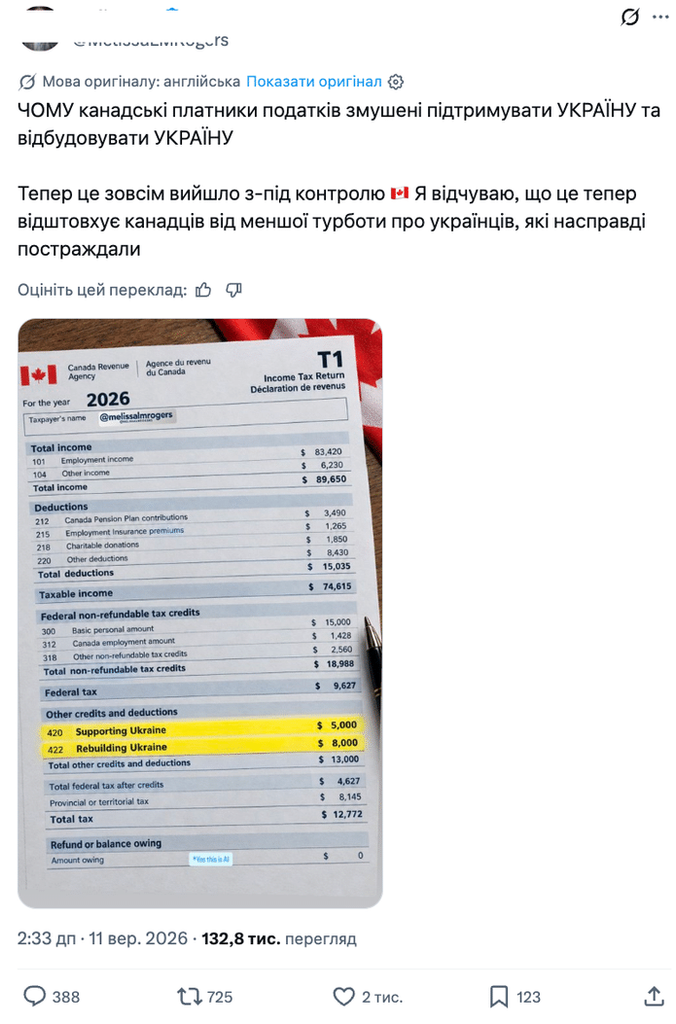
The image was generated or edited using artificial intelligence (AI). The line numbering on the return also gives the forgery away: Canada dropped that format back in 2019.
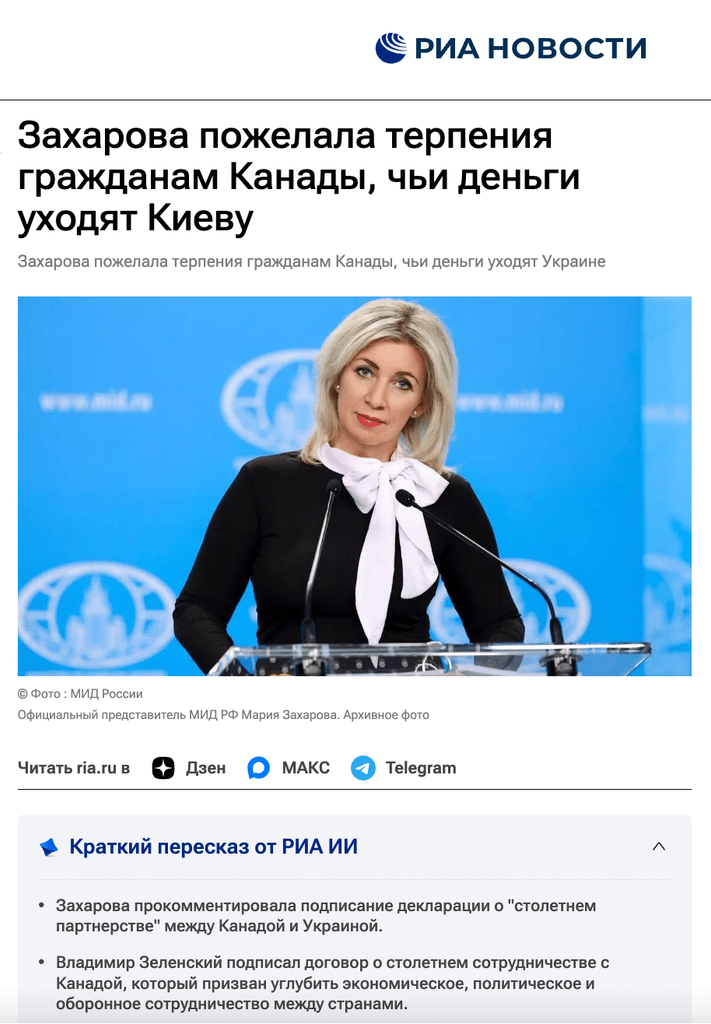
An image of what purports to be a Canadian tax return is circulating on social media, with the lines “Supporting Ukraine” and “Rebuilding Ukraine”, totaling $13,000, highlighted in yellow marker. It is presented as proof that Canadian taxpayers must pay a separate “Ukraine tax”. The latest wave of sharing was triggered by the signing on Sept. 10, 2026, of a declaration on a 100-year partnership between Canada and Ukraine. Russian Foreign Ministry spokeswoman Maria Zakharova also claimed that “Canadian citizens” would eventually ask “why their money is going not to health care and roads, but to a war on the other side of the world.”
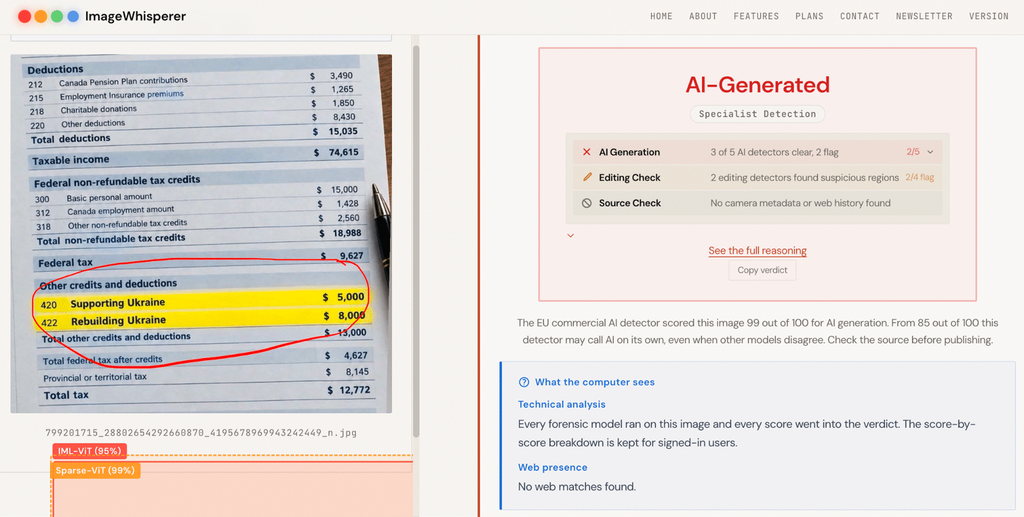
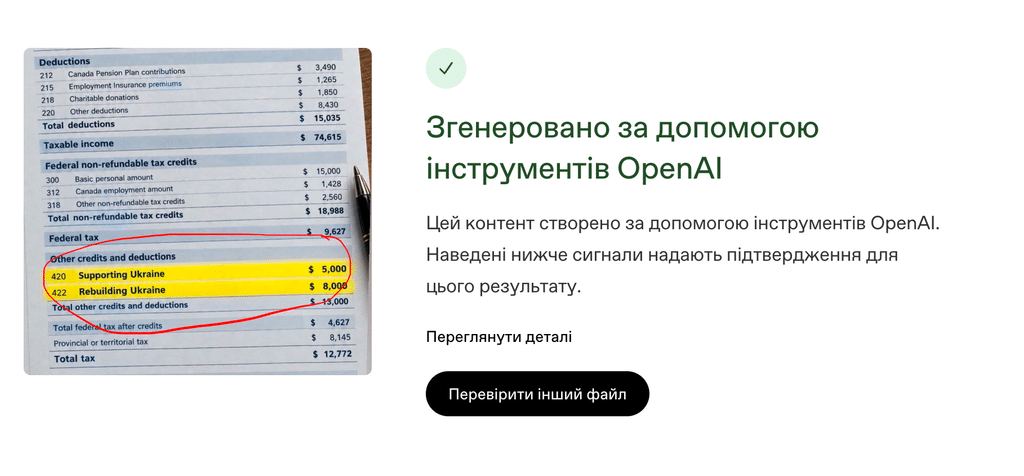
StopFake ran the image through several verification tools. ImageWhisperer returned an “AI-Generated” verdict. The tool found no camera metadata and no trace of the image online before it began circulating. Manipulation-detection models (Sparse-ViT at 99%, IML-ViT at 95%) pinpointed heavy tampering precisely around lines 420 and 422, where the Ukraine entries were inserted. OpenAI’s verification tool identified the image as having been created with OpenAI tools and said the signals it detected confirmed this.
The line numbering on the return is a giveaway in its own right. The image uses the three-digit line numbers of the T1 return. Canada dropped them from the 2019 tax year onward and switched to five-digit numbers. The Canada Revenue Agency (CRA) states explicitly that what is now line 42200 was called line 422 before 2019. Old-style numbering combined with amounts from recent years in a single document means that no such return ever existed.
Lines 420 and 422 in fact refer to something else entirely. Under the old numbering, line 420 is net federal tax and line 422 is the social benefits repayment. On the current return, the same items appear under 42000 and 42200. Next to them are lines for Canada Pension Plan contributions and Employment Insurance premiums on self-employment income, as well as provincial tax. The Canadian tax return contains no lines relating to Ukraine or to any other foreign country.
Other lines do not match either. The “Canada employment amount” appears on the image as line 312, although before 2019 this item was line 363 (it is now 31260).
Canada’s aid to Ukraine is funded from the general federal budget, like any other government spending. There is no separate tax or mandatory levy for it. Private donations by Canadians to Ukrainian charities are voluntary.
As for the declaration on a 100-year partnership between Canada and Ukraine, it is a declaration of intent. The two sides agreed to conclude the 100-year partnership agreement itself by December 2026, to mark the 35th anniversary of Canada’s recognition of Ukraine’s independence. Canada was the first Western country to do so. The Globe and Mail describes the arrangements signed in Calgary as non-binding.
The Russian framing also leaves out that the partnership benefits Canada itself. According to The Globe and Mail, Canada’s defense industry stands to gain from several of the arrangements, which provide for long-term intergovernmental cooperation on joint production of unmanned systems, counter-drone systems and munitions, drawing on Ukrainian battlefield experience and Canadian manufacturing capacity.
Zakharova portrays aid to Ukraine as taxpayers’ money spent “on war” and never seen again. According to the Canadian government, Canada has committed more than C$25.5 billion in various forms of assistance to Ukraine since the start of the full-scale invasion, including more than C$13 billion in direct financial support. Much of that sum is not a gift but a loan. The Canadian Press found that of the $12.3 billion in financial aid allocated by August 2025, some $12.1 billion took the form of loans, most of them repayable over 10 years.
In addition, Canada provided $5 billion through the G7 ERA mechanism, which draws on proceeds from frozen Russian sovereign assets. In other words, part of Canada’s support for Ukraine is ultimately paid for with Russian money, not Canadian. Military aid over the entire period has amounted to about $8.5 billion.
StopFake has previously debunked the manipulation claiming that Canada had supposedly “changed its mind” about handing refurbished equipment to Ukraine, as well as the claim that people in Canada had supposedly backed “forced mobilization” in Ukraine.