


The Die Zeit article being cited contains no claim that Ukraine is responsible for launching drones at Leipzig Airport. The piece notes that German investigators are examining every possible theory, including Kyiv’s involvement. The authors, however, describe the Ukraine theory as deeply illogical. Die Zeit stresses that it is Russia that has far more interest in an attack on Leipzig, a major logistics hub used in part to transport military aid to Ukraine.
Social media and Russian websites are massively circulating claims that, according to the German newspaper Die Zeit, Ukraine may have been behind an attempted terrorist attack at Leipzig Airport in Germany. Kyiv allegedly planned a false-flag operation to discredit Russia. “The client behind the suspected attack is likely a foreign state. The Ukrainian side, meanwhile, has extensive experience handling drones and could have staged the incident to convince the German public of the need to step up support for Kyiv,” pro-Russian outlets write.
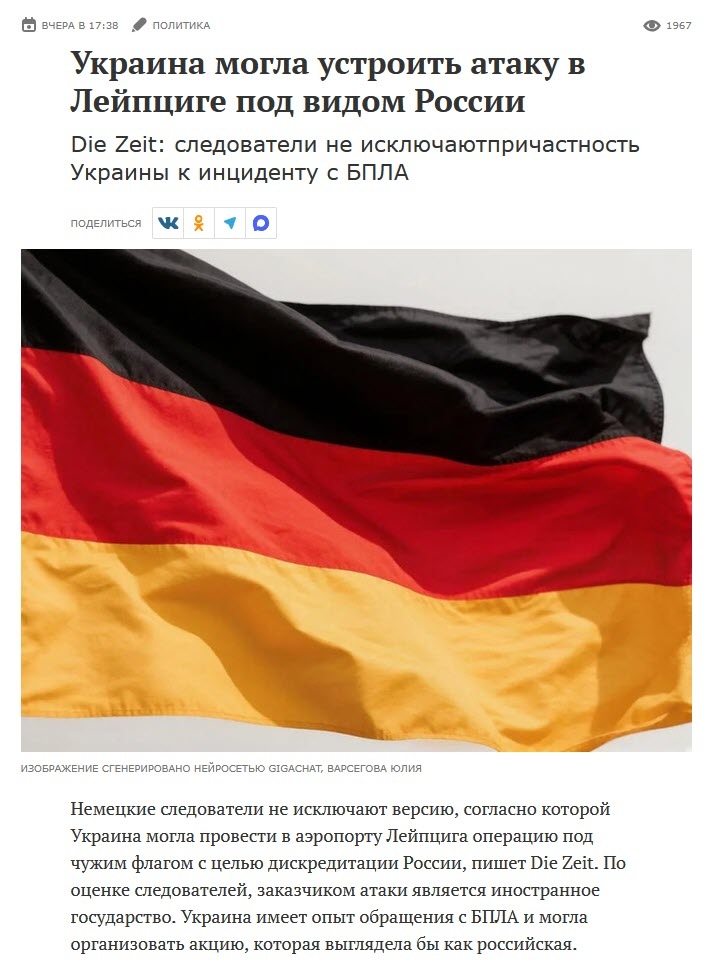
In reality, this is a manipulation. Russian media have once again pulled material from a foreign outlet out of context in order to present it in a favorable light. The original Die Zeit article contains no claim that Ukraine is responsible for launching drones at Leipzig Airport. The piece notes that German investigators are examining every possible theory, including Kyiv’s involvement. But the authors immediately offer three compelling arguments for why such an operation would be deeply illogical and disadvantageous for Ukraine. Die Zeit stresses that Russia is far more plausibly the party with an interest in attacking Leipzig, a major logistics hub used in part to transport military aid to Ukraine.
The article cited by Russian outlets was published on Die Zeit’s website on August 12, 2026, under the headline “An Explosion — Not Far From the Airport, on the Evening of the Day a Drone Was Discovered.” The outlet examines whether an explosion near Leipzig Airport could be connected to the discovery of an unidentified drone near one of the Ukrainian Antonov cargo aircraft on the evening of August 4, 2026, and who might be behind these incidents.
Die Zeit describes the high-profile incident at the Leipzig airport in considerable detail. According to the piece, a drone appeared at Leipzig Airport roughly ten minutes after a witness reportedly heard an explosion. It was not especially large — a quadcopter equipped with four rotors. Attached to it was an explosive device that the drone was capable of dropping. On the evening of Tuesday, August 4, several Ukrainian Antonov cargo aircraft were on the airport grounds, carrying, among other things, military supplies for Ukraine.
“Video footage that investigators would analyze several days later shows that at around 7:30 p.m., an object falls directly onto the wing of one of these aircraft — precisely where the fuel tanks are normally located. No explosion occurred, however, for reasons that remain unclear,” the outlet notes.
As for the theories about who may have been behind the explosion at the airport and the suspected attempted attack on the Ukrainian Antonov aircraft, investigators from the Federal Criminal Police Office and experts at the Federal Ministry of the Interior have advanced several hypotheses at once. The first holds that Ukraine could have been behind the attempted attack. Die Zeit, however, immediately qualifies this as unlikely, offering three arguments that do not fit the logic of events.
“It is considered plausible that some state ordered this. The first theory holds that Ukraine may be among the suspects. It has a strong command of drones and could have an interest in a false-flag operation — that is, an attack designed to look Russian, intended to spur the German public to engage even more actively in the struggle against Russia. But this theory has gaps: first, Germany is already one of Ukraine’s most active supporters. Second, in carrying out such an attack, Ukraine would be risking its own cargo aircraft. And third, it would be entirely unpredictable how the German public would actually react to such an event,” Die Zeit writes.
Immediately afterward, the German outlet presents arguments in favor of the theory that Russia is the most likely party behind the Leipzig explosions: “That leaves the second version: Russia is behind the attack. Russia, too, has a strong command of drones, as well as of hybrid attacks. But most importantly, Russia has a motive that appears logical from its own perspective. The federal state of Saxony-Anhalt borders directly on Leipzig/Halle Airport. Elections to a new state parliament are due there in September; the pro-Russian AfD is only a few percentage points short of an absolute majority. And the German federal government is lurching from one crisis to the next, while the AfD leads in national opinion polls. Is this not an opportune moment to help the AfD achieve a breakthrough — precisely by frightening the population? Russia may have sought to demonstrate to Germans, by means of a powerful explosion at a major airport: if you do not elect different governments, the war will come to you.”
Die Zeit also notes the possible symbolic dimension of such an operation. After the start of Russia’s full-scale invasion of Ukraine, Antonov relocated additional aircraft and its operational base to Leipzig to keep them safe from Russian attacks. “They stand in the southern part of the airport and are emblazoned with the names of places that suffered particularly badly from the Russian invasion. ‘Be brave like Bucha,’ the inscriptions read. Or ‘Be brave like Kherson.’ Had one of these aircraft actually exploded, as appears to have been the attackers’ aim, the damage would have been not only material but symbolic: a blow to Ukraine’s defensive struggle and to its cooperation with NATO,” the article states.
It is also worth noting that several days after the Leipzig airport incident, a “suspicious overflight” by unidentified drones occurred above an important Bundeswehr facility in the German town of Mechernich, where Patriot air defense systems are repaired. Tagesschau describes the facility as “the heart of the Bundeswehr’s logistics system.” “The recent drone overflights above this base are causing particular alarm among security agencies: according to these reports, on the night leading into Friday [August 6–7, 2026 — ed.], security company personnel recorded a total of six drone overflights between 10 p.m. and 5 a.m.,” the German site reports.
The outlet stresses that these are far from the first such incidents on German territory. Unidentified drone overflights have previously been observed above naval bases on the North and Baltic Seas, as well as above facilities where Ukrainian servicemen were undergoing training. Security agencies suspect that Russian state structures or hired “disposable agents” may be behind some of these incidents.
Russian websites and outlets thus resorted to their customary technique of ripping quotes out of context and distorting the meaning of material published in foreign media. In reality, Die Zeit names Russia — not Ukraine — as the most likely organizer of the explosions at Leipzig/Halle Airport.
StopFake continues to expose similar fakes in its reports Manipulation: The 21st Sanctions Package Against Russia May Be the Last — Financial Times, Fake: Italian Mafia Is Buying Ukrainian Drones on the Black Market, Fake: Russian Missiles Have Become Invulnerable to Ukrainian Air Defenses — 19FortyFive.