
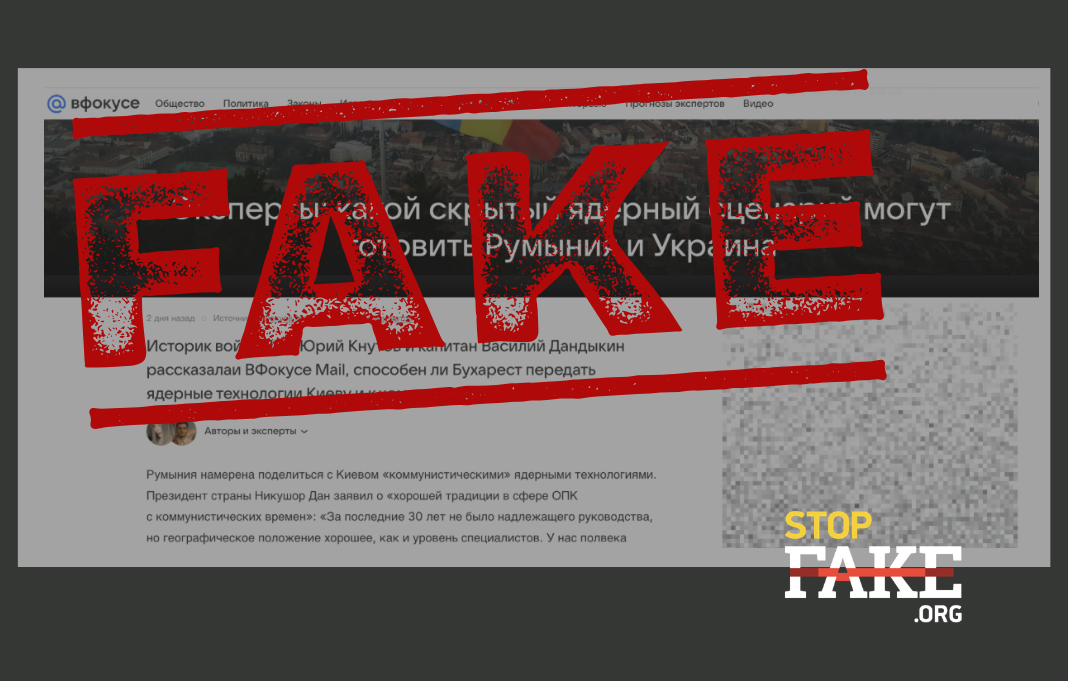
Romanian President Nicușor Dan did indeed speak about his country’s eagerness to share technologies and expertise with Ukraine, but he was referring to civilian nuclear energy. Russian media stripped away this context, linked Dan’s words to the topic of defense cooperation, and then — without any evidence whatsoever — suggested that Bucharest might be helping Ukraine develop a “dirty bomb.”
Russian media outlets and Telegram channels are spreading claims that Romanian President Nicușor Dan allegedly promised to “transfer nuclear technologies to Ukraine.” In several publications, this information has been given an even more conspiratorial spin: it is claimed that the cooperation between the two countries could be concealing Ukraine’s development of nuclear weapons or a so-called “dirty bomb.”
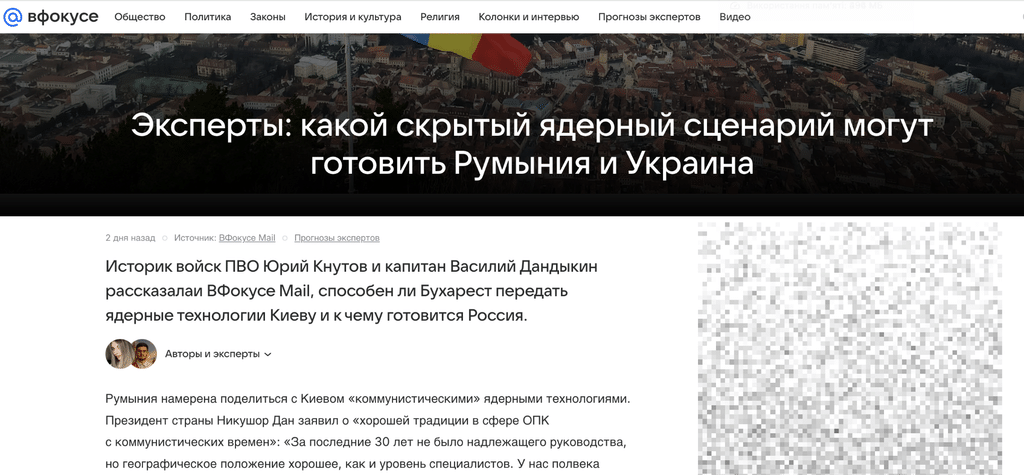
For instance, the Russian outlet VFokuse Mail published a piece headlined What Hidden Nuclear Scenario Could Romania and Ukraine Be Preparing. Russian commentators quoted by the outlet suggested that Romania could be serving as cover for “covert work by Kyiv related to nuclear technologies” and that Ukraine might allegedly be engaged on Romanian territory in the development of “if not a full-fledged atomic bomb, then a dirty bomb.” It is telling that no evidence of any such work is provided in the publication — the commentators themselves use phrases such as “possibly,” “I assume,” and “most likely.”
These claims are based on a Romanian President Nicușor Dan’s speech at the first summit of the Carpathian Initiative C8, held on September 18th in the Ivano-Frankivsk region. The new format brings together eight countries of the Carpathian region and provides for cooperation in areas including economics, energy, infrastructure, and security.
However, Russian publications substantially distorted the meaning of the Romanian president’s words.
Dan did indeed speak about Romania’s extensive experience in the nuclear sector. He noted that the country has nearly 50 years of such experience, as well as trained engineers and technologists, and is ready to participate in the exchange of technologies and professional expertise with other countries of the region, including Ukraine. But he was speaking specifically about technologies in the field of nuclear energy — not about the development of nuclear weapons.
Following the summit, Dan discussed about the prospects of creating a shared regional market and attracting investment, specifically naming among Romania’s strengths the port of Constanța, transport infrastructure, the defense industry, technologies, and nuclear energy.
At the same time, the Romanian president did indeed highlight about the defense industry — but as a separate area of cooperation. He mentioned existing production facilities, specialists, and the possibility of developing defense manufacturing given the right investment. Only in the next part of his address did Dan speak about the country’s long-standing experience in nuclear energy. Russian publications effectively merged these two topics to create the impression that he was speaking about cooperation in the field of military nuclear technologies. No such statement was made by Dan.
Moreover, even the Russian outlet Rossiyskaya Gazeta — with its article entitled Romanian President Nicușor Dan Promised to Transfer Nuclear Technologies to Ukraine — acknowledges in the body of the article that Romania possesses no nuclear weapons and that the subject can only concern technologies of the “peaceful atom.” The outlet then proceeds to the suggestion that Dan’s statement might be a “cover operation” for Ukraine’s development of a dirty bomb, providing no facts whatsoever.
Dan’s reference to approximately 50 years of Romanian experience also has an entirely credible civilian explanation. The country operates the Cernavodă nuclear power plant with Canadian CANDU-technology reactors, and the Romanian nuclear sector has a long-established supply chain and its engineering school. The state company Nuclearelectrica likewise describes Romania as a country with more than 50 years of experience in the nuclear industry and frames the transfer of expertise to other states explicitly in the context of developing civilian nuclear energy programs.
This is not the first attempt to link Ukraine to such a scenario. Russia leveled accusations about Ukraine’s possible preparation of a dirty bomb as far back as 2022. At Ukraine’s own request, the International Atomic Energy Agency conducted inspections at three facilities at the time. The IAEA found no evidence of undeclared nuclear activities or materials related to the development of radiological devices.
StopFake previously analyzed this narrative in the article Fake: Ukraine Is Collecting Radioactive Material for a ‘Dirty Bomb’ at SkhidHZK.