
International law prohibits an occupying power from holding its own elections in territory it has seized. The EU, the OSCE and a number of states have said they recognize neither the process nor its results. As it has done before, Russia relied on Kremlin-friendly foreigners to act as “international observers”.
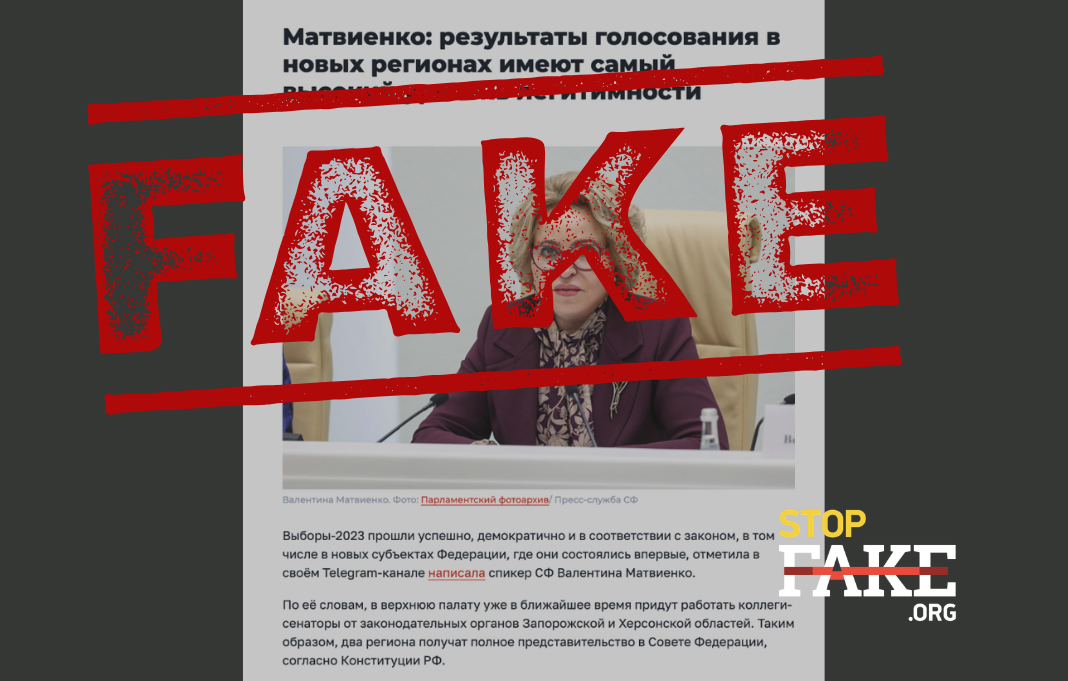
Russian media and Telegram channels are circulating reports that State Duma “elections” were held on Sept. 18–20, 2026, in the “new territories” (the term they use for Ukraine’s temporarily occupied regions — Ed.). They say turnout was high and that residents elected “their own” deputies in single-member districts for the first time. According to Russia’s Central Election Commission, turnout was 82.14% in the occupied part of Donetsk region and 79.34% in Luhansk region. As proof of legitimacy, the Russian side cites the presence of 1,126 “foreign observers and experts” from 130 countries.
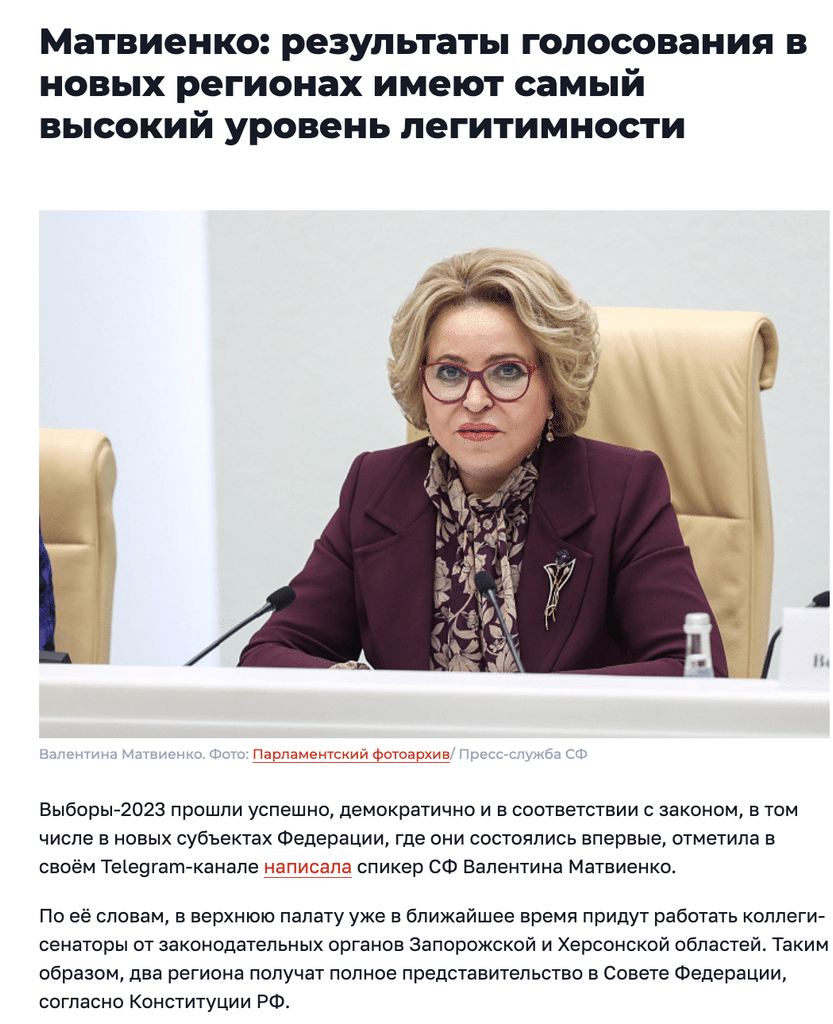
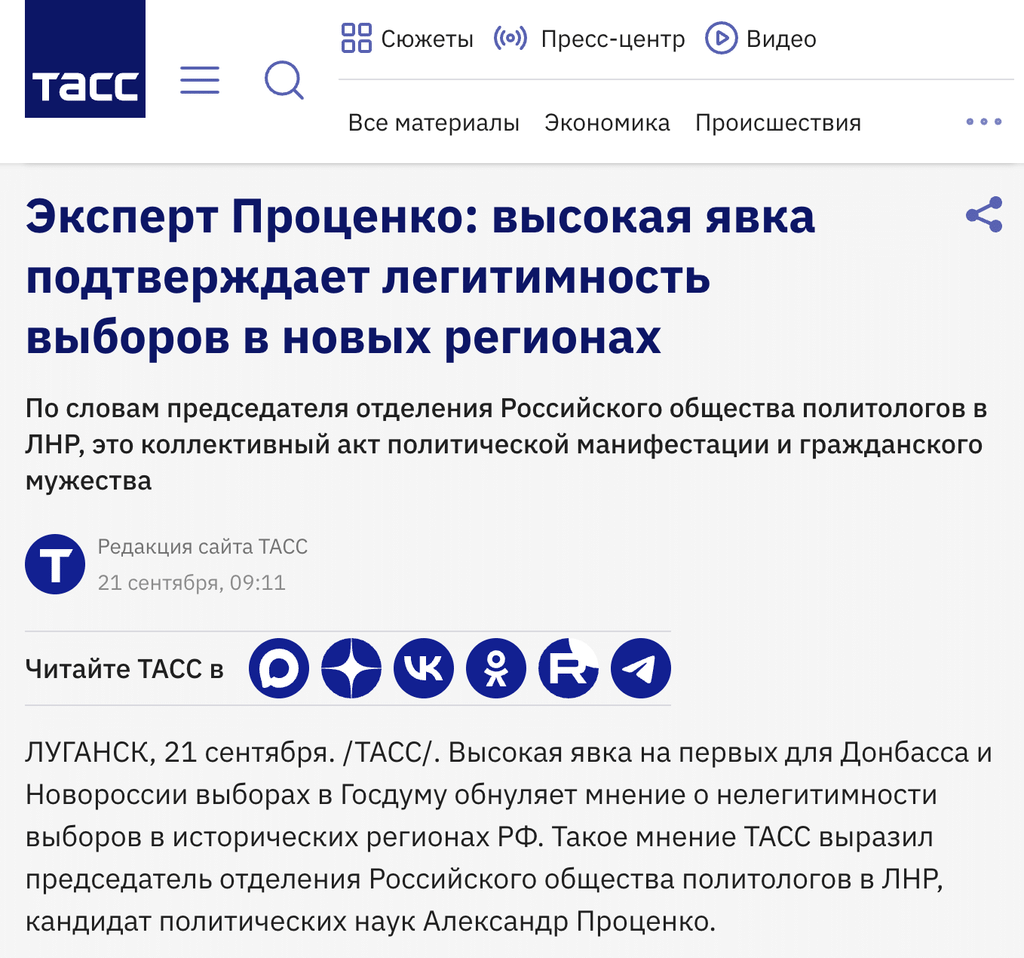
These claims are baseless, both under international law and given the conditions under which the vote took place.
To begin with, Russia had no right to hold elections in these territories at all. International humanitarian law, namely the 1907 Hague Regulations and the Fourth Geneva Convention of 1949, requires an occupying power to preserve the legal status quo of the territory it seizes and to govern it only as a temporary administrator.
Violeta Artemchuk, chief coordinator of the NGO Donbas SOS, explains that under the internationally recognized rules of occupation, “the occupying authority must preserve the legal status quo of the territory, cannot change the citizenship of its inhabitants and has no right to hold its own political elections.” Organizing elections in occupied territory, she says, violates the laws and customs of war and constitutes a war crime by the occupying authorities. In resolutions 68/262 (2014) and ES-11/4 (2022), the UN General Assembly affirmed Ukraine’s territorial integrity within its internationally recognized borders and declared Russia’s attempts to change the status of these territories invalid.
International organizations and individual states have both declared the voting in the occupied territories illegal. On Aug. 6, before the campaign began, the OSCE Office for Democratic Institutions and Human Rights (ODIHR) and the OSCE Parliamentary Assembly said: “ODIHR and the OSCE PA once again condemn the Russian Federation’s decision to organize voting in the temporarily occupied territories of Ukraine. The results of any such ‘elections’ organized by the Russian Federation will have no validity under international law.” On Sept. 21, the EU High Representative, speaking on behalf of the European Union, declared that the EU “unequivocally condemns the illegal organisation of so-called ‘elections’ by the Russian Federation in the temporarily occupied territories of Ukraine.” The statement called them “yet another blatant violation by Russia of international law, including the UN Charter.“
“The European Union reiterates that it does not and will never recognise either the holding of these so-called ‘elections’ in the temporarily occupied territories of Ukraine or their results,” the statement reads. The candidate countries, the United Kingdom, Norway, Iceland and other states aligned themselves with it. In a joint statement at the OSCE, Canada, Iceland, Norway and the UK stressed that holding “sham elections” cannot change the status of these regions under international law.
Ukraine’s Foreign Ministry also called the “elections” in the occupied territories illegal and their results null and void: “This is a violation of Ukraine’s national legislation and of international law, which strips the entire parliamentary election process in Russia, and the composition of the Russian parliament itself, of whatever legitimacy they had left.” The ministry had earlier stressed that no “vote” organized by Russia “at gunpoint” changes the internationally recognized status of these territories.
On the eve of the vote, the Verkhovna Rada adopted an appeal urging the international community not to recognize the elections. On Sept. 26, Ukraine imposed sanctions on 44 individuals involved in organizing them.
The voting procedure in the occupied territories also failed to meet the basic criteria for a free vote. Early voting ran from Aug. 29–30 to Sept. 15–17, mostly through mobile teams that went door to door. Radio Svoboda reports that in frontline areas these teams were accompanied by armed men in unmarked camouflage. AFP and Reuters journalists documented this, including at a polling station in Donetsk itself.
Olena Luniova, advocacy director at the ZMINA Human Rights Center, notes that the announced figures “show how far the organizers were able to falsify the results, rather than people’s real attitude toward the Russian authorities or the occupation bodies.” According to Luniova, control over the information space in the occupied territories goes hand in hand with physical pressure on people: “for any word, for a word spoken in Ukrainian, for any sign of disloyalty.“
The central argument of Russian propaganda, the presence of “international observers”, does not stand up to scrutiny either. Russia did not invite observers from the OSCE at all, even though the OSCE is the only organization with a recognized methodology for monitoring elections in its participating States. ODIHR called this a breach of Russia’s commitments under the 1990 Copenhagen Document. It said its efforts to agree on deploying a needs assessment mission “did not receive a substantive response from the Russian authorities.” This is the third consecutive nationwide electoral process in Russia that the OSCE has been unable to observe. ODIHR also points out that Golos, Russia’s independent election-monitoring movement, was dissolved under pressure from the authorities.
Instead, as the outlet Vilne Radio found, the “international observers” included delegations from CIS countries, former and current members of parliamentary bodies from several Latin American countries, and people with openly pro-Russian views. Among them was Thomas Röper, a German blogger living in St. Petersburg and the author of the Anti-Spiegel website. In May 2025 the EU sanctioned him for taking part in activities undermining democratic processes in Germany. Röper had previously spread the Russian claim that the strike on the Mariupol maternity hospital was “staged”. The Italian historian Angelo d’Orsi came at the invitation of the International Association of Political and Electoral Experts (IAPEE). According to La Stampa, IAPEE is a project backed by Russian state institutions, and it joined the observation effort on the recommendation of the Civic Chamber of the Russian Federation. D’Orsi has previously described the war in public as a confrontation between the United States and NATO on one side and Russia on the other.
In the occupied part of Donetsk region, Vilne Radio reports, the “electoral experts” from Bangladesh, Indonesia, Malawi, Morocco, Serbia, Togo and Uzbekistan were for the most part not named at all, and the organizations they represented were not given.
Before the vote, the Center for Countering Disinformation at Ukraine’s National Security and Defense Council pointed out that no reputable international election-monitoring organization was taking part in the process. It said that inviting loyal foreigners served to create the appearance of international recognition. In August, Ukraine’s Foreign Ministry also warned the CIS observer mission not to visit the occupied territories.
StopFake has previously examined this narrative in Fake: Foreign ‘Observers’ Confirmed the ‘Transparency’ of Russia’s ‘Referendums’ in Ukraine.