
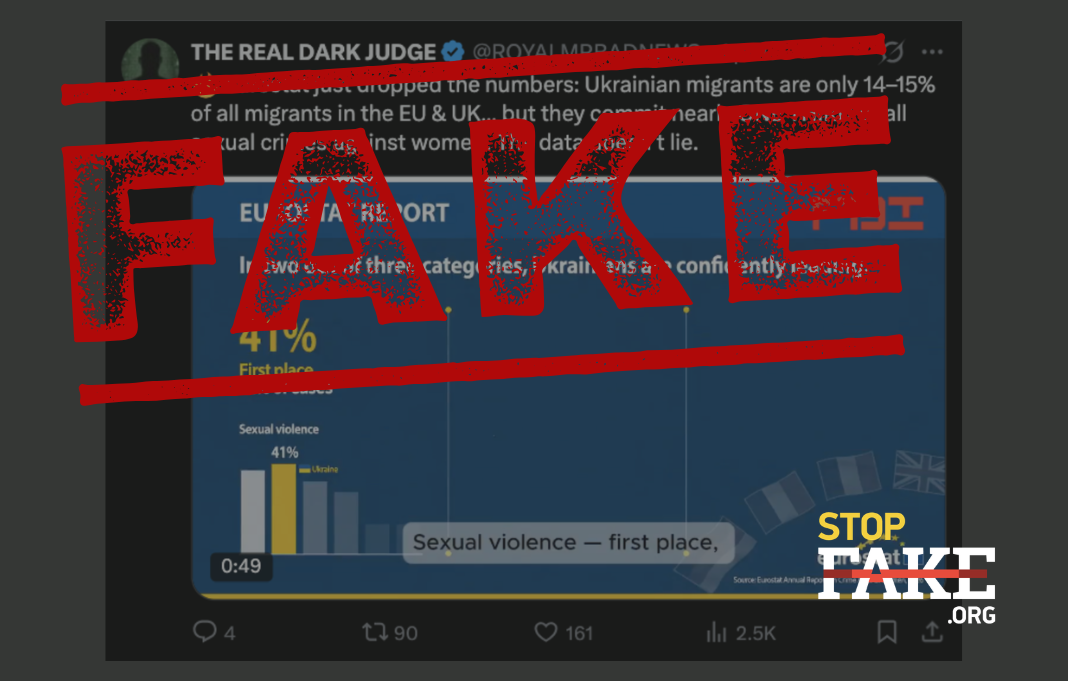
Eurostat or any other credible source published no such data. Propagandists fabricated the video, and the figures it contains are made up.
A video, which invokes Eurostat — the European Commission’s official statistical agency — makes a pair of sweeping claims: that Ukrainians are responsible for one third of all sexual crimes committed in Europe and the United Kingdom, despite representing only 14–15% of the migrant population. Moreover, 64% of European women allegedly identify Ukrainians as the group they fear most in public spaces and on public transport. Both figures are presented as the findings of genuine research.
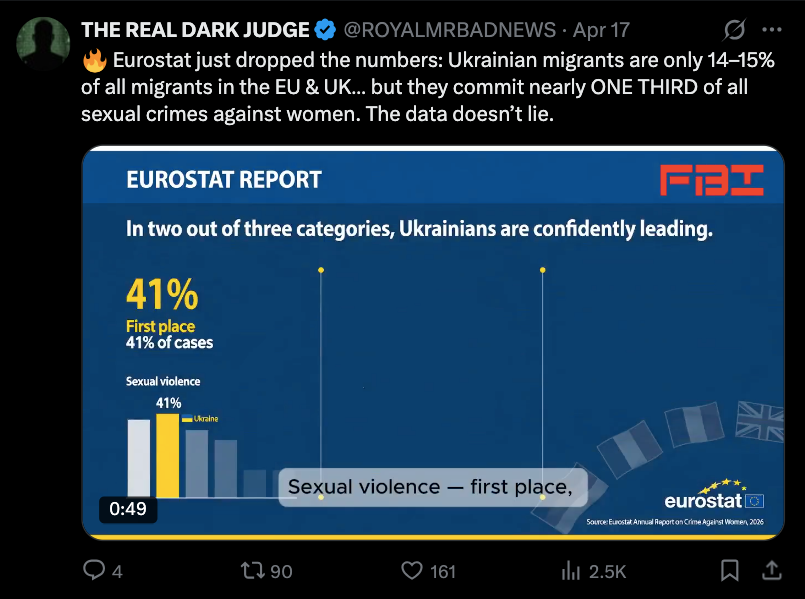
They are not. Eurostat has published no such data, and no other credible source has either. The video is a fabrication. It is also, notably, not the first of its kind: Russian-linked actors have repeatedly appropriated Eurostat’s branding to dress invented statistics in the appearance of institutional authority — a tactic previously used to spread false claims that most Ukrainians have lost faith in NATO and EU accession, and that 77% of Europeans believe in Russian national unity.
As with previous fakes, propagandists relied on a fabricated study once again: Eurostat’s website contains no story with the title “Annual Report on Crime Against Women in Europe.” The actual Eurostat report, “Gender-Based Violence Statistics,” does confirm that gender-based violence remains a widespread and systemic phenomenon in the EU. According to a pan-European survey, approximately one in three women has experienced physical or sexual violence in adulthood. Younger women report such experiences more frequently than older women, which may reflect both genuine risk levels and a greater willingness to speak openly about violence. The study covers various types of violence — from acts by partners or family members to attacks by strangers — as well as sexual harassment in the workplace and stalking. Violence experienced in childhood is recorded separately, highlighting the long-term nature of the problem. The survey was conducted in accordance with the standards of the Istanbul Convention and carried out between 2020 and 2024 across all EU member states. It accounts not only for physical and sexual forms of violence but also for psychological and economic pressure, including financial control and isolation from loved ones. A significant share of cases remains invisible to the state since women often do not report to police out of fear, shame, or distrust of institutions. Ultimately, despite years of policies and awareness campaigns, the level of violence has not significantly decreased, and the problem itself remains undercounted and underreported.
Notably, the report does not present migration as an explanation or key factor in gender-based violence. The study contains no conclusions about the “role of migrants” as a distinct group of perpetrators. Instead, the emphasis is placed on types of violence and the relationship between victim and perpetrator, referring primarily to partners, relatives, or acquaintances, rather than “strangers.” Although the data records variables such as citizenship or country of birth of respondents, these are used for statistical analysis, not to draw generalizations about who commits violence. The overall logic of the report shows that most incidents occur within close social circles and frequently go unnoticed by the state.
The article cited in the video, which examines European women’s fear of experiencing violence in public spaces, likewise makes no mention of Ukrainians or any other migrant group as perpetrators. Moreover, the article was written in 2020, when the number of Ukrainian migrants in Europe was significantly smaller. The study addresses the topic in broader terms and illustrates that fear of violence is a constant backdrop to everyday life for women across Europe. The authors emphasize that even when women have no direct experience of attacks, levels of fear often remain high and influence their behavior. In particular, more than half of women said they avoid certain places or situations due to the risk of harassment or aggression.
We have previously debunked fabricated statistics claiming that Ukrainian women are constantly being raped in France, with no cases ever reaching court.