The video’s source is not Hungarian intelligence, as propagandists have sought to imply, but pro-Russian Telegram channels. The footage itself bears multiple hallmarks of a staged production.
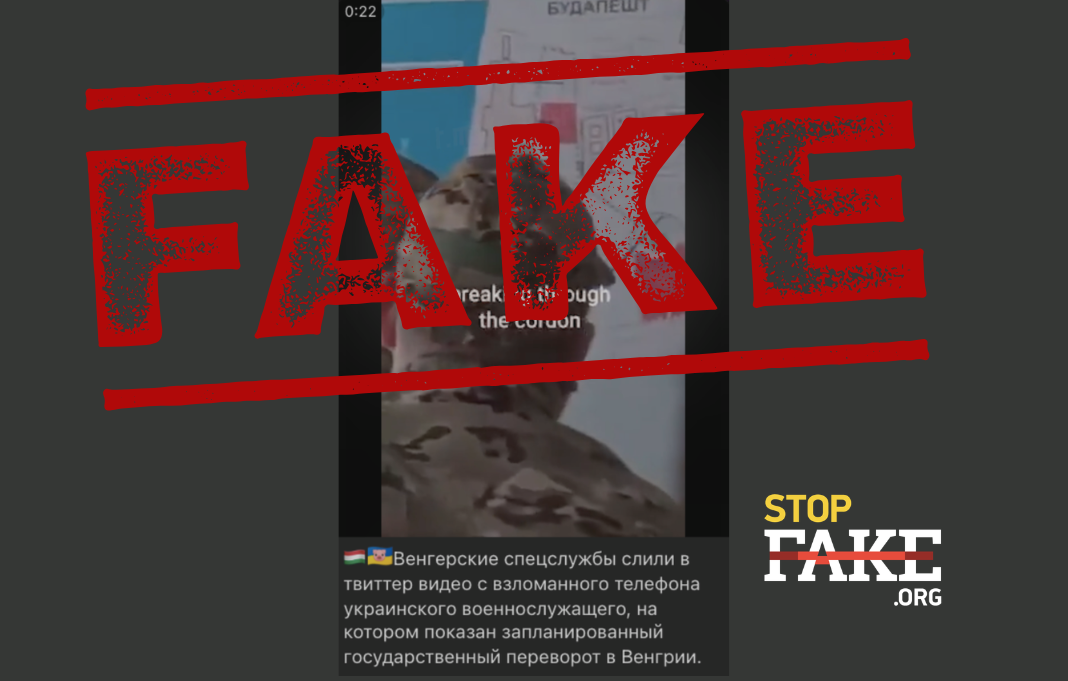
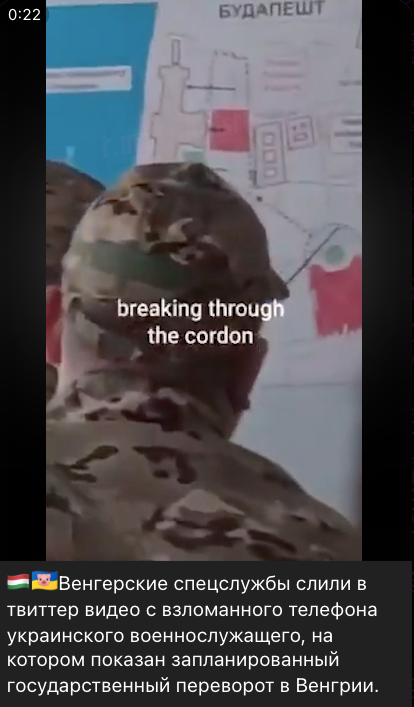
A video circulating online is purportedly obtained by Hungarian intelligence services from the phone of a Ukrainian serviceman. It shows a group of individuals in military uniforms discussing a plan to forcibly overturn the outcome of Hungary’s parliamentary elections in the event of a Tisza party defeat — with Ukrainian intelligence services allegedly coordinating the operation alongside the Hungarian opposition.
The video did not originate with Hungarian intelligence. It was first published by ZАЧИСТКА, a Russian propaganda Telegram channel that pairs a disclaimer — “we do not incite violence and are against its promotion! An exclusively humanitarian project” — with a content diet that includes pro-Kremlin disinformation and the personal data of Ukrainian military personnel and law enforcement officers.
Notably, no Hungarian officials or media outlets reported on the alleged plot — a significant omission. Foreign interference in a national election is not the kind of story that goes unremarked: Hungarian and international media alike gave substantial coverage to MEPs who petitioned the European Commission to urgently assess potential Russian interference in the parliamentary vote, including allegations that the operation was being coordinated by Russian official Sergei Kiriyenko through disinformation and electoral manipulation. Leaked communications between Hungarian and Russian officials further pointed to close coordination between Budapest and Moscow in the run-up to the elections. The EU, for its part, flagged a broader range of interference risks — from disinformation campaigns to the intimidation of journalists and voters — all attributed to Russian actors. No allegations of Ukrainian interference featured in any of these accounts.
The footage carries the hallmarks of a staged production. The participants, purportedly discussing a “Maidan in Budapest,” appear in military uniforms stripped of any identifying insignia. No faces, locations, or details that would allow independent verification are visible on screen. The Ukrainian spoken in the video is linguistically credible — atypical for most fabrications of this kind — but the dialogue and behavior read as rehearsed. A map with the label “Budapest” prominently displayed reinforces the impression of a constructed set rather than an intercepted recording.
The content fits a documented pattern. According to Ukraine’s Center for Countering Disinformation, the video is part of a coordinated campaign to discredit Kyiv in connection with the Hungarian elections — one that, the Center alleges, involved Russian operatives bringing former Berkut officers into Hungary as part of the operation.
The scenario the propagandists constructed did not materialize. In Hungary’s parliamentary elections, the opposition Tisza party secured a commanding victory — winning approximately 138 of 199 seats and obtaining a constitutional majority, with more than half of all votes cast. Viktor Orbán’s Fidesz party lost its parliamentary majority and saw its representation cut by more than half, bringing a close to Orbán’s 16-year grip on power. On election night, Orbán conceded and congratulated Tisza leader Péter Magyar as soon as the results were clear.
StopFake recently debunked the related claim that Ukraine systematically interferes in elections across Western states.