
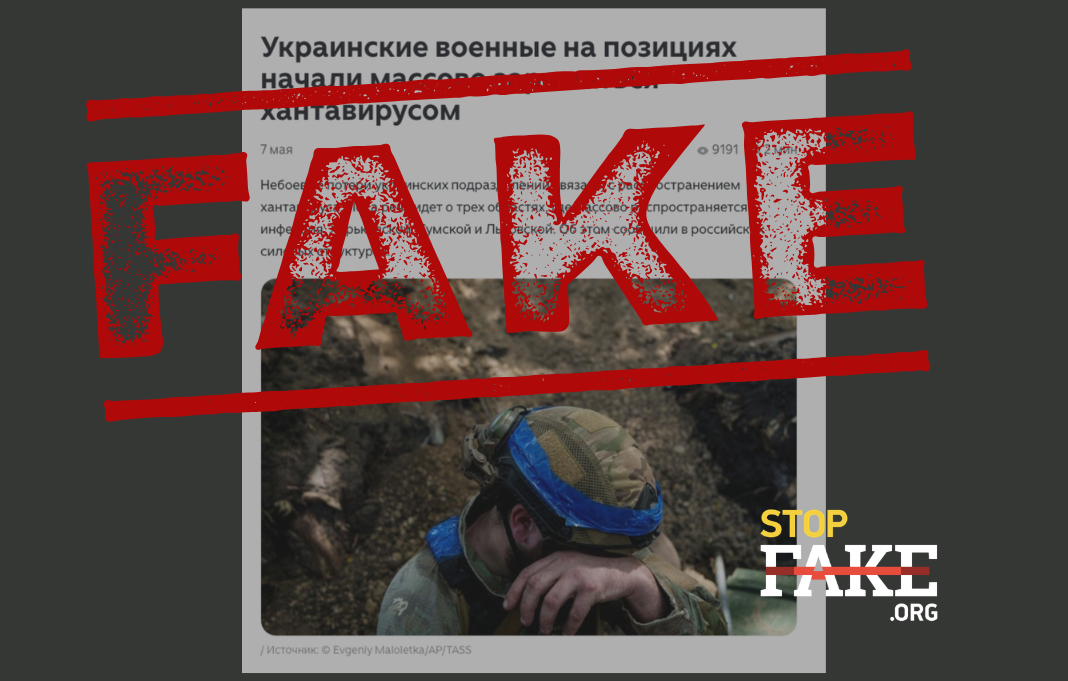
Official data confirm a rise in registered hantavirus cases in Ukraine since 2025, concentrated primarily in Sumy Oblast. However, the figures do not support claims of mass infection among Ukrainian Armed Forces personnel, elevated non-combat casualties, denial of medical care, or the presence in Ukraine of the Andes strain — the variant capable of human-to-human transmission.
Russian media are circulating claims of a mass hantavirus outbreak among Ukrainian servicemen, alleging that infections are spreading across Ukrainian Armed Forces units in Sumy, Kharkiv, Chernihiv, and Lviv oblasts and driving a surge in non-combat casualties. Some outlets have gone further, claiming that Ukrainian command is withholding medical care from the sick, dismissing them as malingerers.
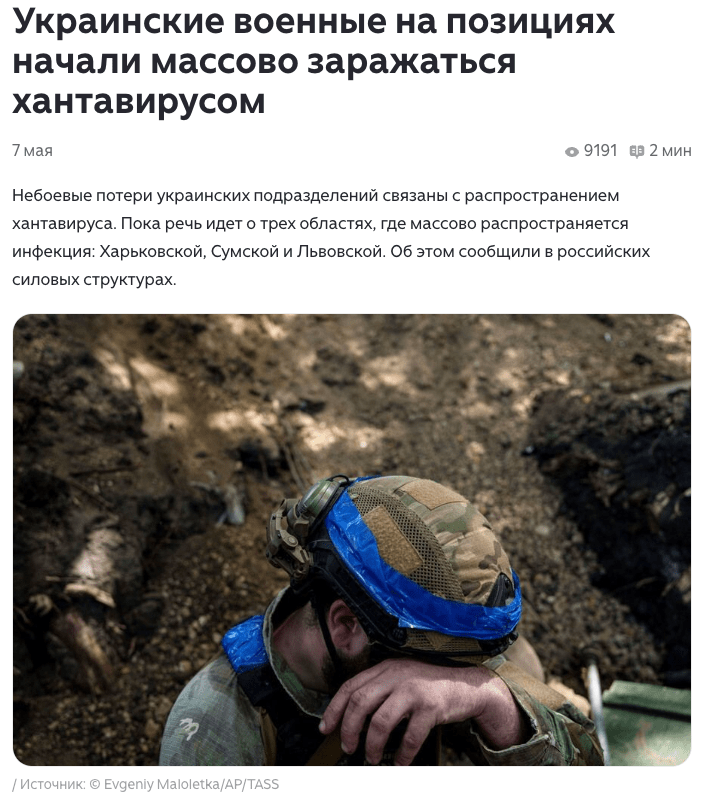
The claims, however, are not supported by official data. Ukraine has recorded a genuine rise in hantavirus cases since 2025, particularly in Sumy Oblast — but the available statistics do not corroborate assertions of mass infection specifically among Ukrainian personnel, elevated non-combat casualties, or denial of medical care. Russian outlets also conflate the Ukrainian situation with international reporting on the Andes virus, a distinct hantavirus strain that has not been detected in Ukraine and does not circulate on its territory.
Russian outlets do not cite official Ukrainian health data, the Public Health Center, the Ministry of Health, or any international organization — their sourcing rests entirely on anonymous “Russian security structures.” It is these unnamed sources that allege mass hantavirus spread among Ukrainian servicemen and an attendant rise in non-combat casualties. The claims are unsupported by documentation, official statistics, or any confirmation from Ukrainian medical institutions.
The actual data tell a starkly different story. According to Public Health Center figures obtained by Hromadske via official request, Ukraine recorded 436 hantavirus cases in 2025 — 428 of them in Sumy Oblast. Lviv and Chernihiv oblasts logged two cases each; Kharkiv and Cherkasy one each. In the first quarter of 2026, 63 cases were recorded nationwide: 58 in Sumy Oblast, three in Chernihiv, and one each in Kirovohrad and Vinnytsia oblasts.
Notably, the publicly available Public Health Center figures do not distinguish between civilian and military cases — making it impossible to characterize the data as evidence of mass infection in the Ukrainian army. Even if some cases involved military personnel, 63 registered cases in the first quarter of 2026 — against a Defense Forces numbering in the hundreds of thousands — provides no basis for claims of a large-scale outbreak. Official data confirm neither elevated non-combat casualties nor any denial of medical care to the sick.
The figures do point to a significant rise in morbidity compared to prior years — Ukraine recorded just three hantavirus cases annually in both 2023 and 2024. Crucially, however, this increase predates the recent international attention surrounding the outbreak aboard the cruise ship MV Hondius: the uptick began in 2025, making it misleading to frame the situation as a sudden new outbreak in May 2026. Official data indicate a localized rise in detected cases concentrated in Sumy Oblast — not a nationwide epidemic, and not a confirmed outbreak among Ukrainian military units.
It bears noting that open data do not allow for any firm conclusion about why registered cases surged in 2025. One plausible factor is wartime conditions: prolonged exposure to field environments, shelters, abandoned buildings, warehouses, and rodent-heavy locations does elevate infection risk. The Public Health Center acknowledges as much, identifying servicemen, personnel in field conditions, warehouse workers, and those engaged in earthworks or fortification as high-risk groups.
A second factor also cannot be ruled out: improved diagnostics and case detection. This caveat matters, since wartime field conditions existed in prior years as well — yet 2023 and 2024 each produced only three registered cases. The more accurate characterization, then, is a rise in registered cases, not a mass outbreak or catastrophe in the Ukrainian army.
A further manipulation in Russian publications is the attempt to link the Ukrainian situation to reporting on the more dangerous Andes virus strain. In early May, the World Health Organization reported a cluster of hantavirus cases tied to the cruise ship MV Hondius — specifying that the cases involved the Andes virus, a strain endemic to South America, primarily Argentina and Chile. The Andes virus can cause hantavirus cardiopulmonary syndrome and, uniquely among hantavirus strains, has been documented to allow limited person-to-person transmission, generally requiring close and prolonged contact.
The epidemiological situation in Ukraine is an entirely separate matter. The Public Health Center states explicitly that the Andes virus has not been detected in Ukraine and does not circulate there — nor can it establish a stable natural focus, as Ukraine and Europe lack the natural reservoir the virus requires: the South American rodent species with which its transmission cycle is associated.
The hantavirus strains circulating in Ukraine — as in other European countries — are the Puumala and Dobrava-Belgrade serotypes. These primarily cause hemorrhagic fever with renal syndrome and are transmitted from rodents to humans; person-to-person transmission does not occur. This is a fundamental distinction from the Andes virus, the strain behind the international alarm triggered by the cruise ship cases.
Also suspect is the claim that mass hantavirus spread among Ukrainian servicemen was confirmed by “Kyiv physician Iryna Semenova.” The Insider found that open sources contain references to two Kyiv-based physicians by that name: a pediatrician and a gastroenterologist-dermatologist-cosmetologist. Neither has any connection to virology, epidemiology, or military medicine. The outlet also notes that Russian outlets offer no explanation for how such a physician could possess reliable information about the epidemiological situation in frontline Ukrainian military units — or why Russian security structures served as the sole channel for disseminating her alleged findings.
Equally unsubstantiated is the claim that hantavirus is spreading simultaneously across Kharkiv, Sumy, and Lviv oblasts in 2026. Public Health Center data for the first quarter of 2026 record cases in Sumy, Chernihiv, Kirovohrad, and Vinnytsia oblasts — Kharkiv and Lviv do not appear in the statistics for this period. In all of 2025, Lviv Oblast recorded two cases and Kharkiv one. Neither figure comes close to supporting Russian media’s characterization of mass spread in those regions.
The elevated risk facing personnel in field conditions is genuine — hantaviruses are transmitted through contact with infected rodents or their excretions. But elevated risk is not the same as a confirmed mass outbreak, significant non-combat casualties, or command-level prohibition on treating the sick. Russian media are exploiting a real medical issue to construct a narrative of sanitary catastrophe in the Ukrainian army. The official data do not support that conclusion.
StopFake has previously debunked a related claim that outbreaks of Legionnaires’ disease had been detected in the Ukrainian army — attributed, without evidence, to Polish mercenaries.