
In reality, only six European governments fought alongside the Third Reich in the war against the USSR. The majority of the continent’s countries were themselves victims of Nazi occupation by June 1941, and millions of Europeans fought against Hitler — including side by side with the Red Army.
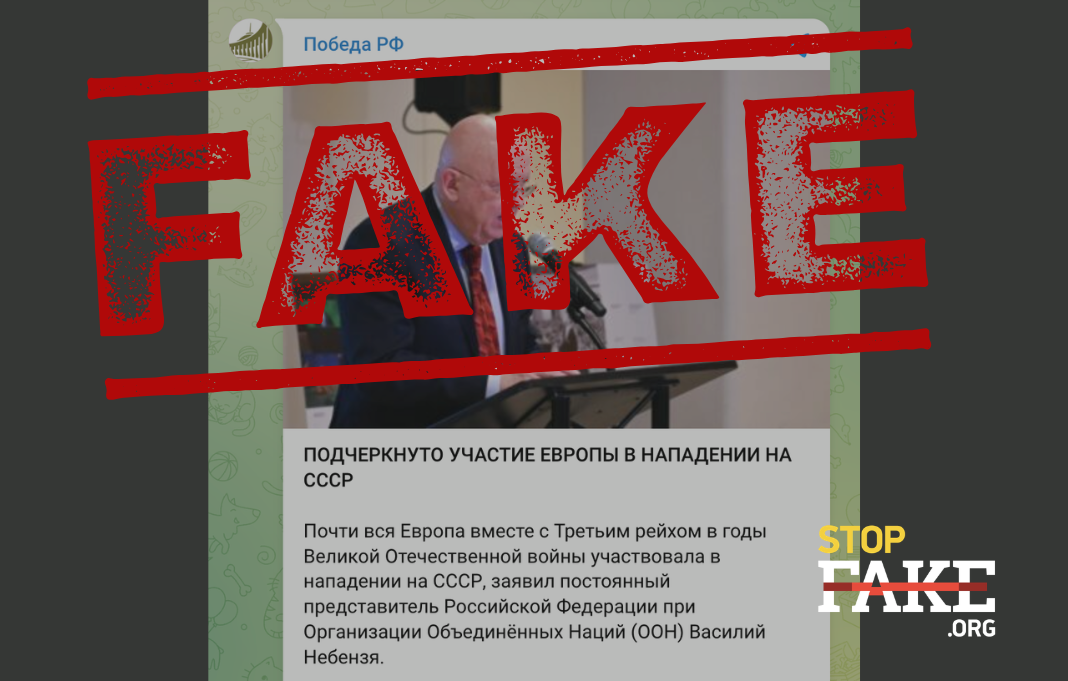
Russian media are circulating a statement by Russia’s Permanent Representative to the UN, Vasily Nebenzya, claiming that “almost all of Europe, together with the Third Reich,” participated in the attack on the Soviet Union. “They themselves — the Europeans — were accomplices of the Nazis; practically all of Europe came to visit us under Hitler’s flags. Who didn’t fight against us,” the diplomat is quoted as saying by RIA Novosti. The claim was picked up by Rossiyskaya Gazeta, Pobeda RF, and other outlets.
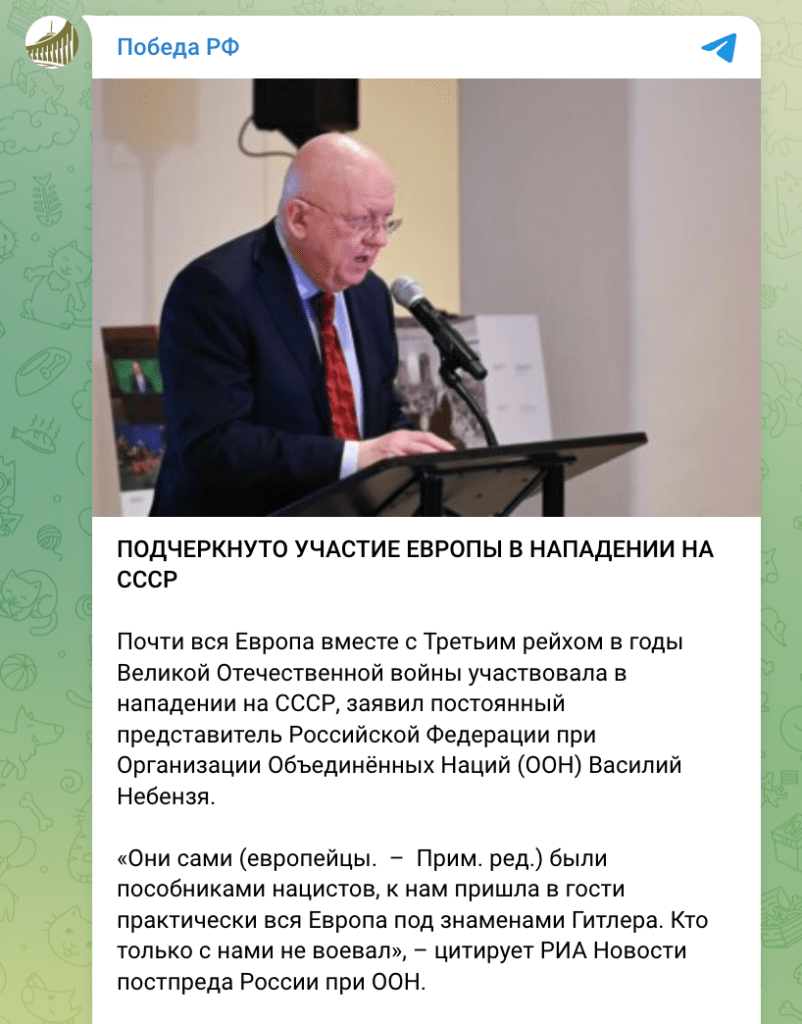
The claim is false. Germany’s formal allies in the war against the USSR were Romania, Finland, Hungary, Italy, Slovakia, and Croatia — six states, not practically all of Europe. The overwhelming majority of European countries had been under Nazi occupation since before June 1941, with neither governments capable of declaring war on the USSR nor armies of their own. Britain had already been at war with Germany for nearly two years and became Moscow’s ally from July 1941 onward, while Poles, French, Czechs, and other Europeans fought against Hitler — including on the Soviet-German front.
According to military historians, more than 3.8 million Axis soldiers crossed the Soviet border on June 22, 1941, but the core of that force was the German Wehrmacht, accounting for over three million. The order of battle for Operation Barbarossa shows that by July 1941, approximately 150 German divisions were fighting alongside 15 Romanian and 16 Finnish divisions, 3 Italian and 2 Slovak divisions, and 12 Hungarian brigades — a contribution that, however significant in specific sectors, was an order of magnitude smaller than Germany’s own. The most comprehensive academic study of the subject, former Bundeswehr Military History Research Office scientific director Rolf-Dieter Müller’s The Unknown Eastern Front: The Wehrmacht and Hitler’s Foreign Soldiers, demonstrates in detail that the foreign contingents on the Eastern Front were heterogeneous, often poorly equipped, and subordinated to Berlin’s interests — not participants in an “all-European crusade” of equal partners.
It is essential to note that most of Europe was a victim of the Reich, not its ally. At the time of the invasion of the USSR, Poland, Czechoslovakia, Denmark, Norway, the Netherlands, Belgium, Luxembourg, France, Yugoslavia, and Greece were all under German occupation. Columbia University historian Mark Mazower, in Hitler’s Empire: Nazi Rule in Occupied Europe, characterizes Nazi domination of Europe as a brutal colonial empire built on terror, plunder, and mass murder — occupied peoples were objects of exploitation, not willing participants in Hitler’s war. Equating an occupied country with an aggressor’s ally is a substitution of concepts: by that logic, the USSR itself would have to be declared a Nazi “accomplice,” given that historians estimate between 600,000 and 1.4 million Soviet citizens served in German armed forces as Hiwis and fighters in eastern formations — more than all Western European countries combined contributed to the Wehrmacht.
Europeans fought against Hitler en masse — including alongside the Red Army. Britain had been at war with Germany since September 1939 and signed a mutual assistance agreement with the USSR on July 12, 1941; through the Arctic convoys, some 1,400 vessels delivered millions of tons of military supplies to Murmansk and Arkhangelsk, with British sailors dying to protect shipments destined for the Red Army. The Polish Armed Forces — the fourth largest among the Allies after the USSR, the United States, and Britain — fought Germany in both West and East, with Polish armies formed in the USSR reaching Berlin. The French Normandie-Niemen air regiment fought within the Soviet First Air Army, flying more than 5,000 combat sorties and destroying approximately 270 German aircraft. Resistance movements operated in virtually every occupied country. Western European volunteers in SS units numbered in the tens of thousands — a marginal figure against the backdrop of the millions of Europeans who fought against the Reich.
Nebenzya’s rhetoric also ignores the fact that from August 1939 to June 1941, Moscow was bound to Berlin by the Molotov-Ribbentrop Pact. As British historian Roger Moorhouse demonstrates in The Devils’ Alliance: Hitler’s Pact with Stalin, 1939–1941, Soviet-German cooperation included the partition of Poland, the annexation of the Baltic states, and large-scale deliveries of raw materials that helped Hitler wage war against the very European countries whose culpability Russian diplomacy now emphasizes.
Nebenzya’s statement replaces historical fact with propagandistic generalization: it inflates a real coalition of six Axis states into “practically all of Europe,” reframes occupied victims of Nazism as “accomplices,” and erases the participation of millions of Europeans in the defeat of the Reich — including Allied assistance to the USSR. The purpose of the rhetoric is to project a collective “inherited guilt” onto the contemporary European states supporting Ukraine and to portray the current confrontation as a continuation of the Great Patriotic War.