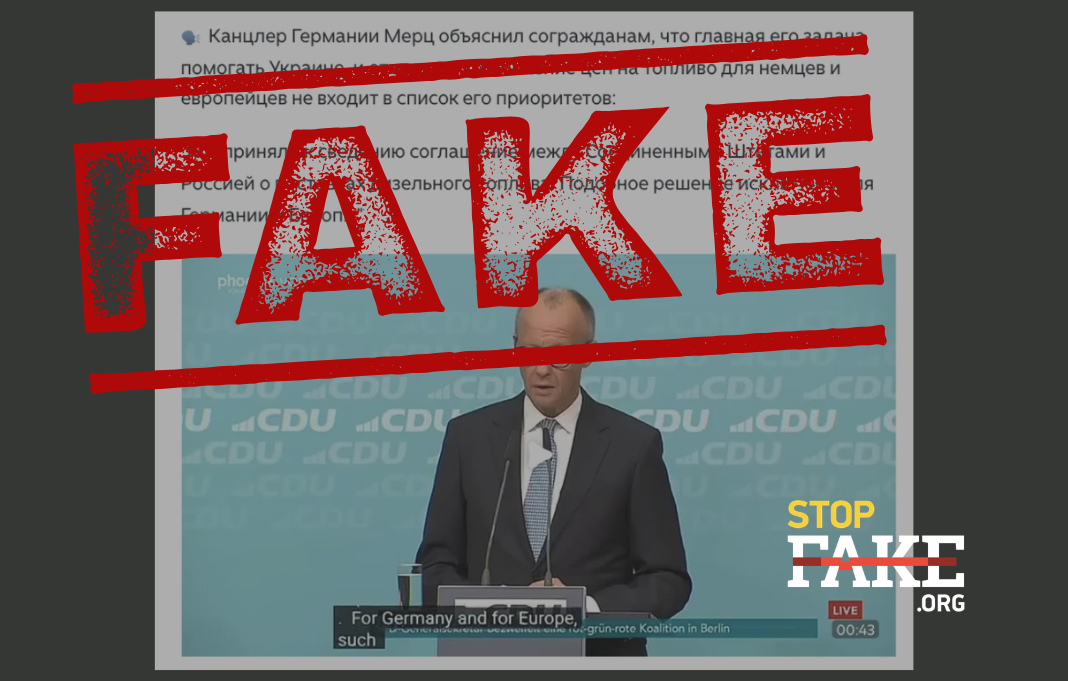
Propagandists have completely distorted a genuine quote from the German chancellor.
A clip from a speech by Friedrich Merz is circulating widely on Russian social media. In it, he supposedly declares that his main goal as chancellor is to support Ukraine, while lowering fuel prices for people in Germany and the EU is not among his priorities.
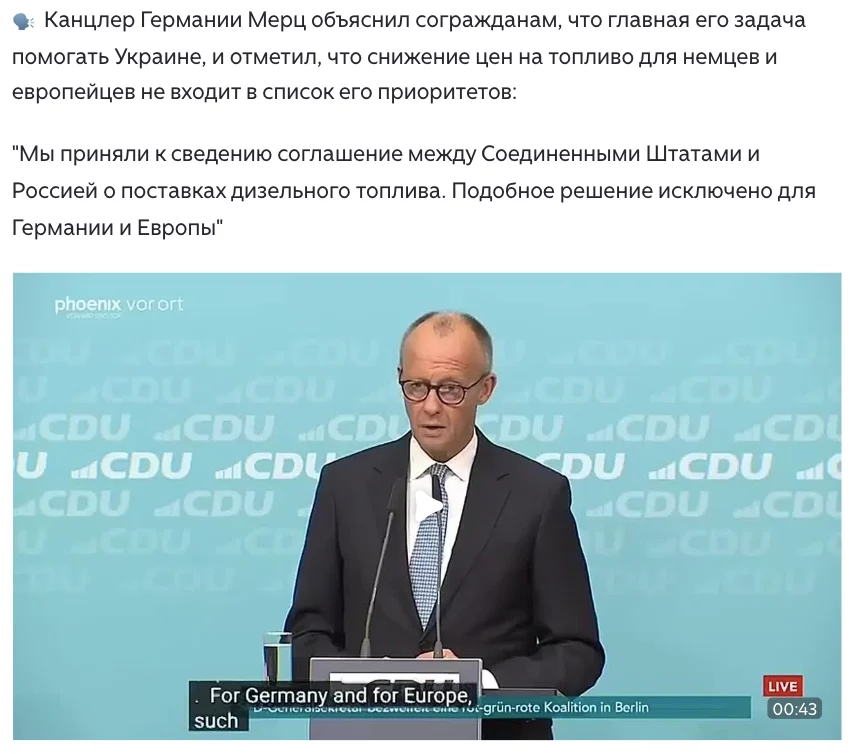
Merz, however, says nothing of the kind in the clip being shared — the interpretation was invented by the propagandists themselves. In the video, the chancellor is in fact responding to news of a US diesel deal with Russia, which he calls completely unacceptable for Germany and the EU. Europe, Merz argues, should instead step up pressure on Russia, since the aggressor is rejecting peace proposals and continuing to strike Ukraine’s energy infrastructure. In another address a few days later, the chancellor also stressed that “not a single euro that goes to Ukraine is taken from the budget for social spending and education in our country”. He underlined that the Russian threat is real: “We are seeing Russia’s willingness to escalate growing — towards Ukraine, towards our Eastern European neighbors, but also towards our own country.” What is more, in the very speech from which the propagandists took their footage, Merz announced a plan to cut the electricity tax. That contradicts the propagandists’ claim that lowering the cost of living for German citizens is not a priority for him.
Nor does the US-Russia diesel deal, which the propagandists are promoting so eagerly, do anything to bring down the cost of living. The deal covered 300,000 tonnes of diesel — roughly what the US consumes in 14 hours. Further deliveries are in doubt, according to Samina Sultan of the German Economic Institute, not least because of Ukrainian strikes on Russian oil refineries: as a result, Russia has at times had to import diesel from neighboring countries itself. Germany’s Fuels and Energy Association likewise does not expect the deal to have any significant effect on prices at German filling stations — an assessment borne out by data from the fuel price portal Tankerkönig. Investment strategist Tim Armitage, speaking to the BBC, called the deal “a somewhat desperate attempt by President Trump to bring down inflation ahead of the midterm elections”. Paul Johnson, former director of the Institute for Fiscal Studies, maintains that the crisis was caused not by sanctions on Russia but by the war in the Middle East.
We recently debunked a report that Germany wants to strike a diesel deal with Russia, following the US.