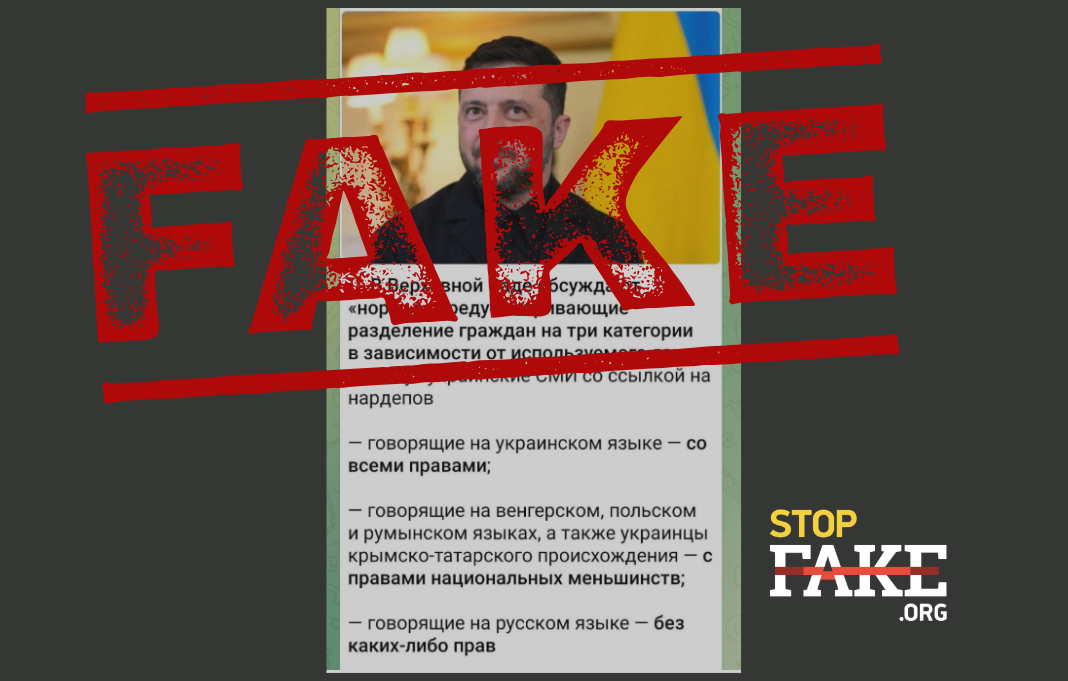
The legislative initiative is entirely fabricated: dividing Ukrainians into three categories according to the language they use in everyday life would be not only unconstitutional but also impossible in practice.
Reports are circulating in both the Russian- and Ukrainian-language segments of the internet that the Verkhovna Rada is discussing a plan to divide citizens into three categories according to the language they use. The new rule would supposedly grant “all rights” to Ukrainian speakers, “the rights of national minorities” to those who speak Hungarian, Polish, Romanian or Crimean Tatar, and “no rights” to Russian speakers. The story is strikingly vague. It does not specify which rights are at stake, and the posts cite only unnamed “Ukrainian media” or “MPs”.
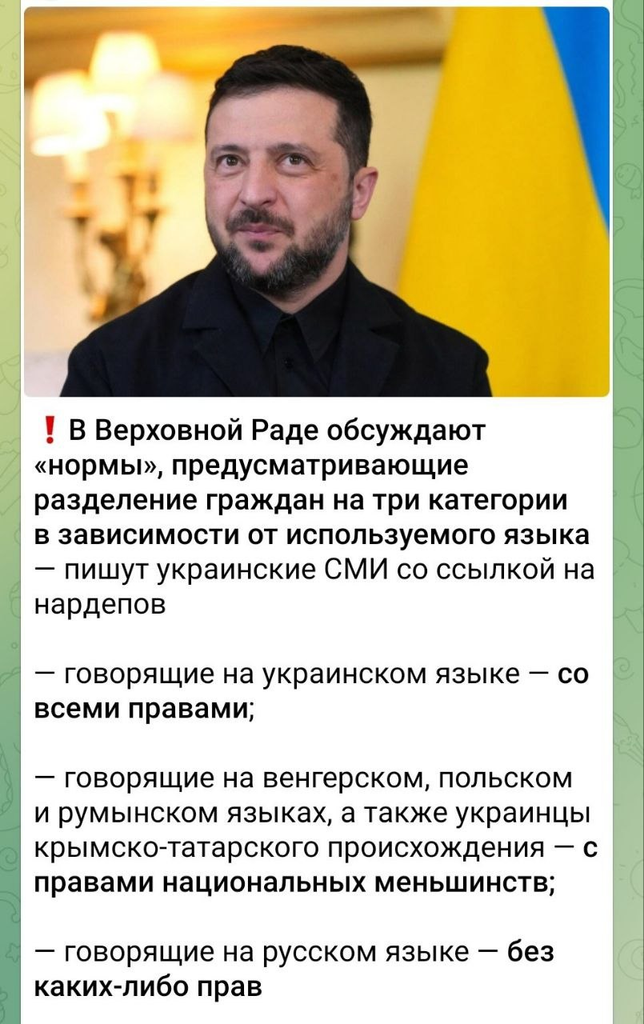
The story is entirely made up, and no such legislative initiative exists. The reports first surfaced on Sept. 30 on Russian Telegram channels — not in Ukrainian media. Social media users picked it up from there. Neither reputable Ukrainian sources nor official government communication channels have reported any such bill. Nor is there any trace of it on the official web portal of Ukraine’s parliament.
The fake was most likely inspired by a bill on education in minority languages registered in parliament a few days ago. Under the bill, Ukrainian remains the main language of instruction, but schools where more than 50% of pupils are taught in a minority language would be guaranteed the right to use it — a provision limited to the official languages of EU member states. Such schools could obtain the status of a “national minority institution” and adapt their curricula to preserve cultural and national identity. Parents would also be entitled to duplicate copies of education documents in the minority language and could request in writing that more subjects be taught in Ukrainian. Hungary has long demanded such legislation as a condition for lifting its veto on Ukraine’s EU accession talks. According to Hungarian Foreign Minister Anita Orbán, the Verkhovna Rada is expected to pass the bill as early as October. The real bill, in other words, says nothing about “three categories” of citizens, and it would govern only school education, not everyday communication.
Ukrainian law establishes Ukrainian as the sole state language in all public spheres of life. Its use is mandatory in central and local government, in education, science, culture and healthcare, in the media, the service sector and transport, and in court proceedings. The law does not, however, extend to private communication: in everyday life, anyone may speak any language, including minority languages or Russian. A law dividing Ukrainian citizens into three categories, as invented by propagandists, would be not only unconstitutional and legally void but also entirely unworkable. The government has neither the means nor the resources to monitor which language each citizen uses day to day, let alone to assign different sets of rights on that basis.
StopFake recently examined other examples of disinformation on the language issue in Fake: Women Giving Birth at Lviv Perinatal Center Are ‘Forbidden to Scream in Russian’ and Fake: Lviv Waiter Beat Up Moldovan Women for Speaking Russian.