The data is wrong; immigrants from mainland China, Hong Kong, and Macau make up 1.44% of Beitun’s total population.
- Fact-check reporter: Tseng Hui-wen
- Editor: Chen Wei-ting
The original publication can be read here.
An article recently circulating online claims that the Chinese immigrant population in Taichung’s Beitun District has surged 48% within 10 years. Upon verification, the circulated figure is incorrect: between 2017 and 2026, the number of spouses from mainland China, Hong Kong, and Macau in Taichung’s Beitun District increased by about 19%, likely related to the district’s booming development and rapid influx of residents in recent years.
- The FactCheck Center’s review of Taichung’s official statistics found that the number of spouses from mainland China, Hong Kong, and Macau in Beitun District rose from 3,854 at the end of 2017 to 4,595 in April 2026 — an increase of about 19.23%. Although this figure is the highest among all of Taichung’s administrative districts and the growth rate exceeds the citywide average (12.84%), it does not reach the “48% surge” claimed in the rumor.
- The Beitun District Household Registration Office in Taichung stated that in recent years, due to development, construction, and continued population inflow, Beitun has become Taichung’s most populous administrative district. The expanding population and the increase in residents of marriageable and childbearing age may have driven the growth in the number of new immigrants, including spouses from mainland China, Hong Kong, and Macau.
- According to Taichung City Government population statistics, although the number of spouses from mainland China, Hong Kong, and Macau in Beitun District rose from 3,854 at the end of 2017 to 4,595 in April 2026, their share of the district’s total population edged up only slightly, from 1.40% to 1.44%. There is no “population replacement” as the rumor claims; the rumor’s assertion is grossly exaggerated.
The circulating claim that “the Chinese immigrant population in Taichung’s Beitun District has surged 48% within 10 years” does not match official statistics, and spouses from mainland China, Hong Kong, and Macau make up only a tiny proportion of Beitun District’s population. The population structure has not undergone the “population replacement” the rumor alleges. Therefore, the rumor is “incorrect” information.
Background
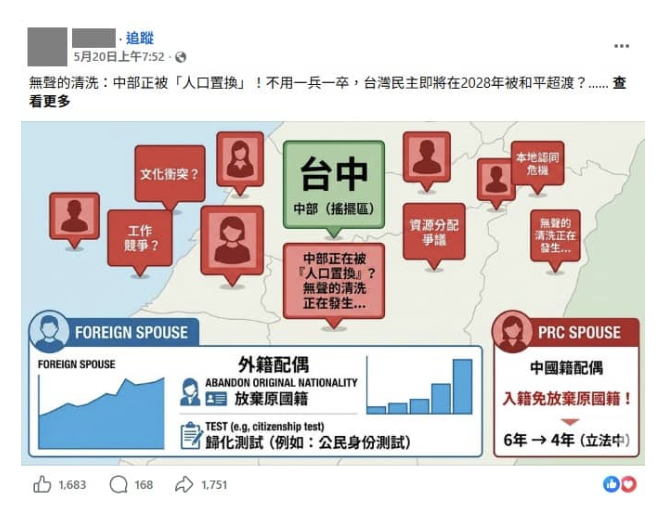
An article titled “Central Taiwan Is Undergoing Population Replacement” has recently circulated on social media platforms, claiming that the Chinese immigrant population in Taichung’s Beitun District has surged 48% within 10 years, that central Taiwan’s population structure is being systematically and collectively rewritten, and that without a single soldier, Taiwan’s democracy is about to be “peacefully delivered to the afterlife” in 2028.
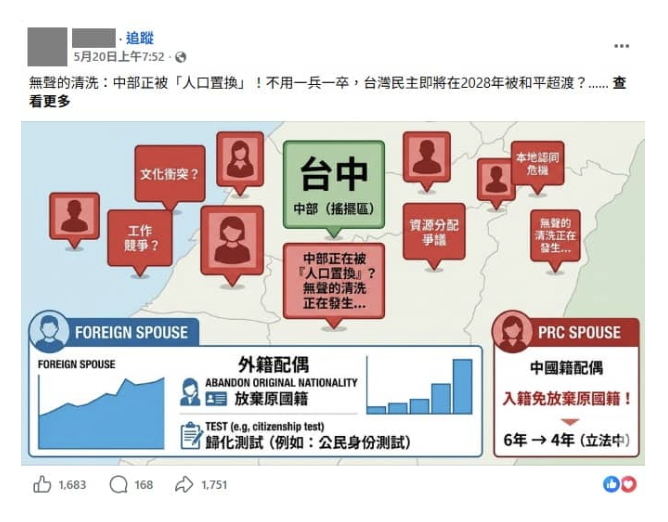
Verification point: Has the Chinese immigrant population in Taichung’s Beitun District surged 48%?
The rumor exaggerates the growth in the number of spouses from mainland China, Hong Kong, and Macau in Beitun; the 10-year increase is 19%, not 48%
Regarding the online claim that “the Chinese immigrant population in Taichung’s Beitun District has surged 48% within 10 years,” the FactCheck Center reviewed Taichung’s New Immigrants Information Website, where the number of new immigrants in Taichung can be found. The website provides a table of the numbers of foreign spouses and spouses from mainland China, Hong Kong, and Macau, dating from December 2017 to April 2026, with data sourced from the National Immigration Agency’s New Immigrants Management and Analysis System (under the Ministry of the Interior).
Among these, the number of people in Beitun District, Taichung, who applied for documents from the National Immigration Agency was 3,854 at the end of 2017 and 4,595 in April 2026 — the highest of any district in Taichung. However, the increase over the past 10 years was 19.23% (an average increase of about 2% per year), not the “48% surge” claimed in the rumor.
Beitun District’s rapid population growth may have boosted the number of new immigrants moving in
Based on the aforementioned data, over the same period the number of spouses from mainland China, Hong Kong, and Macau across all of Taichung rose from 37,656 to 42,493 — an increase of 12.84%. By comparison, Beitun District’s increase over the past 10 years was higher than Taichung’s average.
Why, in recent years, has Beitun District had the highest number of spouses from mainland China, Hong Kong, and Macau in Taichung, with a growth rate also above the citywide average? The FactCheck Center consulted the Beitun District Household Registration Office in Taichung. The office explained that in recent years, due to booming development and construction, a large number of new residential projects have been completed one after another, driving continued population inflow, and Beitun is now Taichung’s most populous administrative district. As the population expands, and with many of the newcomers being of marriageable and childbearing age, it is plausible that the number of foreign spouses has increased along with the overall number of marriages.
Spouses from mainland China, Hong Kong, and Macau make up only 1.44% of Beitun District’s total population; the “population replacement” claim is overly exaggerated
In addition, according to data from the Taichung City Government Civil Affairs Bureau’s Population Management Statistics Platform, in December 2017 Beitun District’s population was 274,819, of which 3,854 were spouses from mainland China, Hong Kong, and Macau — 1.40% of the district’s total population. In April 2026, Beitun District’s population was 318,057, with 4,595 spouses from mainland China, Hong Kong, and Macau, accounting for 1.44%.
In other words, in recent years the share of spouses from mainland China, Hong Kong, and Macau in Taichung’s Beitun District’s total population has increased only slightly, and the rumor’s claim of “population replacement” is overstated.
Reposted from the TFC website in collaboration with StopFake as part of the Ukraine–Taiwan Initiative for Election Information Resilience.