
Neither Statista nor the Institute for the Study of War published any such study. The infographic circulating online is a forgery built on Statista’s visual branding. The real debate about France’s insufficient stockpiles of certain types of ammunition does not mean the country would be defeated by Russia in seven days.
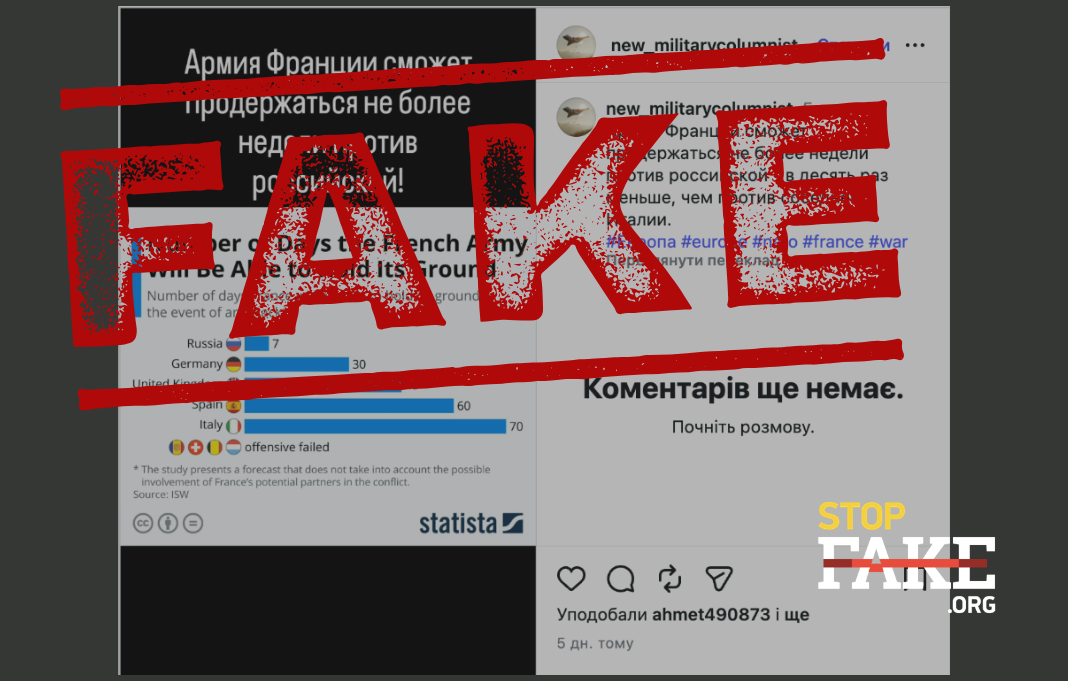
Russian and pro-Russian Telegram channels are circulating an infographic bearing the Statista logo purportedly showing how many days the French army could withstand an attack by various states. According to the image, France would last only seven days against Russia, 30 against Germany, 45 against Britain, 60 against Spain, and 70 against Italy, while Andorra, Switzerland, Belgium, and Luxembourg would allegedly fail in any offensive against France.
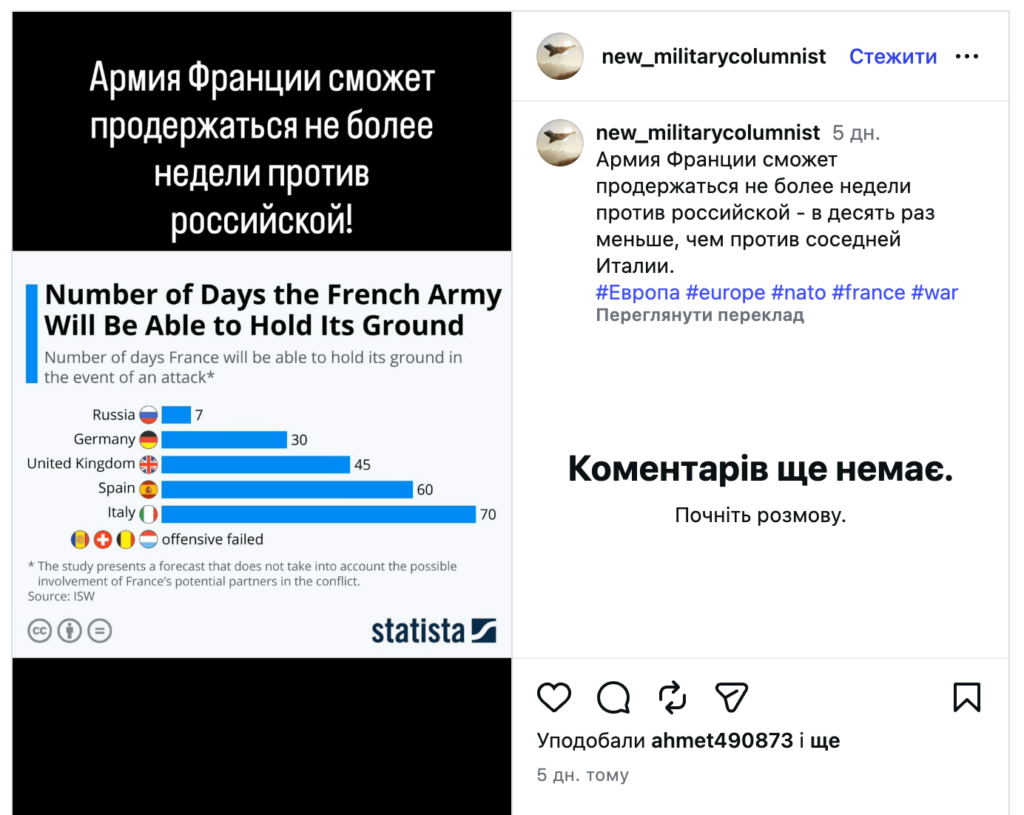
The image cites as its source the ISW — the American Institute for the Study of War. On this basis, propaganda outlets claim that “without allies, France is in trouble” and that the Russian army could defeat France in just one week.
According to the Osavul monitoring system, the image first surfaced on July 15 on the Telegram channel “Gagauz Republic,” after which it began circulating as supposed confirmation of France’s military weakness.
Neither Statista nor ISW has published any such data. A search for the image’s exact English-language title — “Number of Days the French Army Will Be Able to Hold Its Ground” — returns no results on Statista’s official website or among ISW’s research output. The phrase appears almost exclusively in pro-Russian publications and social media videos, circulating without any link to a primary source.
Genuine Statista infographics have their own dedicated page on the website listing the publication date, author, data description, and source. In November 2022, for instance, Statista used ISW data for an infographic on the share of Ukrainian territory liberated from Russian occupation — a page that included the author’s name, publication date, methodological description, and specific data drawn from ISW. The mere combination of the Statista logo and a “Source: ISW” caption does not authenticate an image: the fake’s authors could simply have copied the visual style of genuine platform content. Neither Statista’s archive nor ISW’s publications contain any study comparing the projected duration of France’s defense against Russia, Germany, Britain, Spain, or Italy.
The content of the infographic itself also signals a forgery. It contains no date, author name, study title, publication link, or methodological description, and fails to define what “holding out” means — whether this refers to maintaining control of the entire territory, exhausting specific stockpiles, the defeat of ground forces, or state capitulation. Equally absent is any explanation of what forces, weapons, air power, naval assets, logistics, and type of attack were supposedly factored into the calculation.
The list of potential attackers is itself absurd: Germany, Britain, Spain, Italy, Belgium, and Luxembourg are all France’s NATO allies. French defense is not planned in artificial isolation from those allies — under Article 5 of the North Atlantic Treaty, an armed attack on one member is considered an attack on all, obligating the alliance to respond.
That said, France is genuinely engaged in a debate about its military readiness for a prolonged high-intensity conflict. A 2023 French National Assembly report noted that the war in Ukraine had demonstrated the need to increase ammunition stockpiles, observing that the average annual quantity of modular charges France purchases for training exercises would correspond to roughly one week of intensive consumption at the rates observed in Ukraine. This referred to a specific type of artillery munition and its rate of use — not to the French army or state being capable of fighting for only one week.
The same parliamentary report explicitly stressed that ammunition requirements depend on the duration, intensity, and location of the conflict, the specific adversary, the format of allied participation, and the chosen military strategy. France’s defense model also incorporates naval and air forces, industrial production, nuclear deterrence, and partner interoperability — making it impossible to derive a universal number of days France could resist any given country without a detailed scenario.
To address the identified shortfalls, France is already increasing defense spending. The Military Programming Law for 2024–2030 allocates 413 billion euros for armed forces transformation, stockpile expansion, and preparation for new threats, with an additional 8.5 billion euros directed specifically toward ammunition, according to France’s Ministry of Armed Forces during the program’s 2026 update.
StopFake previously debunked false claims that the French Foreign Ministry confirmed 22,000 French mercenaries are fighting in Ukraine.