
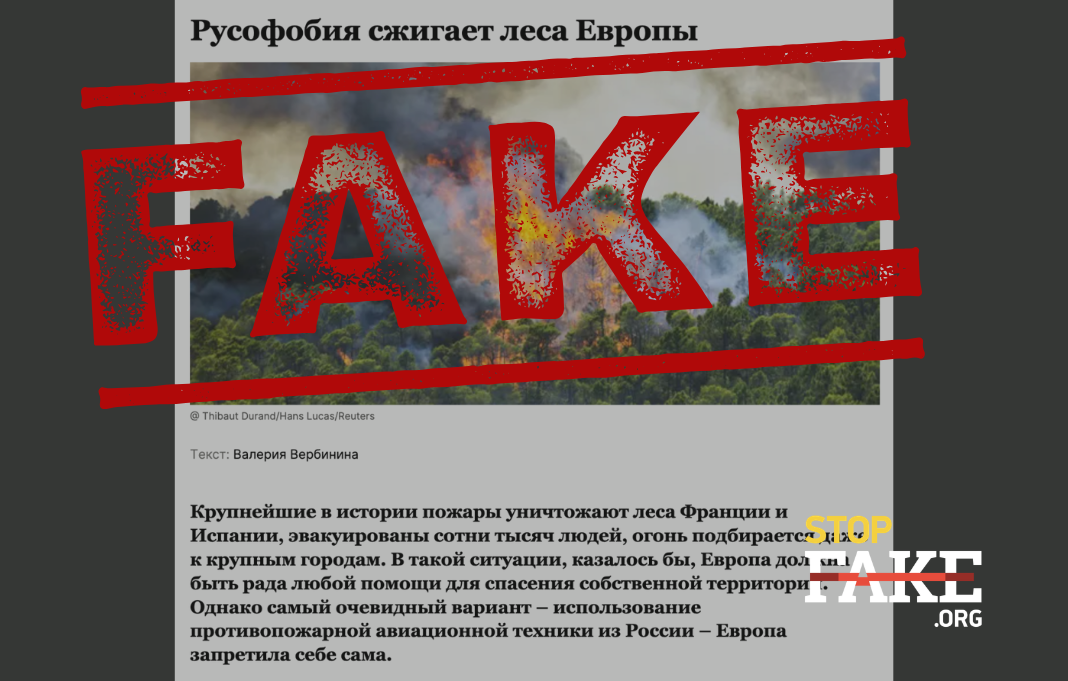
Russian propaganda outlets are circulating claims that the scale of the wildfires in France and Spain was caused by EU sanctions against Russia. Europe, the argument runs, deprived itself of Russian firefighting equipment — Ka-32 helicopters and Be-200 amphibious aircraft — out of “Russophobia,” and is therefore unable to contain the blazes. In reality, the cause of the disaster is record heat and drought amplified by climate change, compounded by decades of neglected forest management. The grounding of eight Ka-32 helicopters — out of roughly 56 aircraft available to Spanish firefighters — due to lack of maintenance and spare parts had no meaningful effect on firefighting operations.
Claims circulating on social media and Russian propaganda outlets hold that the scale of the wildfires in France and Spain was caused by European sanctions against Russia, specifically sanctions targeting manufacturers of Russian firefighting equipment. European countries, the argument goes, have through sanctions and hostility toward Russia deprived themselves of access to Russian firefighting aircraft and helicopters: they cannot buy them, service them, or get them airborne. As a result, this year’s wildfires reached catastrophic proportions. The conclusion such material offers is that the EU “places Russophobia above its own forests and even its own citizens.” The same message is promoted almost verbatim by French Eurosceptic Florian Philippot, leader of Les Patriotes, who accuses Brussels of “stupid Russophobic ideology.”
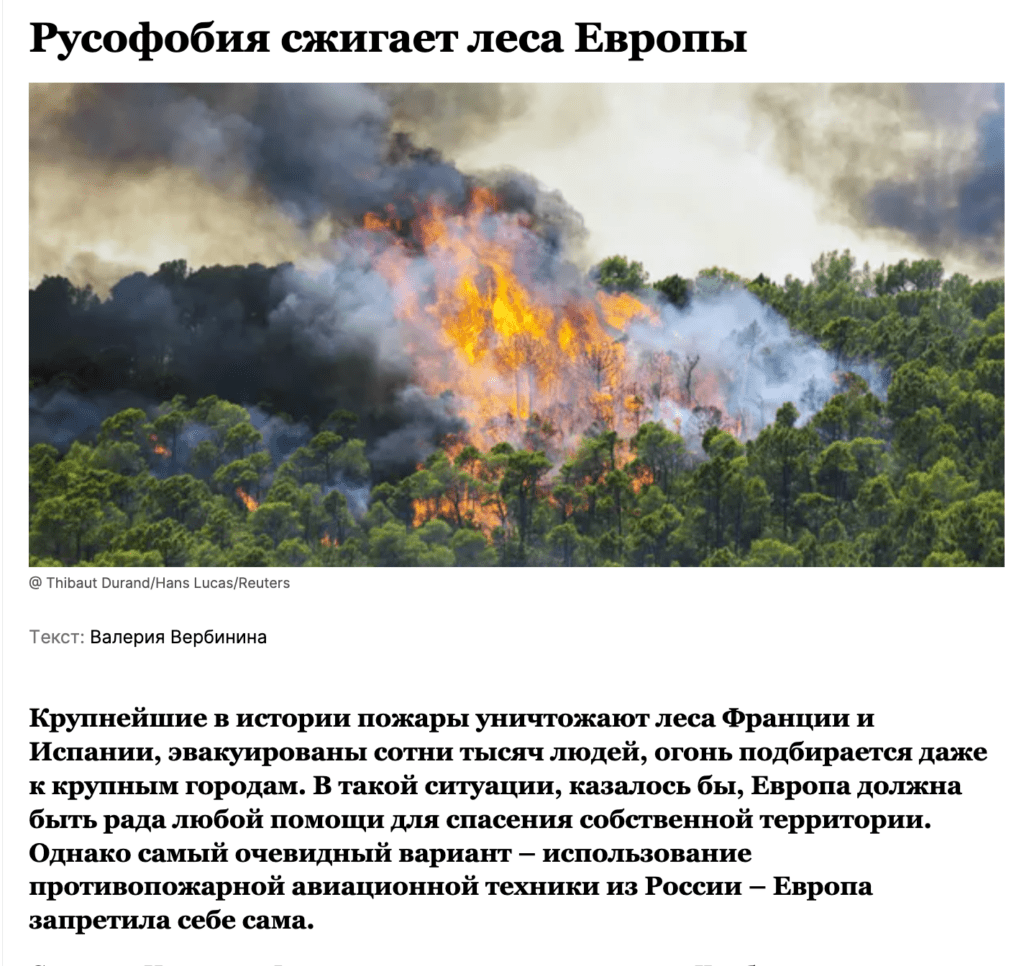
This is a manipulation designed to link sanctions to the fires and cultivate a sense among European audiences that sanctions are costing them lives and property. The actual cause of the 2026 fires is record heat and drought. According to the Copernicus Climate Change Service, June 2026 was the hottest on record in Western Europe. The World Weather Attribution group described the June heatwave as the most severe ever recorded in the region studied. It was precisely this series of heatwaves, with record June temperatures that scientists concluded would have been impossible without the climate crisis, that dried out soils and vegetation and turned them into fuel for this year’s fires.
The scale of the disaster is unprecedented. In France’s Gironde, 220,000 people were evacuated, along with more than 30,000 in the neighboring Landes; the Gironde fire alone destroyed 42,000 hectares, making it one of the largest-area devastations in France since the Second World War. More than 116,000 hectares have burned nationwide since January, compared with 70,000 in all of 2025. In Spain, a fire in the mountainous terrain of Ávila west of Madrid became the largest in the country’s history at 50,000 hectares; together with a second fire northwest of the capital, the scorched area near Madrid reached 70,000 hectares. In total, the Spanish government reported 172,000 hectares of woodland destroyed this year — six times last year’s figure. In southern Spain, a fire claimed at least 13 lives: according to a European Commission representative, the flames advanced at roughly 6.5 kilometers per hour, while firefighters are capable of responding to fires moving no faster than 300 meters per hour.
It is climate change, not sanctions against Russia, that is driving fire intensity to levels that existing firefighting resources physically cannot handle. Spanish specialists interviewed by Infobae identify the climate crisis, rural depopulation, and the state of forest management as the principal causes — sanctions do not appear on the list. Cristina Santín of the Joint Institute for Biodiversity Research (CSIC–University of Oviedo) explained the mechanism behind this year’s catastrophe: a very wet winter produced abundant vegetation, after which a relatively dry spring and an extremely dry June rapidly stripped away the remaining moisture, while three intense heatwaves already recorded this summer helped spread the flames. Forestry engineer Valentín Gómez Mampaso, a spokesman for Spain’s Institute of Engineering, goes so far as to call his country the best-prepared in the world for fighting wildfires, but stresses that climate change and biomass accumulation are making forests increasingly dangerous. The central argument of the Infobae article is that however effective prevention may be, the risk of major fires continues to grow: vegetation is accumulating as traditional rural land use declines, and because of climate change it spends more days per year primed to burn.
In France, natural and land-use factors also affected the speed at which the fires spread. According to World Weather Attribution, more than 800,000 hectares of the Landes de Gascogne, where the fires originated, are covered by densely planted maritime pine monocultures. Such forests burn with particular ease, because flames move quickly from the ground into the canopy and then travel along the treetops. The Gironde fire also generated a pyrocumulonimbus — a storm cloud created by the fire itself. Superheated air and smoke rise and form a cloud that produces lightning and gusting winds, which in turn drive the flames and ignite new outbreaks. The same report shows that during the worst week of the season, the fire danger index in southwestern France was roughly 46% higher than it would have been in a climate without human-caused warming, and that the likelihood of such conditions has at least doubled. In central Spain, equally extreme conditions have become at least 20 times more likely.
Two sets of factors are hampering firefighting efforts, and neither has anything to do with Russia. The first is the sheer scale. Dozens of fires burning simultaneously disperse resources, leaving firefighters and military personnel working at the limit of their capacity and unable to contain blazes before the next heatwave arrives. The second is structural problems accumulated over decades: neglected forest management, the buildup of biomass fuel, rural depopulation, and aging national air fleets. With fires on this scale, Spanish specialists openly acknowledge that the objective is no longer to extinguish everything, but to protect settlements and establish control lines.
The condition of both countries’ air fleets is a separate matter. Aircraft are indeed in short supply — but for reasons unrelated to Russia. In May 2026, Spain announced the largest deployment of state resources in its history: 56 aircraft. Yet just two months later, at the worst moment of the season, three of ten heavy water-bombing seaplanes were grounded due to wear, while a 2022 contract to modernize the remaining amphibious aircraft had sat blocked for four years over a mundane shortage of technical documentation — a matter with no connection to Russia whatsoever, as La Repubblica notes. The picture in France is similar: of twelve Canadair aircraft, only five were operational at the height of the fires, owing to incomplete maintenance and delays in spare parts deliveries. Paris ordered two new Canadairs in June 2026 to bring the fleet to sixteen, but delivery within a few years is impossible, as the Canadian supplier’s production capacity is limited. It is important to stress, however, that aviation is decisive only in the first hours, before an ignition has grown into a major fire. Sixth-generation fires, which generate their own weather systems, cannot be fought from the air at all, and even the most modern fleet cannot compensate for decades of forest neglect.
The disinformation campaign is built around a genuine fact: Spain does own Russian Ka-32 helicopters that are sitting idle because of sanctions. This much is true — spare parts deliveries ceased in 2022, and in February 2024 the European Union Aviation Safety Agency withdrew the certificate permitting these aircraft to fly in the EU, after other Kamov models were used in the war against Ukraine. Building on this fact, Russian propaganda constructs a causal chain: Europe is burning because it rejected Russian equipment on ideological grounds. But the propaganda omits three important circumstances. First, this concerns eight aircraft out of roughly 56 deployed by the state in the firefighting campaign. Second, the Spanish government has still not submitted a formal exemption request to Brussels, even though EU legislation permits such requests on grounds of public interest or strategic security. Third, no study exists attributing the burned hectares to the absence of the Ka-32: calculating how many hectares would have been saved is impossible, and any figure in circulation is an invention.
A separate layer of manipulation is the claim that Russian equipment is “irreplaceable.” Propaganda supports this by citing Spain’s own Ministry of Ecology, which supposedly acknowledged that the Ka-32 “has no substitute” on the market. In fact, the wording in the public contract justification is narrower: no helicopters exist with an equivalent price-to-capability ratio. Aircraft with comparable or greater payload capacity exist and operate worldwide — the American Sikorsky S-64 Skycrane, for instance, carries roughly 10,000 liters against the Ka-32’s 4,500. Forest services in Italy and South Korea have purchased such helicopters. The Spanish defense publication Revista Ejércitos, reviewing Ka-32 replacement options, counted at least six American operators of heavy firefighting helicopters whose services states routinely contract during summer campaigns.
The case of the Be-200 amphibious aircraft is more telling still. Propaganda claims Russia possesses a fleet of these aircraft that Europe refuses to operate out of “Russophobia,” while deliberately omitting the state of that “fleet.” Engines for the Be-200 were developed and manufactured by Ukraine’s Ivchenko-Progress together with Zaporizhzhia’s Motor Sich, and deliveries to Taganrog ceased back in 2014, following the annexation of Crimea. Production of the remaining aircraft halted after a Ukrainian drone strike in March 2024, and the roughly fourteen aircraft still operated by Russia’s Emergencies Ministry and naval aviation are suffering from a shortage of spare parts. Russia’s “unique” firefighting aviation has not been produced for several years — precisely because of the war Russia launched against the country that made its engines.
Russian propaganda thus asserts that EU sanctions and “Russophobia” burned the forests of France and Spain, and that Brussels deliberately chose ideology over the lives of its own citizens. The facts show otherwise. The principal cause of the disaster is the hottest June on record in Western Europe and the most severe heatwave ever documented — one that would have been impossible in the climate of 50 years ago. Sixth-generation fires, which generate their own weather, cannot be attacked directly by any deployment of resources. The grounding of the Ka-32s is real, but amounts to 8 aircraft out of roughly 56. Madrid never submitted an exemption request to Brussels, and any figure for “hectares saved” is an invention by the admission of Spanish sources themselves. Russia’s Be-200, meanwhile, which propaganda presents as unique, has not been produced since 2024, and the existing fleet is hobbled by a shortage of spare parts because it depends on Ukrainian engines.
This manipulation follows a recognizable pattern: a true detail is presented first, and a generalization that does not follow from it is then derived. One specific detail — the grounding of Spain’s Ka-32s — is entirely accurate, and it is precisely this that makes the whole construction persuasive. From there, a nonexistent causal link is extrapolated: that sanctions, rather than the climate and the state of the forests, determined the scale of the disaster. The European External Action Service, through its EUvsDisinfo project, describes this tactic as a “wedge”: the Kremlin uses climate disasters to inject skepticism about sanctions into public debate in European countries. The campaign bears all the hallmarks of a coordinated information and psychological operation: a disinformation thesis picked up by European pro-Russian politicians and amplified through a network of “mirrors” in local languages. The goal is not to explain the fires, but to cultivate a sense among European audiences that sanctions are costing them lives and property.
Russian propagandists previously manipulated the subject of the California wildfires in similar fashion. StopFake debunked claims that the Los Angeles fires could not be extinguished because all the equipment had been given to Ukraine, as well as claims that eight Ukrainian generals’ cottages had burned in those fires.