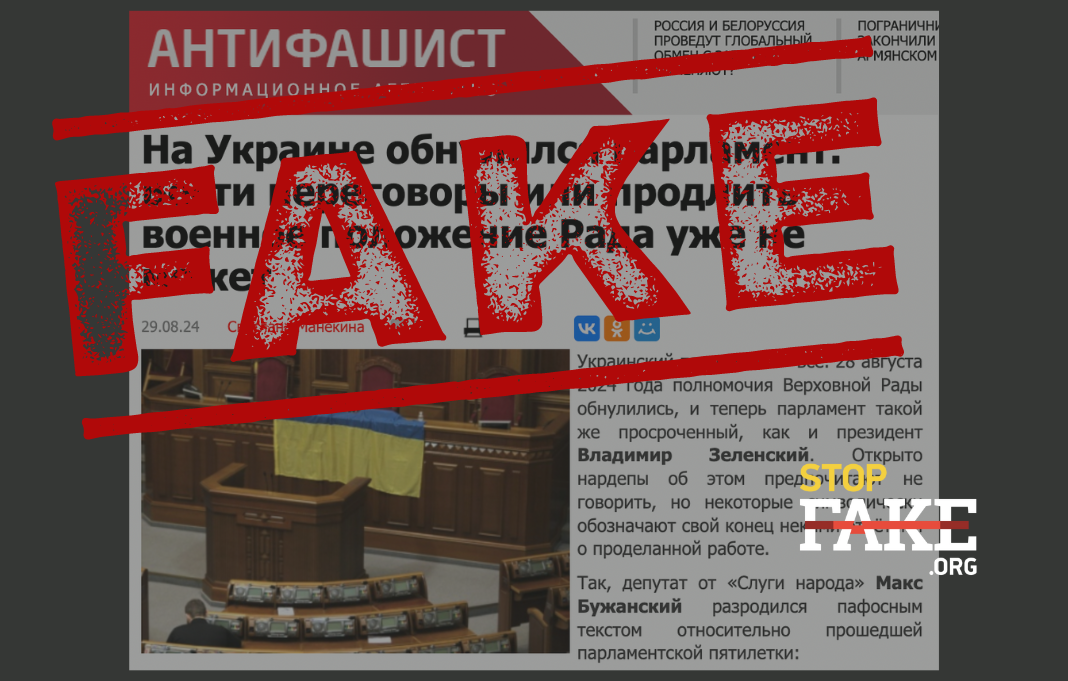
Updated version (October 2026) – supplemented with evidence from StopFake, the election observation network OPORA, the Atlantic Council, the presidential decree on martial law, and new academic literature (see footnotes and bibliography).
The claim that President Volodymyr Zelenskyy has held office “illegally” since 20 May 2024 because no presidential elections were held is unfounded under constitutional and international law. It ignores Ukrainian constitutional law, the law on martial law, and the practice of democratic states – and serves solely to delegitimize Ukraine’s negotiating leadership. The accompanying claim that Ukrainians themselves regard Zelenskyy as a “usurper” is likewise clearly refuted by polling data.
Since 2024, the accusation has been spread primarily by Russian state media and pro-Kremlin channels. In August 2025, Foreign Minister Sergey Lavrov took it up: under the Ukrainian constitution, he claimed, Zelenskyy was “at the moment” not legitimate and therefore could not sign any peace documents.1 Earlier, the propaganda had already extended the narrative to parliament – the Verkhovna Rada, too, had allegedly lost its legitimacy, leaving “no one to negotiate with.”2 In doing so, the propaganda invokes the very Ukrainian constitution whose unambiguous provisions it conceals. Pro-Kremlin messaging typically frames the accusation as follows:
“Zelenskyy has been a usurper since May 2024. The constitution says: five years in office – no exceptions. Because he refuses to hold elections, he rules illegally.”
Evidence (documented example): EUvsDisinfo, Disinfo Report “Zelenskyy is illegitimate, his official term expired in May 2024”: https://euvsdisinfo.eu/report/zelenskyy-is-illegitimate-his-official-term-expired-in-may-2024/
“A president without an election is a dictator. The West, which always speaks of democracy, accepts this coup against its own constitution.”
Evidence (documented example): EUvsDisinfo, Disinfo Report “Zelenskyy is not legitimate according to the Ukrainian constitution”: https://euvsdisinfo.eu/report/zelenskyy-is-not-legitimate-according-to-the-ukrainian-constitution/
“When we come to a stage when you have to sign documents, we would need a very clear understanding by everybody that the person who is signing is legitimate. And according to the Ukrainian constitution, Mr. Zelenskyy is not at the moment.” – Sergey Lavrov, NBC News, 24 August 2025
Evidence (documented example): Atlantic Council, “Russia attacks Zelenskyy’s legitimacy to derail US-led Ukraine peace talks”, 28 August 2025: https://www.atlanticcouncil.org/blogs/ukrainealert/russia-attacks-zelenskyys-legitimacy-to-derail-us-led-ukraine-peace-talks/
“The Ukrainian parliament, too, has lost its legitimacy; even the martial law it imposed should be considered illegal.”
Evidence (documented example): StopFake, “Fake: Ukrainian Parliament Has Lost Its Legitimacy”, 3 September 2024: https://www.stopfake.org/en/fake-ukrainian-parliament-has-lost-its-legitimacy/
“Ukrainians themselves consider Zelenskyy a usurper.”
Evidence (documented example): StopFake, “Fake: Ukrainians Believe Zelenskyy Is ‘Usurper’”, 22 May 2024: https://www.stopfake.org/en/fake-ukrainians-believe-zelenskyy-is-usurper/
Refutation:
1. What the constitution actually stipulates
The Ukrainian constitution is unambiguous on this question. Article 103 provides for a five-year term – but Article 108 stipulates that the president exercises his powers “until the assumption of office by the newly elected president.” The term therefore does not end on a calendar date but with the swearing-in of a successor. At the parliamentary level, Article 83(4) expressly extends the mandate of the Verkhovna Rada until the first session of a new Rada elected after martial law is lifted. Parliamentary Speaker Ruslan Stefanchuk pointed out that Article 108 clearly regulates when presidential powers end and that the law on martial law ensures that all state authorities continue to operate until martial law is lifted.3 Both provisions are binding law, not a matter of interpretation: in wartime, the legal continuity of the state is constitutionally guaranteed, not suspended.
The Ukrainian election observation network OPORA has summarized the legal situation in five arguments: First, the principle of continuity and succession of state power runs through the entire constitution (Articles 83, 108 and 115). Second, Leonid Kuchma had already exercised presidential powers after his regular term expired at the end of 2004, until Viktor Yushchenko’s inauguration on 23 January 2005. Third, Article 19 of the law on martial law supplements the constitution by prohibiting presidential elections while martial law is in force. Fourth, the chairman of the Verkhovna Rada may serve as acting president only in the event of early termination of presidential powers (resignation, incapacity for health reasons, impeachment, death) – and then only with limited competences. Fifth, binding interpretation rests solely with the Constitutional Court of Ukraine.4
The legal literature confirms this reading: continuing in office until a successor is elected is regarded as a constitutional guarantee of state continuity, and postponing the elections is compatible with national law and international electoral standards alike.5 Constitutional practice adds to this: no Ukrainian president has ever served exactly five years; terms have always varied with election and inauguration schedules. A co-author of the 1996 constitution summed up the legal situation in The Economist: “Zelenskyy continues in power for as long as martial law applies. There is no political or legal crisis. Full stop.”6
2. Martial law and the ban on elections
On 24 February 2022, the day of Russia’s full-scale invasion, President Zelenskyy issued Decree No. 64/2022 “On the Imposition of Martial Law in Ukraine”; the Verkhovna Rada approved it the same day with 300 votes. The decree expressly rests on the law “On the Legal Regime of Martial Law.”7 This law (Art. 19) and the Election Code simply prohibit holding elections while martial law is in force. The background is not only the legal norm but physical impossibility: millions of citizens are displaced within the country or have fled abroad, soldiers serve at the front, voter registers cannot be updated, and polling stations would be targets of Russian attacks. An election under bombardment would strip millions of their right to vote instead of protecting it. International electoral standards likewise require a peaceful political environment, the full realization and comprehensive protection of all freedoms and human rights, and guarantees of public order and security – conditions that cannot be met during active hostilities.8
The European legal community supports this position as well: the Council of Europe has affirmed that postponing elections in exceptional situations such as a state of war may be necessary to preserve constitutional order and to allow citizens to express their will in safety. Historical precedents exist, too: the United Kingdom postponed scheduled parliamentary elections during both world wars.9 Political science research confirms the restraint: prematurely scheduled elections in conflict and immediate post-conflict situations demonstrably increase the risk of renewed violence; democracies have repeatedly postponed elections in emergencies – most recently during the COVID-19 pandemic – in order to protect the integrity of the electoral process and fundamental political rights.10
3. Checks and balances instead of one-man rule
Zelenskyy’s powers are neither unlimited nor uncontrolled: every extension of martial law requires the approval of the Verkhovna Rada, which continues to convene, debate, and pass legislation during the war. The Constitutional Court can review the legality of all measures – upon petition by the president, at least 45 members of parliament, the Supreme Court, the parliamentary commissioner for human rights, or the Verkhovna Rada of the Autonomous Republic of Crimea. The opposition is represented in parliament, critical media report, and the government is held publicly to account – most recently in the disputes over the independence of the anti-corruption agencies. Zelenskyy’s current authority therefore rests not on personal decree but on a functioning, albeit war-shaped, democratic system.11
4. Refuted: “Ukrainians themselves consider Zelenskyy a usurper”
The propaganda’s accompanying claim that the Ukrainian population regards its president as a “usurper” is false. Despite declining approval ratings, support for Zelenskyy remains above 60 percent, according to a survey by the Rating Group; the same study shows that a clear majority of Ukrainians oppose holding elections during the war.12 The Razumkov Center recorded a share of 59 percent in June 2024 who take a negative view of holding national elections before the end of the war; in 2023 the figure was 64 percent. More than 100 civil society organizations declared in a joint statement that elections and full-scale war are incompatible. In a December 2023 survey, 69 percent favored Zelenskyy remaining in office until martial law ends. The figure circulated by Russian officials – that only 17 percent of Ukrainians consider Zelenskyy legitimate – is, by contrast, not corroborated by any independent survey.13
5. International recognition
The international community recognizes Zelenskyy without reservation as the legitimate president. The European Commission stated that it has “no doubts the president of Ukraine is Volodymyr Zelenskyy.” German Foreign Minister Annalena Baerbock emphasized during her visit to Kyiv on 21 May 2024 that Zelenskyy is the “rightful and legitimate president of Ukraine”: “Those who speculate on Zelenskyy’s ‘illegitimacy’ after May 21, especially those who started this war, are playing a cunning game and promoting false narratives to the world.” At the same time, she pointed out that the constitutions of many states – including the German Basic Law – prohibit elections under martial law or provide for new elections only after the end of a state of defence.14
The propaganda’s argumentative reversal is striking: Moscow criticizes Ukraine’s constitutional order while simultaneously staging “elections” for Russian presidential and parliamentary ballots in the occupied territories of Ukraine, which the European Union condemned as illegitimate; the European Parliament expressly refused to recognize the 2024 Russian presidential election in a resolution.15 The purpose of the narrative is obvious: a negotiating partner declared “illegal” is to be pushed out of peace talks, and a Ukrainian capitulation sold as a “solution.”
6. The pattern: delegitimizing Ukrainian elections since 2019
The narrative follows a documented pattern. As early as January 2019 – months before election day – Russian state media declared Ukraine’s presidential election of 31 March 2019 “illegitimate” after the Ukrainian Central Election Commission, for security reasons, closed the five polling stations at the embassy and consulates in Russia and relocated them to Georgia, Kazakhstan, and Finland. Foreign Minister Pavlo Klimkin justified the move with the safety of voters and noted that of the roughly 2.5 million Ukrainians living in Russia, only 49,418 were registered to vote in the 2014 election and only 1,134 actually cast a ballot. In 2024 the delegitimization of the president followed, in September 2024 that of parliament, and in August 2025 Lavrov’s move with an eye to the peace talks. Mykhailo Podolyak, adviser to the head of the Presidential Office, names the campaign’s goal: to sow doubts about the legitimacy of the Ukrainian leadership among Western partners, to weaken Western support, and to suggest hopelessness to the Ukrainian population. Scholarly analysis of Russian strategic narratives confirms that delegitimizing Ukrainian statehood and leadership is a central, recurring element of Russia’s information campaign; Zelenskyy’s own discursive legitimation has meanwhile also become a subject of research.16
Conclusion:
The legitimacy claim collides with the Ukrainian constitution (Art. 108), with the law on martial law, and with the practice of democratic states that suspend elections in war and emergencies. It conceals that the election ban serves to protect the right to vote, ignores the continuing parliamentary and constitutional-court controls, and is refuted by opinion research: a clear majority of Ukrainians reject elections under martial law and recognize Zelenskyy as the legitimate president. To declare Zelenskyy a “usurper” while his country defends itself against a war of aggression is not constitutional criticism – it is delegitimization as an instrument of war, following a pattern that StopFake documented as early as 2019.
__________________________
- Atlantic Council (2025): Savelii, Serhii: Russia attacks Zelenskyy’s legitimacy to derail US-led Ukraine peace talks, 28 August 2025 (Lavrov interview with NBC News, 24 August 2025; earlier, Putin had declared that Zelenskyy “has no right to sign anything”). URL: https://www.atlanticcouncil.org/blogs/ukrainealert/russia-attacks-zelenskyys-legitimacy-to-derail-us-led-ukraine-peace-talks/ ↩︎
- StopFake (2024): Fake: Ukrainian Parliament Has Lost Its Legitimacy, 3 September 2024. URL: https://www.stopfake.org/en/fake-ukrainian-parliament-has-lost-its-legitimacy/ ↩︎
- Constitution of Ukraine (1996), Art. 83(4), 103, 108; Ruslan Stefanchuk quoted in StopFake (2024): Fake: Ukrainians Believe Zelenskyy Is «Usurper», 22 May 2024. URL: https://www.stopfake.org/en/fake-ukrainians-believe-zelenskyy-is-usurper/ ↩︎
- OPORA (2024): On the Legitimacy of the President of Ukraine Volodymyr Zelenskyy, 6 June 2024 (principle of continuity; the Kuchma precedent 2004/05; role of the parliamentary speaker; jurisdiction of the Constitutional Court; the “17 percent” figure circulated by Russia is named there as a propaganda element). URL: https://oporaua.org/en/vybory/on-the-legitimacy-of-the-president-of-ukraine-volodymyr-zelenskyy-25269 ↩︎
- Murska, Mariia (2024): The Role of the Constitutional Court of Ukraine in Ensuring the Legitimacy of the Parliament and President’s Power. Baltic Journal of Legal and Social Sciences, 2024. URL: http://www.baltijapublishing.lv/index.php/bjlss/article/view/2525; Buchyn, Mykola / Zavada, Yaryna (n.d.): The Feasibility and Necessity of Holding Elections in Ukraine During the Russian-Ukrainian War: A Legal Analysis. Prawo i Wież. URL: https://prawoiwiez.edu.pl/index.php/piw/article/download/1348/1014 ↩︎
- Atlantic Council (2025), op. cit. (constitutional practice; quote from a co-author of the 1996 constitution in The Economist). ↩︎
- Atlantic Council (2025), op. cit. (constitutional practice; quote from a co-author of the 1996 constitution in The Economist). ↩︎
- StopFake (2024): Fake: Ukrainian Parliament Has Lost Its Legitimacy, op. cit. (international electoral standards). ↩︎
- Atlantic Council (2025), op. cit. (Council of Europe position; British precedents in both world wars). ↩︎
- Brancati, Dawn / Snyder, Jack L. (2013): Time to Kill: The Impact of Election Timing on Postconflict Stability. Journal of Conflict Resolution 57(5). DOI: 10.1177/0022002712449328; Landman, Todd / Di Gennaro Splendore, Luca (2020): Pandemic Democracy: Elections and COVID-19. Journal of Risk Research 23(7–8). ↩︎
- Atlantic Council (2025), op. cit. (parliamentary approval of each extension of martial law; review powers of the Constitutional Court); petitioners according to OPORA (2024), op. cit.; on accountability under martial law see Otamas, P. (2026): Democracy under Fire: Rhetorical Accountability and Wartime Governance in Ukraine. Post-Soviet Affairs. DOI: 10.1080/1060586X.2026.2733263. ↩︎
- StopFake (2024): Fake: Ukrainians Believe Zelenskyy Is «Usurper», op. cit. (Rating Group: above 60 percent; majority opposed to elections during the war); on the December 2023 survey (69 percent) see Melnykovska, Inna (2026): Representative without, Participatory within: The ‘Trump Effect’ and Democracy in Ukraine. European University Institute. URL: https://cadmus.eui.eu/entities/publication/e5c4964f-b00b-4884-a71f-d278f46e11c0 ↩︎
- StopFake (2024): Fake: Ukrainian Parliament Has Lost Its Legitimacy, op. cit. (Razumkov Center, June 2024: 59 percent; 2023: 64 percent; statement by more than 100 civil society organizations); OPORA (2024), op. cit. (on the circulated “17 percent” figure). ↩︎
- Annalena Baerbock quoted in StopFake (2024): Fake: Ukrainians Believe Zelenskyy Is «Usurper», op. cit.; on the reference to the German Basic Law see Euromaidan Press, 21 May 2024. URL: https://euromaidanpress.com/2024/05/21/baerbock-reaffirms-germanys-support-for-zelenskyy-as-president-of-ukraine/; European Commission (Peter Stano) quoted in Atlantic Council (2025), op. cit. ↩︎
- European Parliament, resolution on the non-recognition of the Russian presidential elections in the occupied Ukrainian territories (spring 2024); for a summary see Rubryka (2024): Volodymyr Zelensky’s illegitimacy: fact or myth? URL: https://rubryka.com/en/article/nelegitymnist/; on the purpose of the narrative see Atlantic Council (2025), op. cit. ↩︎
- StopFake (2019): Fake: Ukrainian Presidential Elections Will be Illegitimate, 8 January 2019. URL: https://www.stopfake.org/en/fake-ukrainian-presidential-elections-will-be-illegitimate/; Mykhailo Podolyak quoted in StopFake (2024): Fake: Ukrainians Believe Zelenskyy Is «Usurper», op. cit.; scholarly assessment: Sazonov, Vladimir / Sägi, Janika / Karin, Yurii / Veebel, Viljar (2026): Russia’s Total War Against Ukraine and Lessons for the Baltic States: Russian Influence Activities and Strategic Narratives during the Russo-Ukrainian War 2022–2025. Cham: Springer. URL: https://link.springer.com/chapter/10.1007/978-3-032-31586-1_4; Tomczak-Boczko, Joanna / Goloshchuk, Serhii (2025): “The President is Here”: Legitimation Strategies in the Discourse of President Zelenskyy after 24 February 2022. Przegląd Politologiczny. URL: https://www.ceeol.com/search/article-detail?id=1380973 ↩︎
Further reading
Academic monographs and edited volumes
Wilson, Andrew (2021): Russia’s War on Everybody. London: Bloomsbury.
Sasse, Gwendolyn (2022): Der Krieg gegen die Ukraine. Hintergründe, Ereignisse, Folgen. München: C.H. Beck.
Minakov, Mikhail (2024): From Servant to Leader: Chronicles of Ukraine under the Zelensky Presidency, 2019–2024 (Ukrainian Voices). Stuttgart: ibidem-Verlag. URL: https://www.ibidem.eu/out/media/booksonix_9783838220024_1.pdf
Academic journal articles (newly added)
Murska, Mariia (2024): The Role of the Constitutional Court of Ukraine in Ensuring the Legitimacy of the Parliament and President’s Power. In: Baltic Journal of Legal and Social Sciences, 2024. URL: http://www.baltijapublishing.lv/index.php/bjlss/article/view/2525
Buchyn, Mykola / Zavada, Yaryna (o. J.): The Feasibility and Necessity of Holding Elections in Ukraine During the Russian-Ukrainian War: A Legal Analysis. In: Prawo i Wież. URL: https://prawoiwiez.edu.pl/index.php/piw/article/download/1348/1014
Brancati, Dawn / Snyder, Jack L. (2013): Time to Kill: The Impact of Election Timing on Postconflict Stability. In: Journal of Conflict Resolution 57(5). DOI: 10.1177/0022002712449328
Landman, Todd / Di Gennaro Splendore, Luca (2020): Pandemic Democracy: Elections and COVID-19. In: Journal of Risk Research 23(7–8).
Melnykovska, Inna (2026): Representative without, Participatory within: The ‘Trump Effect’ and Democracy in Ukraine. European University Institute. URL: https://cadmus.eui.eu/entities/publication/e5c4964f-b00b-4884-a71f-d278f46e11c0
Otamas, P. (2026): Democracy under Fire: Rhetorical Accountability and Wartime Governance in Ukraine. In: Post-Soviet Affairs. DOI: 10.1080/1060586X.2026.2733263
Tomczak-Boczko, Joanna / Goloshchuk, Serhii (2025): „The President is Here“: Legitimation Strategies in the Discourse of President Zelenskyy after 24 February 2022. In: Przegląd Politologiczny. URL: https://www.ceeol.com/search/article-detail?id=1380973
Sazonov, Vladimir / Sägi, Janika / Karin, Yurii / Veebel, Viljar (2026): Russia’s Total War Against Ukraine and Lessons for the Baltic States: Russian Influence Activities and Strategic Narratives during the Russo-Ukrainian War 2022–2025. Cham: Springer. URL: https://link.springer.com/chapter/10.1007/978-3-032-31586-1_4
Reports, legal analyses and legal sources
Constitution of Ukraine (1996): Art. 83, 103, 108, 115; Law of Ukraine “On the Legal Regime of Martial Law” (2015), Art. 19 (ban on elections).
Decree of the President of Ukraine No. 64/2022 “On the Imposition of Martial Law in Ukraine”, 24 February 2022. URL: https://www.president.gov.ua/en/news/prezident-pidpisav-ukaz-pro-zaprovadzhennya-voyennogo-stanu-73109
OPORA (2024): On the Legitimacy of the President of Ukraine Volodymyr Zelenskyy, 6. Juni 2024. URL: https://oporaua.org/en/vybory/on-the-legitimacy-of-the-president-of-ukraine-volodymyr-zelenskyy-25269
Atlantic Council (2025): Savelii, Serhii: Russia attacks Zelenskyy’s legitimacy to derail US-led Ukraine peace talks, 28. August 2025. URL: https://www.atlanticcouncil.org/blogs/ukrainealert/russia-attacks-zelenskyys-legitimacy-to-derail-us-led-ukraine-peace-talks/
EUvsDisinfo (2025): Disinfo Report „Zelensky, who is head of a quasi-failed state, lacks the legal authority to sign peace agreements“. URL: https://euvsdisinfo.eu/report/zelensky-who-is-head-of-a-quasi-failed-state-lacks-the-legal-authority-to-sign-peace-agreements/
Fact-checking portals and analyses
StopFake (2024): Fake: Ukrainians Believe Zelenskyy Is «Usurper», 22. Mai 2024. URL: https://www.stopfake.org/en/fake-ukrainians-believe-zelenskyy-is-usurper/
StopFake (2024): Fake: Ukrainian Parliament Has Lost Its Legitimacy, 3. September 2024. URL: https://www.stopfake.org/en/fake-ukrainian-parliament-has-lost-its-legitimacy/
StopFake (2019): Fake: Ukrainian Presidential Elections Will be Illegitimate, 8. Januar 2019. URL: https://www.stopfake.org/en/fake-ukrainian-presidential-elections-will-be-illegitimate/
StopFake – Ukrainian fact-checking organisation (English-language section). URL: https://www.stopfake.org/en/
EUvsDisinfo (2025): Zelenskyy is not legitimate according to the Ukrainian constitution. URL: https://euvsdisinfo.eu/report/zelenskyy-is-not-legitimate-according-to-the-ukrainian-constitution/
EUvsDisinfo: Disinfo Report „Zelenskyy is illegitimate, his official term expired in May 2024“. URL: https://euvsdisinfo.eu/report/zelenskyy-is-illegitimate-his-official-term-expired-in-may-2024/
Rubryka (2024): Volodymyr Zelensky’s illegitimacy: fact or myth? URL: https://rubryka.com/en/article/nelegitymnist/
Delfi (2025): Fact check: Will Zelenskyy not hold elections to stay in power? No, the law forbids elections during a state of martial law, 21. April 2025. URL: https://www.delfi.ee/artikkel/120372039/fact-check-will-zelenskyy-not-hold-elections-to-stay-in-power-no-the-law-forbids-elections-during-a-state-of-martial-law
This fact-check is part of the research project ‘Identifying and Combating Russia’s Propaganda’ (ICORPD), which is funded by the Federal Foreign Office as part of the Eastern Partnership programme.
Supported by: