
The Commander-in-Chief’s official page has denied the reports: members of Mykhailo Drapatyi’s family have made no public statements and have not authorized anyone to speak on their behalf. An analysis of the fake’s spread using the Osavul system found two waves of posts, launched by suspicious Facebook pages and amplified by mass cross-posting into political, regional and unrelated groups.
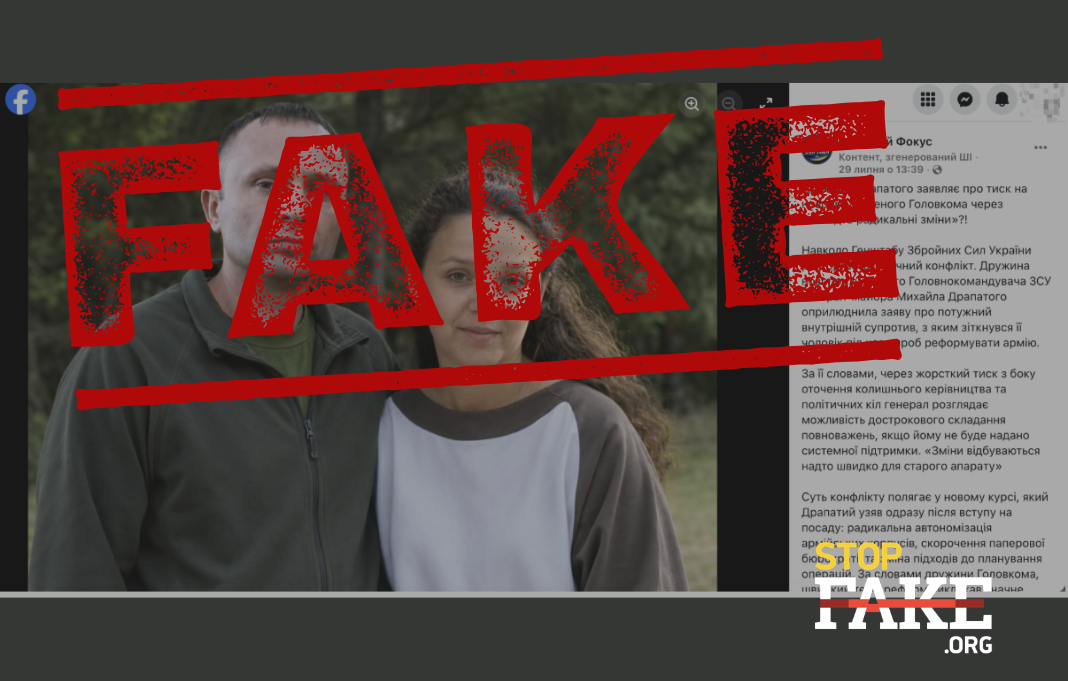
A post circulating in the Ukrainian segment of Facebook claims that the wife of Ukraine’s Commander-in-Chief, Mykhailo Drapatyi, has spoken of “powerful internal resistance” to her husband’s reforms. The post asserts that the general is under pressure from allies of the previous military leadership and from figures in the president’s political circle, and that Drapatyi is weighing an early departure from the post.
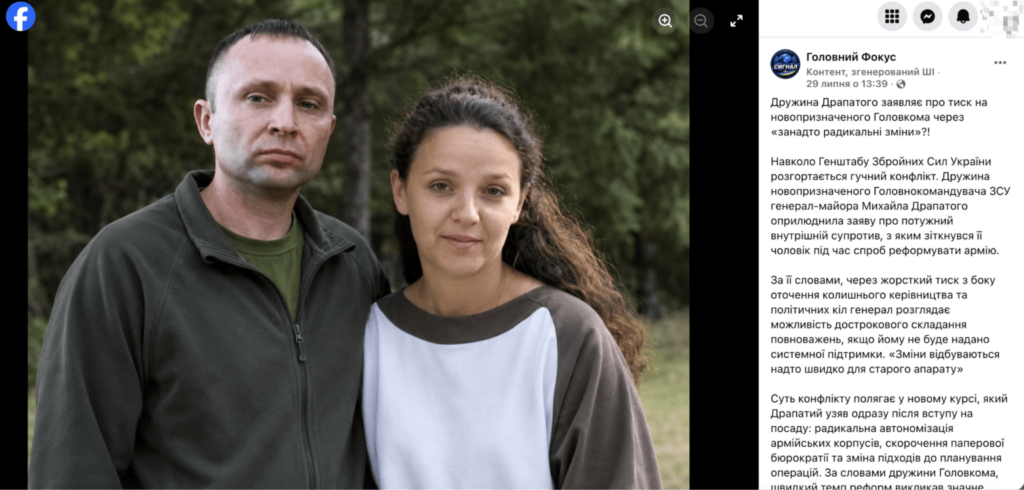
The information is untrue. The authors of the post cite no link to an original statement, to the page of the Commander-in-Chief’s wife, to an interview, a video or any other source from which the quote attributed to her might have been drawn. Even so, the text is styled as a full news item: it describes a purported conflict, supplies details of closed-door discussions and carries extensive direct quotation attributed to Drapatyi’s wife.
On Aug. 17, Drapatyi published a statement on his official Facebook page directly refuting the reports being circulated in his family’s name.
“Members of my family do not make public statements, do not give official comments and have not authorized anyone to speak on their behalf,” the Commander-in-Chief said.
Drapatyi also said that some of the information attacks on the military leadership are coordinated and involve bot networks, and that their aim is to sow distrust within the state and between the army and society. A day earlier, the Center for Countering Disinformation under Ukraine’s National Security and Defense Council likewise reported that there was no evidence the “wife’s statement” was authentic.
For context: Volodymyr Zelensky announced his decision to appoint Mykhailo Drapatyi Commander-in-Chief of the Armed Forces on July 21, 2026. The appointment was formalized the following day by presidential decree No. 630/2026.
The new military leadership was tasked with modernizing the army’s command structure, continuing the corps-system reform, developing military technology and supplying combat units with weapons, drones and necessary equipment. On July 22, Drapatyi assumed the duties of Commander-in-Chief and presented the team he would be working with.
StopFake analyzed the post’s spread using data from the Osavul monitoring system and identified 400 unique posts, 393 of them on Facebook. The earliest post detected appeared on July 29 — just a week after the official appointment. It was published by a page called Holovnyi fokus.
The page is suspect on several counts. Its description states outright: “Positive and exaggerated news! Hypothetical and positive scenarios.” Its content consists largely of AI-generated images and videos. Facebook also flagged the media file in the Drapatyi post with an “AI-generated content” label. As Meta explains, such labeling applies primarily to an image, video or audio file, and not necessarily to the text of the post.
Despite the page description, the post was framed not as a hypothetical scenario but as a straight news story with invented direct quotes. Once other accounts and groups began copying the text, any warning about the “hypothetical” nature of the content vanished entirely.
Within hours the post appeared, seconds apart, in the groups MII RIDNYI KHMELNYTSKYI, UKRAINE, WHICH WE BUILD OURSELVES and Myrhorod.
The “statement” was reprinted in near-identical wording by the Facebook page Emery Hamilton, after which it was actively reposted by other users. The Emery Hamilton account itself uses a false visual identity: its profile photo shows Brazilian blogger and YouTuber Renato Garcia, whose work has no connection to Ukraine. As far back as 2025, users warned in reviews of the Emery Hamilton page that it spreads fakes, clickbait and AI-generated images.
Emery Hamilton became the principal relay of the first wave: Osavul linked 118 posts across 104 profiles, pages and groups to its publication. The fake surfaced, among other places, in the groups Pro Movu — a group for readers’ posts, No Capitulation — Only Victory, EUROPEAN SOLIDARITY. TOGETHER TO VICTORY, Kyiv for PP, European Solidarity and the regional community All of Vinnytsia Is in the Know!
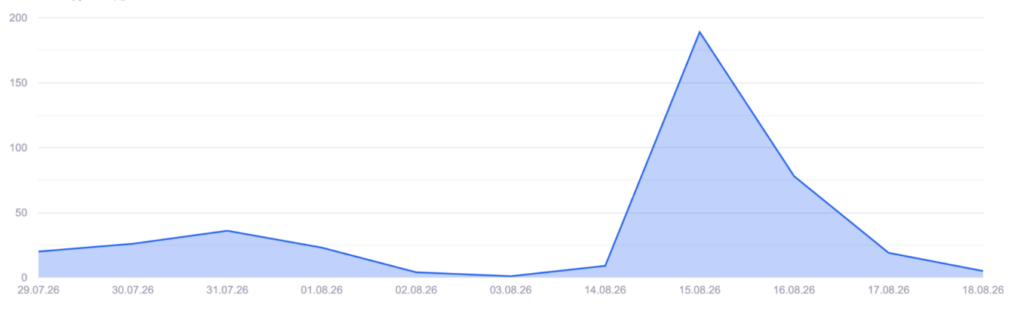
The fake “address,” in other words, was posted not only in political groups but in regional, military, advertising and other unrelated communities as well — allowing it to reach a range of audiences regardless of a group’s subject matter. In all, Osavul recorded 108 unique posts between July 29 and Aug. 3.
After Aug. 3 the spread all but stopped. A second wave began on Aug. 14, following a ten-day pause. One of the key relays was Oleksii Fomin, who once again shared the old “Emery Hamilton” post. Ten minutes later, “Hennadii Chyzhov“ published a separate copy of the text, and the main amplifier of the second wave was a post by “Iryna Shmarova“. At the end of her post, Shmarova credited both earlier sources — “Emery Hamilton” and “Oleksii Fomin” — directly tying the second wave to the July publication. At the time of analysis, Shmarova’s post had more than 2,000 shares, and Osavul linked 110 posts across 101 profiles, pages and groups to it.
Notably, Fomin presents himself as a military pensioner, though there is no independent confirmation of his military status. Osavul flags Fomin’s account for “inauthentic behavior” — an automatic indicator of suspicious activity rather than proof that the profile is a bot. His self-presentation as a serviceman, however, lent the fake the appearance of information from within the army.
In the second wave, from Aug. 14 to Aug. 18, Osavul identified 292 unique posts in all — 2.7 times as many as in the first.
The analysis also showed that of the 400 unique links, 238 led to posts in Facebook groups. Sixty-five groups were used during the first wave and 131 during the second, with eighteen groups used in both. The relaunch of an old post after a ten-day pause, the reuse of the same groups, the verbatim copying of the text and the cross-posting all point to coordinated network distribution rather than the merely organic spread of a fake post.
The statement on the Commander-in-Chief’s official Facebook page likewise notes that some such information attacks are coordinated and involve bot networks. Their aim is to sow distrust within the state, and between the army and society.
StopFake has previously examined this narrative in Video Fake: Azov Corps Commander Denys Prokopenko Called for ‘Regime Change’ Against Zelensky and Video Fake: Soldiers ‘Came to Settle Scores’ at the Verkhovna Rada.