
Neither the German chancellor nor any other government official has made such a statement or put forward any such initiative. What is more, the idea runs counter to German law and there is no practical mechanism for carrying it out.
A quote attributed to German Chancellor Friedrich Merz is circulating online. In it, he supposedly says that Germans are ready to give up their pensions for a year to support Ukraine. A single Facebook post of this kind had gathered nearly five thousand likes, more than a hundred shares and almost two thousand comments at the time of writing. “Do the Germans know?” users ask ironically in the comments. None of the posts, however, say when or in what context Merz supposedly made the statement, and none link to a source.
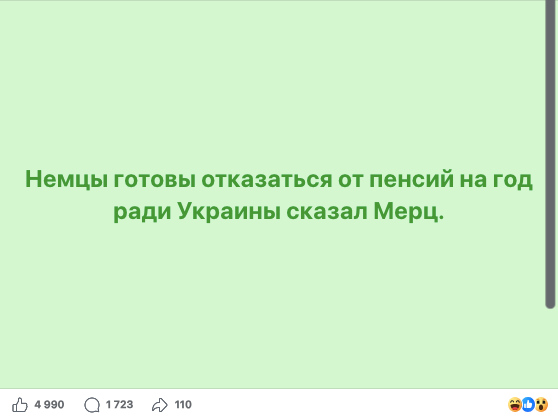
StopFake, however, found no confirmation of the words attributed to Merz. We checked coverage in German and Ukrainian media, along with official transcripts of the chancellor’s speeches on bundesregierung.de and bundeskanzler.de, and found nothing to show that Merz had spoken of Germans being willing to give up their pensions for a year to support Ukraine. Without a primary source, such as a transcript, video or official statement, the quote should be treated as unverified and most likely fake.
Moreover, the very idea that Germans could forgo their pensions for a year to help Ukraine runs counter to German law and has no practical mechanism behind it. Germany’s Federal Constitutional Court has consistently held that pension payments and pension entitlements earned in Germany are protected by Article 14 of the Basic Law, which guarantees property. The court first set out this principle in a ruling of Feb. 28, 1980. On top of that, Germany’s pension system runs on the principle that “current contributions fund current payouts.” Contributions and federal subsidies flow into a separate statutory pension insurance budget and are strictly earmarked. In other words, it is not a “common pot” from which money can simply be redirected to another purpose.
In recent months, Merz has spoken about pensions mainly in the context of a major pension reform, not as a way to fund aid to Ukraine. At a press conference on June 23, 2026, after receiving the pension commission’s report, the chancellor said that “there will be no cuts to pension payments.” He acknowledged, however, that the future funded pension would have to be paid for: contributions will rise by two percentage points from 2031, and pensions will in future rise slightly more slowly than wages. On Nov. 3, 2026, speaking at a breakfast hosted by the Berlin Chamber of Industry and Commerce, Merz called the reform a “paradigm shift.” He explained that it would add a funded component to the state pension system, modeled on Sweden’s. “In the long run, contributions will fall and payouts will rise,” he said. In the same speech, he said there was no point arguing over the “holding line” for the pension level (48, 47.5 or 47 percent), because the main task of the present era is the country’s security and freedom. He added that by Christmas the cabinet should adopt only the pension component that has been fully drafted in legal terms, with the funded component set out, for now, only in its main parameters. Critics point out that this is a retreat from his earlier promise to pass the entire reform before Christmas, and the funded-pension law is not expected until 2027. Nowhere in these materials, however, does Merz say that Germans should give up their pensions for a year.
StopFake has previously debunked a manipulation claiming that Merz said his main goal as chancellor was to “help Ukraine,” not to lower fuel prices for Germans.