

Update: In November, Ekofarm, the manufacturer of “Proteflazid,” provided StopFake with its explanation regarding the “confirmation of ‘Proteflazid’s’ antiviral effect against COVID-19.” The company clarified that “as of today, ‘Proteflazid’ is not officially recommended by the Ministry of Health for the treatment of COVID-19. The necessary evidence-based studies are ongoing.” At the same time, the company assured StopFake that “Proteflazid” was tested in vitro (in a test tube) against two different coronaviruses, CoV229E and SARS-CoV-2 (COVID-19), and not just against the latter.
StopFake previously reported that social media users had spread information claiming that the antiviral effect of the drug “Proteflazid” against SARS-CoV-2 had been confirmed. In reality, the effectiveness of this drug for people infected with the novel coronavirus has not been proven.
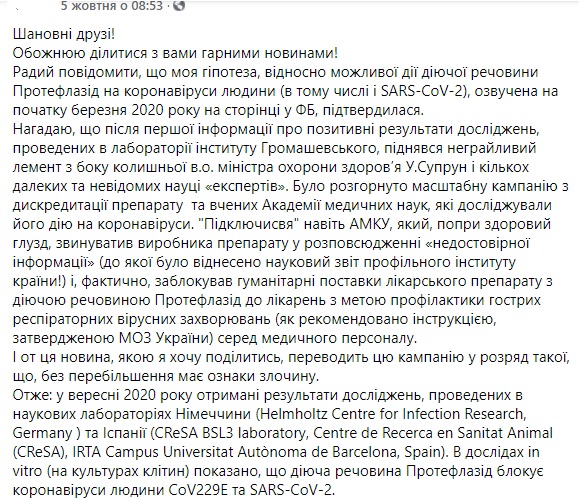
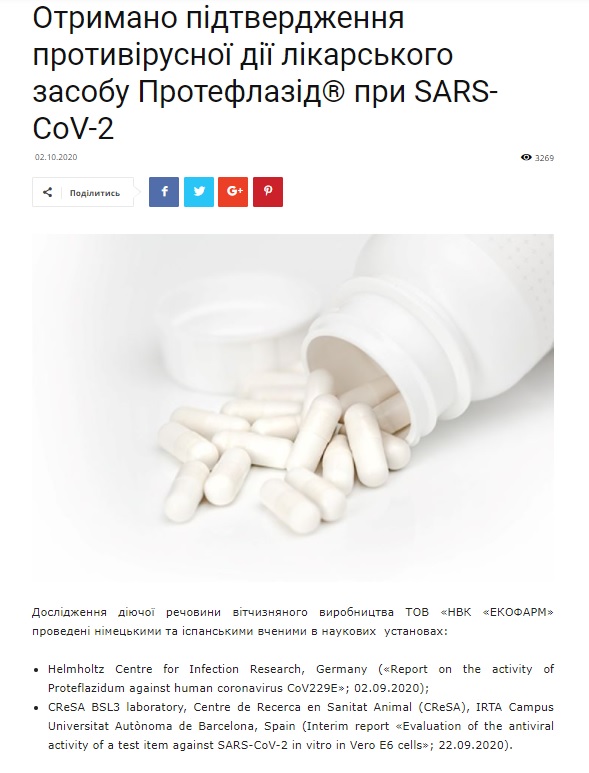
In March 2020, StopFake had already published an article stating that “Proteflazid” has no proven effectiveness against COVID-19. However, on October 2, the National Academy of Medical Sciences of Ukraine announced that it had allegedly obtained the necessary evidence. To support its claims, the Academy cites research by foreign scientists:
“Studies of the active ingredient produced domestically by NPK ECOFARM LLC” were conducted by German and Spanish scientists at the following research institutions: the Helmholtz Centre for Infection Research, Germany, and the CReSA BSL3 laboratory, Centre de Recerca en Sanitat Animal (CReSA), IRTA Campus Universitat Autònoma de Barcelona, Spain. In vitro experiments (on cell cultures) confirmed the preliminary findings of Ukrainian scientists: the drug Proteflazid exhibits specific antiviral activity against the CoV229E and SARS-CoV-2 coronaviruses,” the website states.
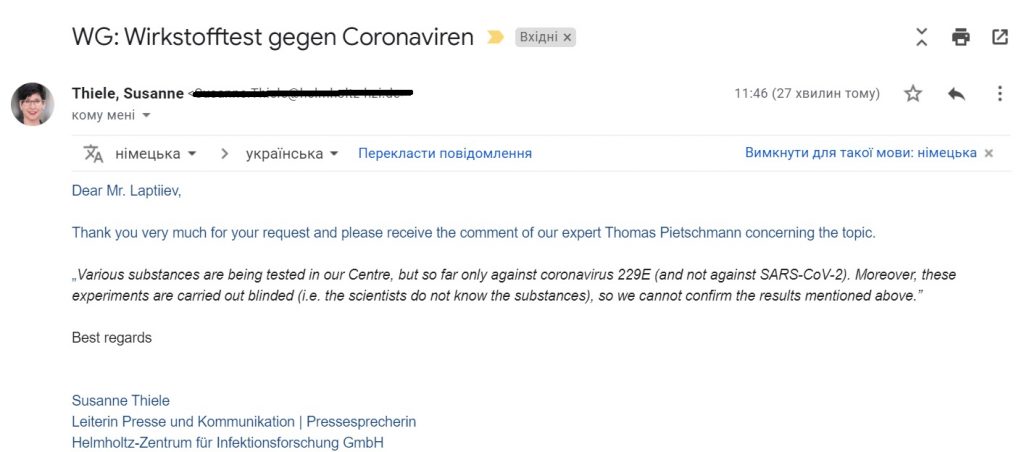
After this information was circulated, StopFake contacted the Helmholtz Centre for Infection Research and asked it to confirm or deny the claim. Susanne Thiele, head of the Public Relations and Communications Department and press secretary, provided a comment from their expert, Thomas Pietschmann, in response to our inquiry. According to the expert, the German center does not test any substances against SARS-CoV-2 at all.
“Various substances are being tested at our Center, but so far only against the 229E coronavirus (not against SARS-CoV-2). Furthermore, these experiments are conducted blind (meaning the scientists do not know which substance is being tested), so we cannot confirm the results mentioned above,” Pitchmann said.
StopFake also reached out to Spanish experts at IRTA, but had not yet received a response as of the time of publication.
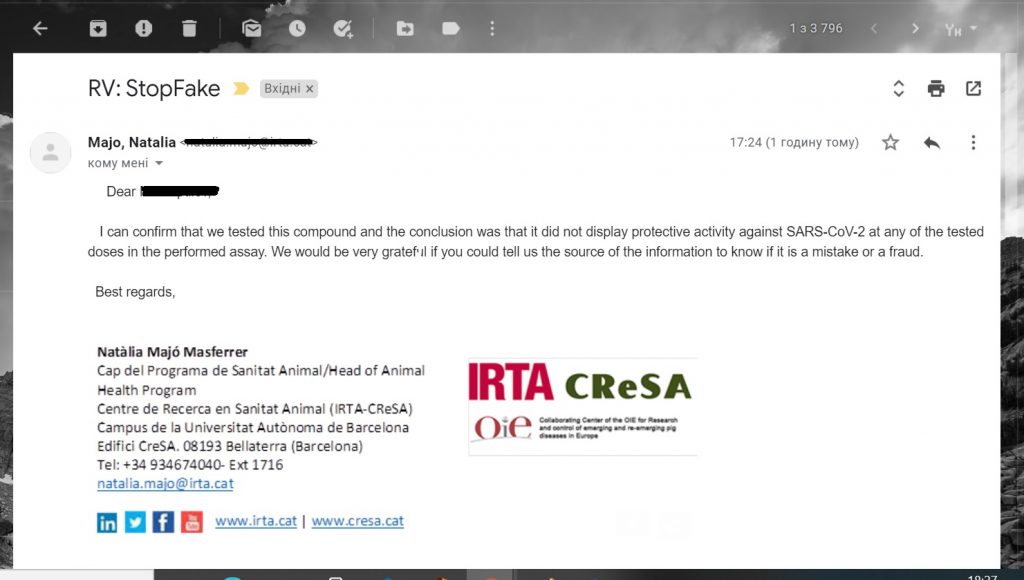
Updated: On October 9, StopFake received a response from IRTA in which the head of the animal health program (Head of the Animal Health Program) Natàlia Majó reported that they had tested “Proteflazid” and it showed no protective activity against the new strain of coronavirus.
“I can confirm that we tested this compound and concluded that it does not exhibit any protective activity against SARS-CoV-2 at any of the doses tested in the analysis. We would be very grateful if you could provide us with the source of this information so we can determine whether this is simply a mistake or a case of fraud,” she said.
We
also asked Fedir Lapii, an infectious disease specialist and member of the European Society for Pediatric Infectious Diseases (ESPID), to comment on the information provided and explain what the alleged confirmation by Spanish scientists of “the antiviral activity of the test subject against SARS-CoV-2 in vitro in Vero E6 cells” actually means. According to him, even if such a study were conducted, it does not imply the drug’s effectiveness in a living organism.
“When we talk about Vero culture, we’re referring to a cell culture in which, for example, infection and viral replication occur. The very wording of the active ingredient ‘Proteflazid’ sounds both sad and funny. An active ingredient is a molecule. ‘Proteflazid’ is not a molecule of any active ingredient. It is a mixture of substances found in two herbs that form the basis of this drug. Even if we assume that there is some “in vitro” effect—that is, outside the body—it must be applied with great caution to “in vivo” clinical use (within the body). In our bodies, we have enzymes, gastric and pancreatic juices, proteins, the liver, and so on. The pathogen is localized in the respiratory tract. The question is: does any of the substances being studied actually reach the site where the virus is located? “Strictly speaking, in today’s world, we cannot make any definitive statements until there is convincing data showing that the drug is effective ‘in vivo’ and that it actually works,” the expert notes.
StopFake previously debunked the claim that “There is a cure for the coronavirus—it’s ‘VetOks-1000.’”