
Numerous sources confirm that the underground school was used by local institutions, served as a shelter for residents and hosted regular humanitarian aid distributions. The people present during the attack are documented to have been civilians. The UN monitoring mission has said the circumstances of the strike point to a likely breach of fundamental principles of international humanitarian law, while Ukrainian law enforcement and military intelligence are still establishing what happened and identifying the Russian servicemen involved.
Russian media and pro-war Telegram channels are trying to justify the Nov. 2, 2026, airstrike on an underground school in the settlement of Komyshuvakha in Zaporizhzhia region. They claim that the Russian army destroyed a Ukrainian military base, not a civilian facility. The accounts vary. The Telegram channel Iznanka reported the destruction of a temporary deployment point of the 128th Separate Mountain Assault Brigade. LostArmour described the site as an underground command post. Voennoye Obozreniye claimed that drone operators were inside the school.
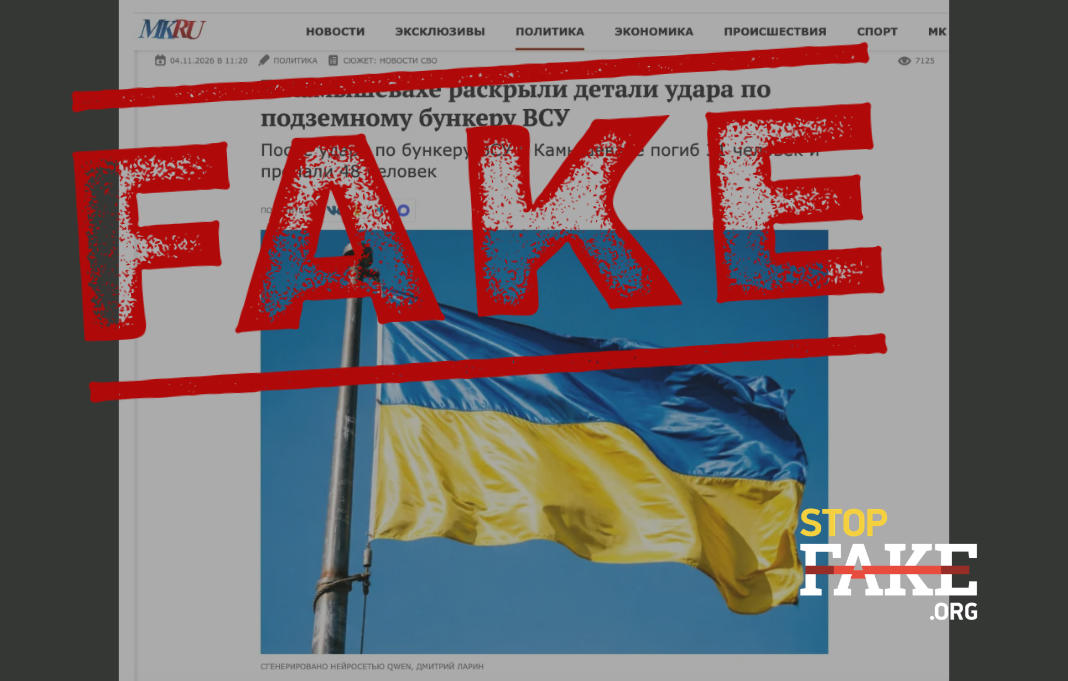
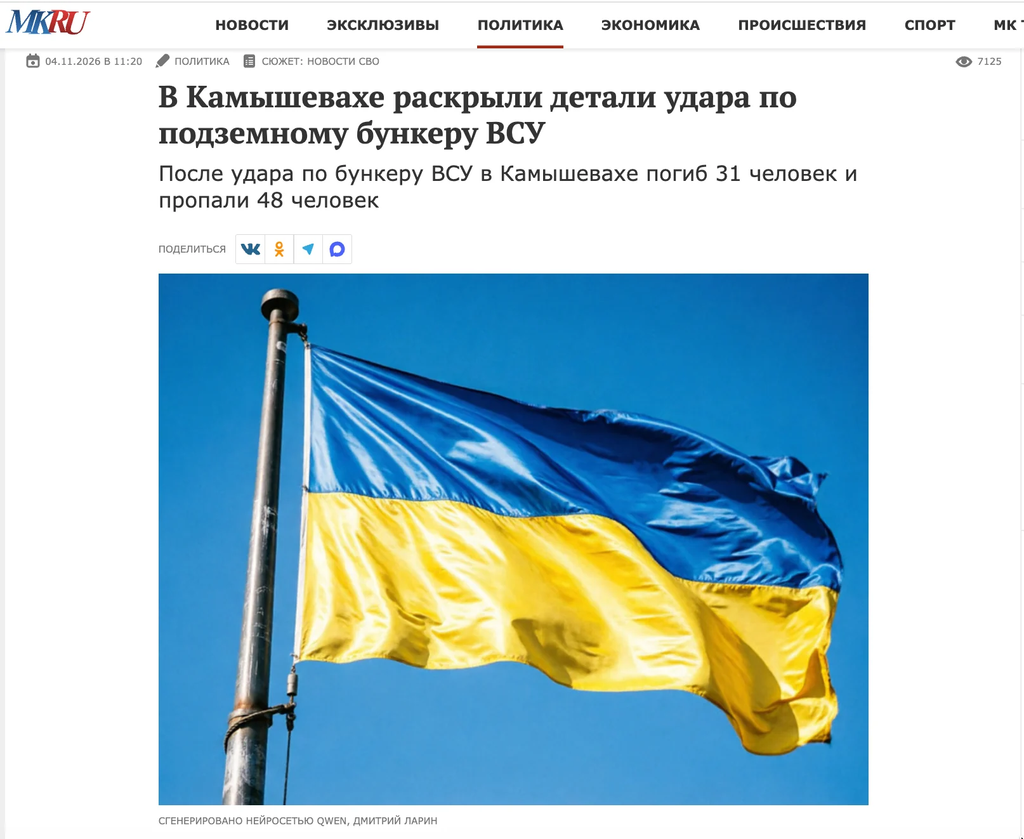
One piece of evidence Russian sources rely on is a statement by Ukrainian blogger Roman Piatyhorets, made a month and a half before the tragedy. Some outlets also present the people killed or missing after the attack as Ukrainian army losses. On Nov. 7, for example, Moskovsky Komsomolets claimed that Kyiv had supposedly confirmed the destruction of a bunker holding 54 drone operators.
Publicly available information does not support the Russian claim that the underground school was a military base or command post of the Ukrainian Armed Forces. Numerous documents, eyewitness accounts and video footage instead confirm its civilian use. The UN Human Rights Monitoring Mission in Ukraine has said the circumstances of the strike point to a likely breach of fundamental principles of international humanitarian law.
What we know about the underground school in Komyshuvakha
The underground school on the grounds of the Dzherelo gymnasium opened in October 2025. It was an underground classroom that also served as a shelter. Because of the constant threat of Russian shelling, however, children attended classes there only in November and December 2025. In January 2026, teaching moved online.
The Zaporizhzhia outlet Spravzhnie reported as early as Feb. 20, 2026, that once in-person classes stopped, the underground school took in the settlement council, the Administrative Services Center (TsNAP) and local medical facilities. Community head Yurii Karapetian said the move had been agreed with the Zaporizhzhia Regional Military Administration, because staff at local institutions could not work safely in ordinary buildings.
A March 11, 2026, report by the Zaporizhzhia Center for Investigations also noted that most administrative functions moved to the underground school after the settlement council building was destroyed. Documents were processed there and humanitarian aid was handed out. Residents who had lost their homes to shelling could stay there overnight.
The school’s civilian use, in other words, was publicly documented long before the tragedy. Nor were aid handouts an occasional event. Reuters reported on Nov. 4 that distributions took place regularly, every Monday.
What happened on Nov. 2
The UN Human Rights Monitoring Mission in Ukraine examined the circumstances of the attack in detail in a Nov. 3, 2026, statement.
UN experts established that on Nov. 1 the local authorities publicly announced an upcoming aid distribution at the school. The notice went out on a social media channel with almost 5,000 subscribers. The distribution was scheduled for the next day, Nov. 2, from 10 a.m. to noon.
That is exactly when Russian forces struck Komyshuvakha with guided aerial bombs. Local residents had gathered at the school to collect aid. Police and rescuers arrived after the first explosions, and people tried to take cover in the underground facility.
According to a Nov. 7 statement by the Main Intelligence Directorate of Ukraine’s Defense Ministry (HUR), the Russian air attack began at 9:45 a.m. Two guided bombs hit the grounds of the Dzherelo gymnasium, destroying the gym and a utility building. About an hour later, Russian forces dropped a three-ton FAB-3000 bomb directly on the school’s underground facility, which housed an Invincibility Point (an emergency support hub) and a shelter for local residents. Concrete structures collapsed, trapping people under the rubble.
HUR also published the results of its work to identify the Russian servicemen involved in the attack. According to Ukrainian military intelligence, the strike was planned by Col. Fyodor Zubakov, head of the fire engagement group at the headquarters of Russia’s Dnepr group of forces. Four Su-34 aircraft were used. Ukrainian intelligence has named six pilots who took part in the strikes: Sergei Yeliseyev, Dmitry Zverev, Rodion Plotnikov, Nikita Ignatyev, Maksim Sokolenko and Vadim Perekhrest. The crew of one more aircraft has yet to be identified. The details were published on HUR’s official website.
A separate statement by the UN Humanitarian Coordinator for Ukraine, Matthias Schmale, said that most of those killed in the first strikes were local residents who had come for humanitarian aid, along with local administration staff. Later strikes also killed two rescuers and four police officers who had come to help the wounded.
Official figures from Ukraine’s State Emergency Service, published on Nov. 7, put the death toll from the Russian attack at 55. Rescuers kept clearing the rubble despite the constant threat of repeat strikes. The final number of victims had not yet been established at that point.
Police video and eyewitness accounts
On Nov. 4, the National Police of Ukraine released body camera footage from one of the officers killed in the attack. It shows local residents and emergency workers trying to escape further airstrikes. People go down the stairs into the underground school, which was being used as a shelter. Then a powerful explosion hits.
Reuters separately verified the date and location of the footage. Its journalists used the original file’s metadata, satellite imagery and their own photographs from the scene.
Rodion Palii, a State Emergency Service rescuer who survived, also described how people ended up in the shelter. In an interview with Spravzhnie on Nov. 6, he said rescuers arrived after the first explosions to free a woman trapped under rubble. During the rescue, a warning came that more guided bombs were incoming. Everyone was told to get to the shelter immediately. People went down into the underground school, and then the rescuer lost consciousness. He survived with serious injuries.
Relatives and acquaintances of the dead offer further evidence that civilians were present. Under a post on Threads, for instance, users wrote about people who were killed in the underground school. Journalists at Forpost.media gathered some of these accounts. Not all of the social media testimony has been independently verified, but Ukrainian journalists have confirmed the identities of a number of the victims and how they died.
Suspilne, for example, reported on 74-year-old Liubov Krasnova, who had come to the school to collect bread handed out as aid, and on a married couple, Artem and Daniela Zhukov, who were killed in the shelter. The identified victims also include Olha Tverdenko, head of the local TsNAP, as well as police officers and rescuers. As Suspilne noted, Tverdenko came to Komyshuvakha regularly, every Monday, to hand out humanitarian aid.
Statements by the Ukrainian authorities, then, are not the only evidence that civilians were at the school when it was struck. Police footage, eyewitness testimony, accounts from victims’ relatives and journalists’ reporting all confirm it. This evidence is consistent with the UN monitoring mission’s findings.
How Russian sources back up their claims
One of the main arguments in Russian publications is a Sept. 17, 2026, appearance by Roman Piatyhorets. The blogger and political commentator did say that the underground school in Komyshuvakha housed the local administration, and that drone operators were supposedly based there too. A video clip of his remarks was published by Ukrainian media.
But Piatyhorets is not an official representative of the Ukrainian government or military command, and he offered no evidence for his claim. None of the verified materials independently confirm that drone operators were in fact based at the school. And a remark made a month and a half before the tragedy says even less about whether the site was a military one on Nov. 2 itself.
Nor does the airstrike footage published by the Russian channel Iznanka prove anything. The video shows an explosion. It does not show who was inside the underground facility or what it was being used for.
A Nov. 4 article by Rossiyskaya Gazeta offers a separate example of manipulation. The outlet claimed that Ukraine’s armed forces lost 80 people in the strike. Yet the article itself cited 31 dead and 48 missing, figures that matched Ukrainian reports of those killed in the attack and those still being searched for. The outlet offered no evidence that these people were military personnel. Reports of the dead and missing were simply passed off as proof of Ukrainian military losses.
The same technique was used by Moskovsky Komsomolets on Nov. 7. Its headline claims that Ukraine supposedly confirmed the destruction of 54 drone operators. The outlet cites no such statement from any Ukrainian state or military body. Instead, it again relies on Piatyhorets’s remarks and mentions the death of a Ukrainian officer, Maj. Vitalii Bevza.
The Volodarka settlement council did report that Vitalii Bevza was killed on Nov. 2 while carrying out a combat mission in Komyshuvakha. But the announcement does not say that he was in the underground school. His death proves neither that a military base existed there nor that dozens of drone operators were killed.
Russian sources have produced no photographs, video or other convincing evidence that the underground school was a military facility at the time of the strike. They rely instead on unverified claims, footage of the explosion itself and information about the dead, to whom they assign military status without sufficient grounds.
International organizations’ assessments and the rules of international humanitarian law
The strike on Komyshuvakha has raised serious concern among international human rights bodies.
In a Nov. 3 statement, Danielle Bell, head of the UN Human Rights Monitoring Mission in Ukraine, stressed that the place and time of the aid distribution were widely known. In her words, Russian armed forces either knew about the distribution taking place at the school or failed to take even the most basic steps to find out what was happening in the community they were about to attack.
The UN monitoring mission’s preliminary conclusion was that the attack likely violated fundamental principles of international humanitarian law.
On Nov. 5, Council of Europe Commissioner for Human Rights Michael O’Flaherty also condemned the Russian strike on a school where civilians had gathered to receive humanitarian aid. He drew particular attention to the follow-up strikes, which killed rescuers and people trying to take shelter. The commissioner stressed that such attacks, if deliberately directed against civilian objects in violation of international humanitarian law, amount to war crimes.
International humanitarian law sets specific requirements for selecting targets and carrying out military attacks.
Under Article 52 of Additional Protocol I to the Geneva Conventions, only objects that make an effective contribution to military action, and whose destruction in the circumstances ruling at the time offers a definite military advantage, may be treated as military objectives. In case of doubt as to whether a school is being used for military purposes, it must be presumed to be a civilian object.
Article 57 of the same Protocol requires those planning an attack to do everything feasible to verify that the target is a military one, and to take precautions to avoid or minimize civilian losses. The expected consequences for civilians must be weighed when choosing the means and methods of attack.
Just as important is the principle of proportionality, set out in Article 51(5)(b). It prohibits attacks that may be expected to cause incidental civilian losses excessive in relation to the concrete and direct military advantage anticipated. As the International Committee of the Red Cross explains, these requirements apply even when the target is a confirmed military objective.
What makes the Komyshuvakha case especially significant is that information about the school’s civilian use was available long before the tragedy. Local administrative and social services had operated there for months. Humanitarian aid was distributed regularly every Monday, and the Nov. 2 distribution had been publicly announced the day before.
These circumstances are what underpinned the UN monitoring mission’s serious concern. In the assessment of its head, Danielle Bell, Russian forces either knew about the aid distribution or failed to take even the most basic steps to clarify the situation before attacking. Either way, the mission said, the strike likely violated fundamental principles of international humanitarian law.
StopFake has repeatedly debunked Russian disinformation that seeks to justify attacks on civilian targets, deny Russia’s responsibility for civilian deaths and cover up the circumstances of Russian war crimes. See, in particular, Fake: Russian Troops Struck a Gathering of Aidar Battalion ‘Nazis’ in the Village of Hroza, “It collapsed on its own” – Five Russian media fakes about the destruction Kakhovka dam, Fake: Ukrainian Troops Carried Out the Strike on Kramatorsk Railway Station and Fake: Mass Civilian Casualties in Kyiv Region Staged.