The U.S. outlet The Diplomat has retracted the article propagandists cited, admitting that its interview with the head of the South Korean defense company Newtype Industries was fabricated. What is more, the editors found evidence that the author’s emails were sent from Russia. The startup itself has also denied reports that it ended its cooperation with Ukraine over the diplomatic dispute.
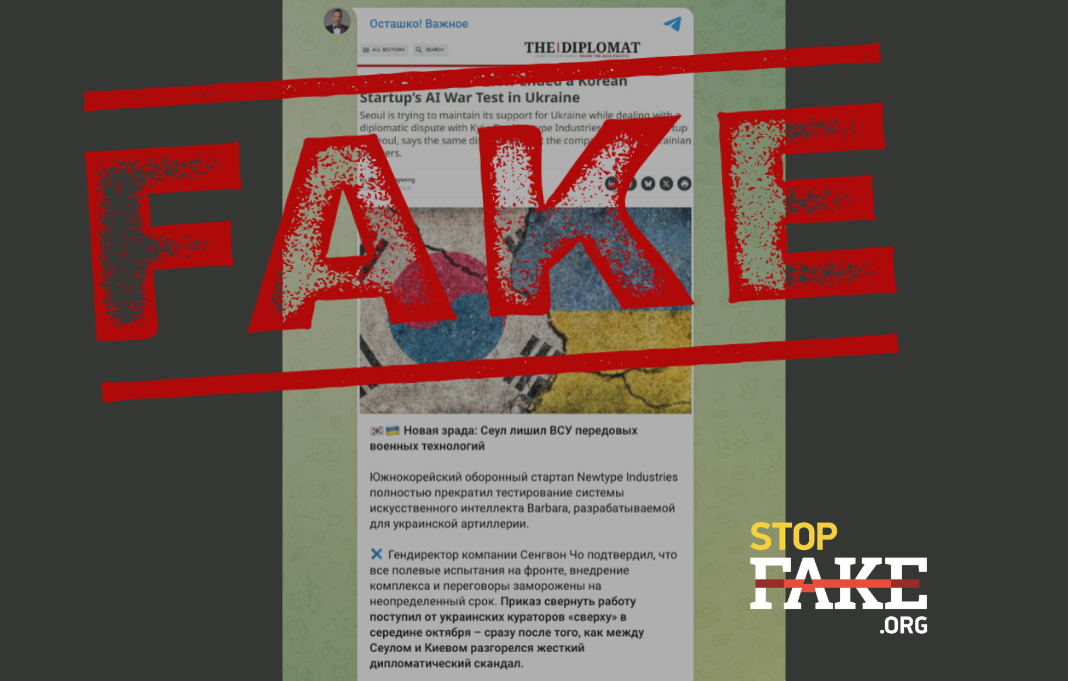
Claims are circulating online that South Korea is gradually scaling back military aid to Ukraine after a diplomatic scandal between Seoul and Kyiv. As evidence, the posts cite an article by the U.S. outlet The Diplomat reporting that the South Korean defense company Newtype Industries had ended its cooperation with the Ukrainian military.
“After the scandal with Zelensky and the recall of the Korean ambassador from Ukraine, the volume of military aid has also started to fall. A South Korean company that was testing its military AI in Ukraine has ended its cooperation with Kyiv and pulled its product,” reads one of the posts.
Propagandists claim the company received an “order from above” to halt trials of its artillery fire-control software. They also present the episode as just the first of several restrictions on South Korean projects in Ukraine, creating the impression that Seoul is gradually winding down its cooperation with Kyiv.
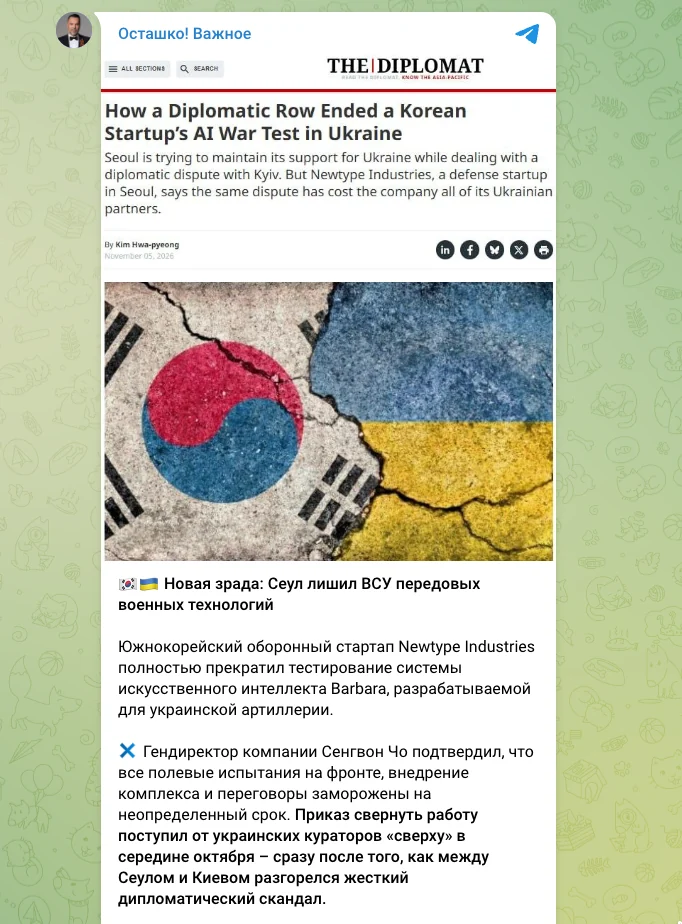
This is untrue. The Diplomat article that served as the source for these posts was retracted after it emerged that its interview with the head of Newtype Industries had been invented.
On Nov. 5, 2026, The Diplomat, an English-language outlet specializing in Asia-Pacific politics and security, published a piece titled “How a Diplomatic Row Ended a Korean Startup’s AI War Test in Ukraine.”
The article claimed that the Ukrainian side had ordered a halt to trials of Barbara, software developed by Newtype Industries. Citing the company’s CEO, Seungwon (Joe) Cho, the author linked the decision to the diplomatic dispute between Ukraine and South Korea. The piece also claimed that the company had lost its Ukrainian partners and that further trials and negotiations had been called off.
Yet as early as Nov. 6, Newtype Industries’ leadership denied the reports. Speaking to the Ukrainian defense outlet Militarnyi, the company’s CEO said that neither he nor anyone else at the startup had spoken to The Diplomat about the matter. He called the report that the Barbara trials had been halted completely false.
“It is a great honor for me and for Newtype to help Ukrainians defend their country. Koreans know what it means to live through an invasion,” Cho stressed.
The company later issued an official statement categorically rejecting the article. Newtype Industries said The Diplomat had not contacted it before publication, had not conducted an interview and had not received the comments cited in the piece. It described the quotes attributed to its staff as fabricated.
Together with its consulting partner Reaktion Group, the company called on outlets that had spread the false information to review it and correct or retract their reports. Newtype Industries declined, however, to disclose confidential details of its current operations or commercial arrangements.
The Diplomat soon admitted it had published a fabricated interview and retracted the article in full. The original piece’s page now carries an editor’s note headed “Retracted Article,” along with Newtype Industries’ official statement.
The editors explained that the author had presented himself as a freelance journalist from South Korea and claimed to have spoken to the company’s CEO in person. Subsequent checks, however, showed that the interview had been fabricated.
The outlet went further and cast doubt on the author’s identity. A closer look at the correspondence revealed evidence that the emails had been sent from Russia. On that basis, the editors suggested the article may have been part of a disinformation operation.
The Diplomat apologized to Newtype Industries and said it would tighten its verification procedures to prevent similar incidents in the future.
The identity of the retracted article’s author deserves particular attention. The piece ran under the byline Kim Hwa-pyeong. The editors now acknowledge, however, that the person posing as a South Korean journalist may not have been who they claimed to be.
The BBC’s Seoul correspondent, Jake Kwon, also flagged the suspicious circumstances. Commenting on the article on X, he noted that a search for the author’s name turns up almost nothing, apart from mentions of someone by that name in Korean-language media roughly six years ago. His comments were also picked up by the media aggregator Mediagazer.
After the retraction, Kwon pointed to The Diplomat’s findings and suggested that a Russian agent may have been behind the piece. That, however, is the journalist’s speculation, not an established fact.
The author’s true identity therefore remains unknown. There is currently no confirmation that the person named in the byline is in fact a South Korean journalist. Nor can it be ruled out that someone else’s name was used.
At the same time, The Diplomat has not disclosed details of its technical examination of the emails, nor has it named any individuals or organizations that may have been behind the alleged disinformation operation. It is therefore premature to speak of proven involvement by any specific Russian entity.
Newtype Industries did, in fact, work with the Ukrainian military. On Aug. 11, 2026, defense analyst Olena Kryzhanivska published an interview with the company’s CEO after meeting him in person. The piece described the trials of Barbara in Ukraine.
The software is designed to speed up the processing of the data artillery units rely on. The system uses artificial intelligence to turn soldiers’ voice messages into structured reports and to cross-check information. Decisions on the use of weapons, however, remain with humans.
According to the startup’s CEO, contacts with the Ukrainian military were established with the help of Reaktion Group. At the time of the interview, the company was working with two Ukrainian units, gathering feedback from the trials and planning further work on the product.
For context: in late September 2026, a dispute broke out between the two countries after President Volodymyr Zelensky publicly announced the handover to Seoul of two North Korean soldiers who had been taken prisoner by Ukraine. The South Korean side accused Kyiv of breaching an agreement to keep this information confidential — an agreement Ukraine denied existed.
On Sept. 28, South Korea’s Foreign Ministry lodged a formal protest, and on Oct. 8, Seoul announced it was recalling its ambassador from Ukraine. Seoul later decided to cut some of its diplomatic staff in Kyiv, partly on security grounds amid Russian air strikes.
The diplomatic dispute, however, does not mean South Korea has stopped helping Ukraine.
On Oct. 15, a South Korean Foreign Ministry official confirmed that Seoul would continue to support Ukraine, treating the question of aid separately from the bilateral diplomatic dispute.
A distinction must also be drawn between South Korean state aid and the commercial projects of individual private companies. Throughout the war, Seoul has maintained a policy of not supplying lethal weapons directly to Ukraine, providing humanitarian and non-lethal aid instead. That position was reaffirmed, among other occasions, at a South Korean Foreign Ministry briefing on July 2, 2026.
StopFake has previously examined misleading claims that Canada had supposedly changed its mind about handing refurbished armored vehicles to Ukraine and would keep them for itself.