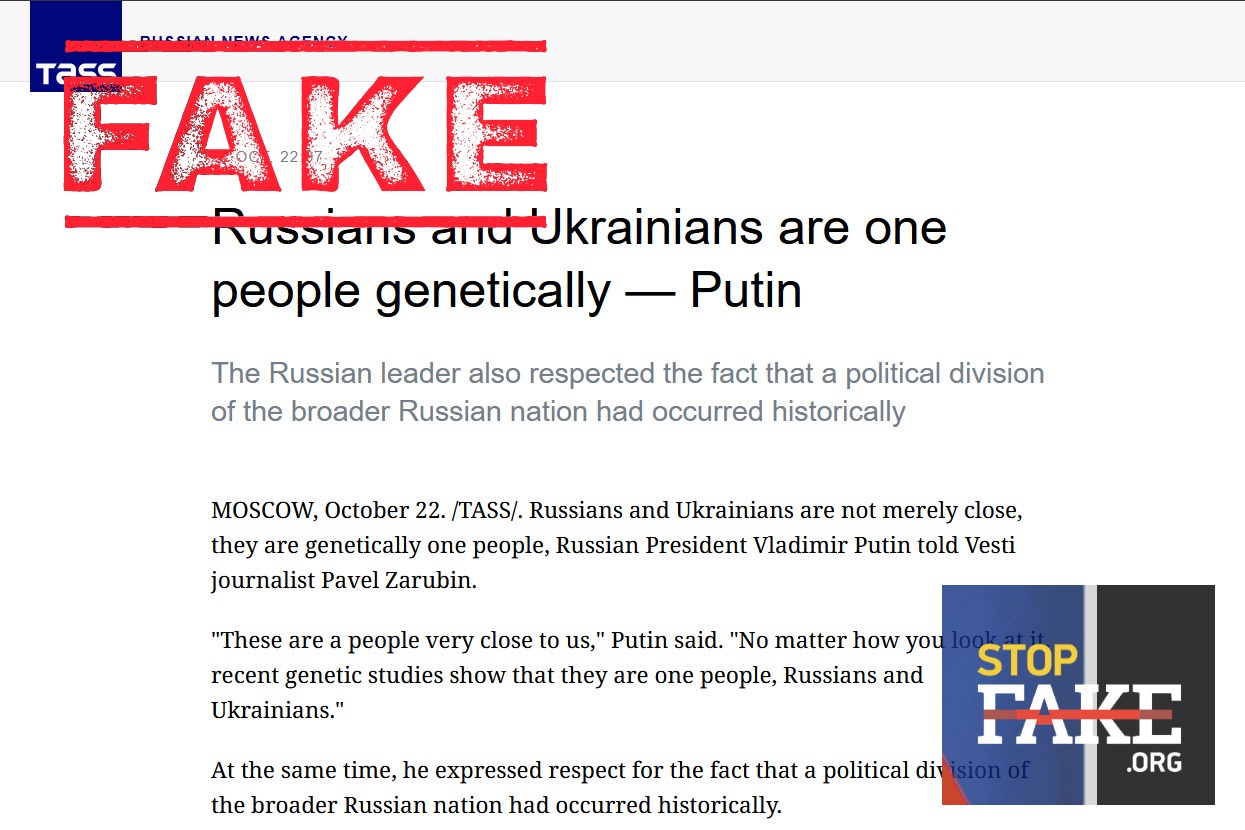
The claim that Ukrainians and Russians are “one people” is not a historical fact, but a geopolitical myth used to justify imperial expansion and aggression. Ukrainians and Russians are two distinct nations, each with its own history, language, culture and political ideology.
One of the central narratives of Russian propaganda is that Russians and Ukrainians are “one people”. In this context, Belarusians are often mentioned as a third ethnic group that forms part of a “unified Russian people”. The aim of this narrative is to refute the distinct identity of the Ukrainian nation and the legitimacy of an independent Ukraine as such. This is not merely a claim about cultural or historical proximity, but an imperial political statement aimed at blurring the differences between Ukraine and Russia and justifying the latter’s control. A shared history or linguistic and cultural ties do not mean that two peoples are one and the same, nor do they imply that one state has the right to rule over another.
Rebuttal:
Different historical origins
First, the Ukrainian people emerged on the basis of Kievan Rus,1 with a consistent orientation towards the European cultural and legal sphere. In this context, one may recall the Magdeburg Law or the Lithuanian Statutes. The Magdeburg Law granted towns municipal self-government and civil rights based on the European model. The Lithuanian Statutes were progressive codes of law. Both established a European legal culture in Ukraine that was alien to Russian centralism. Russian statehood later developed on the basis of the Principality of Vladimir-Suzdal, under the strong influence of the political system of the Golden Horde.2
Linguistic Autonomy
Second, Ukrainian and Russian are two distinct Slavic languages. They exhibit significant differences in vocabulary, grammar and phonetics. By contrast, Belarusian and Ukrainian, among others, share more than 84 per cent of their vocabulary. Polish and Slovak also have more linguistic similarities with Ukrainian than with Russian.
An independent political culture and the Cossack tradition
Furthermore, the cultural traditions of the Ukrainian people are based on individualism, a connection to the land and to the community, rather than on submission to the tsars or the state. A historically significant example of this is the Ukrainian Cossack movement: The Cossacks elected their own leaders (hetmans) in assemblies – an early form of democracy that stood in stark contrast to the absolute power of the Russian tsars and explains the Ukrainians’ current desire for freedom.
Over the centuries, the Ukrainians have defended their sovereignty despite systematic attempts at Russification, the Holodomor (Ukrainian: Голодомор, ‘death by starvation’) and repression. Today’s resistance to Russian aggression has definitively proven the final break with the past and the existence of a clear Ukrainian national consciousness.
Independence under international law and religious independence
The first article of the Constitution of Ukraine states that Ukraine is a sovereign and independent state. Under international law, Ukraine is recognised as a sovereign nation state with its own flag, citizenship and language. A strong argument against the “one people” myth is also that Russia itself has officially recognised Ukraine’s independence and borders on several occasions following the collapse of the Soviet Union, including in the Belavezha Accords (1991), the Budapest Memorandum (1994) and the Russian-Ukrainian Treaty of Friendship (1997). Ukraine has also achieved emancipation on a religious level: since 2018, there has been an autonomous (autocephalous) Orthodox Church of Ukraine, which is independent of the Moscow Patriarchate and has been officially recognised by the Ecumenical Patriarch of Constantinople.
Even before Russia’s full-scale invasion of Ukraine in 2022, surveys carried out by Ukrainian sociological centres (KIIS, Rating, Socis and the Razumkov Centre) showed that more than 90 per cent of Ukrainian citizens identified as Ukrainian by nationality. 6.3 per cent of Ukrainian citizens considered themselves to be Russian; interestingly, the majority of them were older people.
Russians and Ukrainians – one people, according to Putin?
Commenting on Putin’s remarks to the BBC in 2020, in which he claimed that Russians and Ukrainians were one people, Kyrylo Halushko, a historian and senior research fellow at the Institute of the History of Ukraine, described the Russian President’s statements as “a mixture of pseudo-historical, paranoid and conspiracy-theory notions that have nothing to do with historical facts”. In his response to Putin’s remark about the alleged “common language” spoken by the inhabitants of Kievan Rus’ until the 13th century, Halushko emphasises that there was in fact no difference, because all Old Russian territories used the Church Slavonic language of Cyril and Methodius – which was a Thessalonian dialect of the Old Bulgarian language – in their administration and chronicles.
The historian points out that this was also the case in Moravia, part of present-day the Czech Republic, among other places. Yet no one claims that Russians and Czechs are one people. By the same token, one could say that Italians, French, English and Germans of the same era “were one people”, because they all used Latin in the administration of their countries.
“There is a colloquial language and a literary and official language. Research in modern linguistics shows that the Eastern Slavs did not have a common ancestral language. All Slavic peoples – the southern, eastern and western – had initial proto-dialects, which then developed into the modern Slavic languages. This means that there has never been a linguistic community at the everyday level between Ukrainians and Russians,” comments Kyrylo Halushko.
Furthermore, Russian propaganda and Putin himself have repeatedly claimed that “the Ukrainian factor was exploited by the Austrian secret service on the eve of the First World War”. Andrei Subov, a Russian historian, Doctor of Historical Sciences and former professor at the Moscow State Institute of International Relations (MGIMO), notes that while the Ukrainian factor was undoubtedly exploited, this was only because it objectively existed.
“The Ukrainian people’s sense of national identity emerged in the second half of the 17th century, precisely after Ukraine had, more or less voluntarily, become part of the unified Russian state. (…) Previously, Ukrainians had been accustomed to a completely different way of life – in the Polish-Lithuanian Commonwealth they enjoyed Magdeburg law and local self-government, and serfdom had effectively collapsed as a result of Bohdan Khmelnytsky’s uprising. And suddenly they were confronted with the fact that the Tsar was almost a god, before whom one froze in awe: there was nothing of the sort with regard to the Polish king. The towns have no rights; genuine serfdom prevails,” explains Subov.
The historian Subov explains the situation in the 19th century – the era of burgeoning nationalism – as follows: At that time, Austria feared that Russia might take the region of Galicia from it, as the population living there was culturally close to the Russians. (To put this into context: Galicia is a historical region, the eastern part of which, including the city of L’viv, lies in western Ukraine today, while the western part belongs to present-day Poland). To counter this risk, the Austrians used a political ploy: they began to promote the idea of an independent Ukrainian state – albeit with the ulterior motive that this state should be under Austrian control (a protectorate). From the 1880s onwards, Austria deliberately played this “Ukrainian card” in its politics. The Russian government in St. Petersburg, however, did exactly the same, as it was determined to bring Galicia under the control of its own empire. Both great powers thus used the Ukrainians as pawns in a geopolitical game.
Subov sums up the most important aspect of this development as follows: “This political manoeuvre only worked because the Ukrainian nation had long since come into being. The Ukrainians had already developed their own sense of national identity,” comments Andrei Subov
Following Russia’s full-scale invasion of Ukraine, Ukrainians’ sense of national identity continued to strengthen. As shown by a survey conducted by the sociological group Rating in August 2026, an absolute majority of respondents (90 %) stated that it was personally important to them to be citizens of Ukraine. According to the survey, personal identity is the most important criterion for considering oneself Ukrainian (95 %). Furthermore, among other important characteristics, a sense of responsibility for the situation in the country, respect for the law and the political system, and a sense of belonging to the Ukrainian cultural sphere are the most prevalent.
Conclusion
Ukrainians and Russians are neighbouring peoples whose development has been shaped by diametrically opposed experiences: while Ukrainian identity was forged in a constant struggle for freedom, self-government and horizontal ties within communities, Russian statehood was built up over centuries on the absolutisation of imperial power, centralisation and the subordination of the individual to the interests of the state.3 These deep-rooted historical differences have given rise to two divergent political cultures and identities that differ in their fundamental conceptions of the state, rule and freedom. For Ukrainian society, democratic elections, a critical stance towards those in power, freedom of expression and a European path of development in which the state exists for the people are fundamental guiding principles. In the Russian political tradition, by contrast, traditions of the sacralisation and personalisation of rule dominate, as well as paternalism, which subordinates individual rights to the country’s geopolitical stature.4 The thesis of the “one people” (Russian: odin narod), which is historically and culturally unable to acknowledge this divergence, thereby fails to recognise the different developmental paths of the two countries.5
_____________________________
- Kyivan Rus’: A medieval East European great power centred on present-day Kyiv, which existed from the 9th to the 13th century and whose historical origins both Ukraine and Russia today claim as their own. For more on the history, see Ukrainer ↩︎
- The Golden Horde: A Mongol khanate that ruled over large parts of Eastern Europe. The Russian princes of Moscow and Vladimir-Suzdal adopted many of the authoritarian structures of the Mongol administration. ↩︎
- Yitzhak M. Brudny/Evgeny Finkel, Why Ukraine Is Not Russia: Hegemonic National Identity and Democracy in Russia and Ukraine, in: East European Politics and Societies 25 (2011), No. 4, pp. 813–833. ↩︎
- Richard Pipes, Russia under the Old Regime, New York 1974; Michael Cherniavsky, Tsar and People: Studies in Russian Myths, New York 1969. ↩︎
- Taras Kuzio, Russian National Identity and the Russia-Ukraine Crisis, in: Security Policy Working Paper No. 20/2016, Potsdam 2016 (Federal Academy for Security Policy). ↩︎
Bibliography
Monographs and Non-Fiction Books
- Cherniavsky, Michael (1969): Tsar and People: Studies in Russian Myths. New York: Random House.
- Jobst, Kerstin Susanne (2022): Geschichte der Ukraine [History of Ukraine]. 3rd, updated edition. Stuttgart: Reclam.
- Kappeler, Andreas (2022): Kleine Geschichte der Ukraine [A Short History of Ukraine]. 8th, updated edition. Munich: C.H. Beck.
- Kappeler, Andreas (2023): Ungleiche Brüder. Russen und Ukrainer vom Mittelalter bis zur Gegenwart [Unequal Brothers. Russians and Ukrainians from the Middle Ages to the Present]. 2nd, expanded edition. Munich: C.H. Beck.
- Pipes, Richard (1996): Das zaristische Russland [Tsarist Russia]. Munich: Piper. (Original edition: Russia under the Old Regime. New York 1974.)
- Plokhy, Serhii (2022): Das Tor Europas. Die Geschichte der Ukraine [The Gates of Europe. The History of Ukraine]. Hamburg: Hoffmann und Campe.
- Schlögel, Karl (2015): Entscheidung in Kiew. Ukrainische Lektionen [Decision in Kyiv. Ukrainian Lessons]. Munich: Hanser.
- Snyder, Timothy (2018): Der Weg in die Unfreiheit. Russland, Europa, Amerika [The Road to Unfreedom. Russia, Europe, America]. Munich: C.H. Beck.
Journal Articles
- Brudny, Yitzhak M. / Finkel, Evgeny (2011): Why Ukraine Is Not Russia: Hegemonic National Identity and Democracy in Russia and Ukraine. In: East European Politics and Societies 25 (4), pp. 813–833. DOI: 10.1177/0888325411401379.
Dossiers and Online Publications
- Federal Foundation for the Reappraisal of the SED Dictatorship / Jilge, Wilfried (n.d.): Historical Background: The “Great Famine” in the History and Culture of Remembrance of Ukraine – An Introduction. URL: https://www.bundesstiftung-aufarbeitung.de/de/recherche/dossiers/holodomor/historischer-hintergrund
- Federal Agency for Civic Education [bpb] (2026): Four Years of Russia’s Full-Scale Invasion of Ukraine. Hintergrund Aktuell [Current Background]. URL: https://www.bpb.de/kurz-knapp/hintergrund-aktuell/575678/vier-jahre-russische-vollinvasion-in-der-ukraine/
- Der Spiegel / Pötzl, Norbert F. (2014): The Russification of the Soviet Union. Spiegel Geschichte [Spiegel History]. URL: https://www.spiegel.de/geschichte/die-russifizierung-der-sowjetunion-a-6ebd9796-10da-4b80-aed5-1b089ffeb0e6
- Kuzio, Taras (2016): Russian National Identity and the Russia-Ukraine Crisis. Security Policy Working Paper No. 20/2016. Potsdam: Federal Academy for Security Policy. URL: https://www.jstor.org/stable/resrep22141
- State Agency for Civic Education Baden-Württemberg [LpB] (n.d.): The Holodomor as Genocide – Facts and Controversies. URL: https://osteuropa.lpb-bw.de/simon-holodomor-als-voelkerm
- Ukrainian Institute in Germany (2022): The Unpunished Perpetrator Always Returns. 90 Years since the Holodomor. URL: https://de.ui.org.ua/der-unbestrafte-taeter-kommt-immer-wieder-90-jahre-seit-holodomor/
- Centre for East European and International Studies [ZOiS] / Kasianov, Georgiy (2026): Between Geopolitics and Historical Narratives: Ukraine’s Agency. ZOiS Spotlight 8/2026. URL: https://www.zois-berlin.de/publikationen/zois-spotlight/zwischen-geopolitik-und-historischen-narrativen-die-handlungsfaehigkeit-der-ukraine
- Centre for East European and International Studies [ZOiS] / Osipian, Alexandr (2017): “History Is Important for Understanding the Ukraine Crisis”. URL: https://www.zois-berlin.de/publikationen/geschichte-ist-wichtig-um-die-ukraine-krise-zu-verstehen
This fact-check is part of the research project ‘Identifying and Combating Russia’s Propaganda’ (ICORPD), which is funded by the Federal Foreign Office as part of the Eastern Partnership programme.
Supported by: