
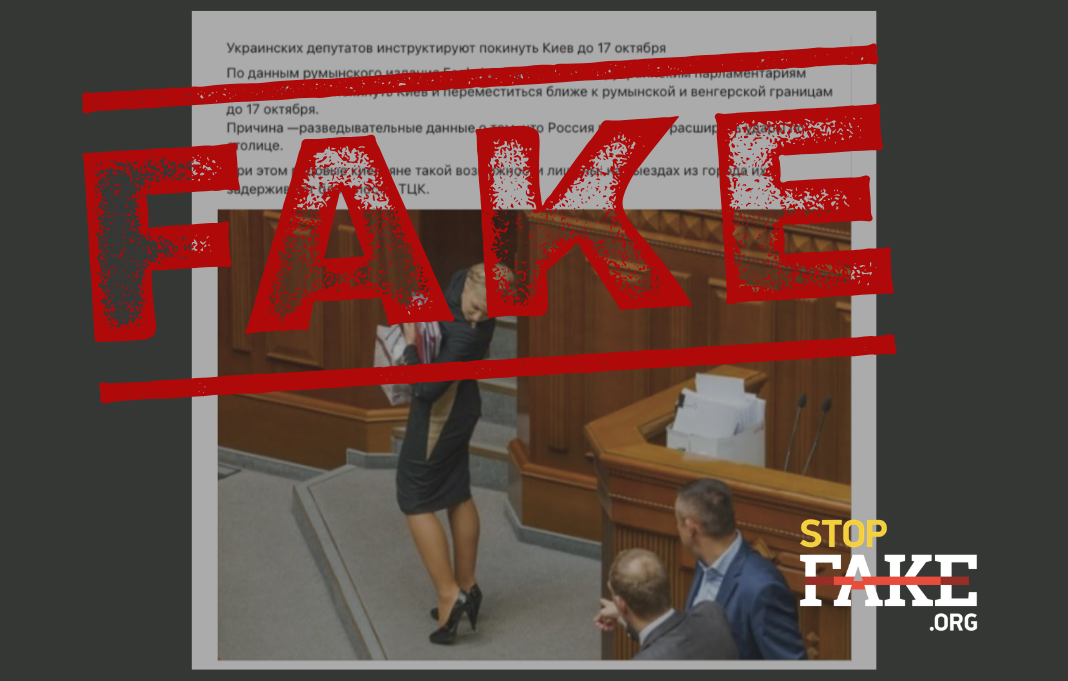
The outlet that published the story cited only an anonymous source. Ukrainian officials have flatly denied that any evacuation of MPs is being prepared.
A story is circulating in the pro-Russian segment of the internet claiming that Ukrainian MPs have been told to leave the capital by Oct. 17 because of intensifying Russian strikes. The lawmakers are supposedly to be moved closer to the Romanian or Hungarian border. The claim cites reports by the Romanian outlet Eagle Intelligence Reports. “Ordinary Kyiv residents, meanwhile, have no such option: they are detained at military recruitment (TCC) checkpoints on the roads out of the city,” the propagandists add.
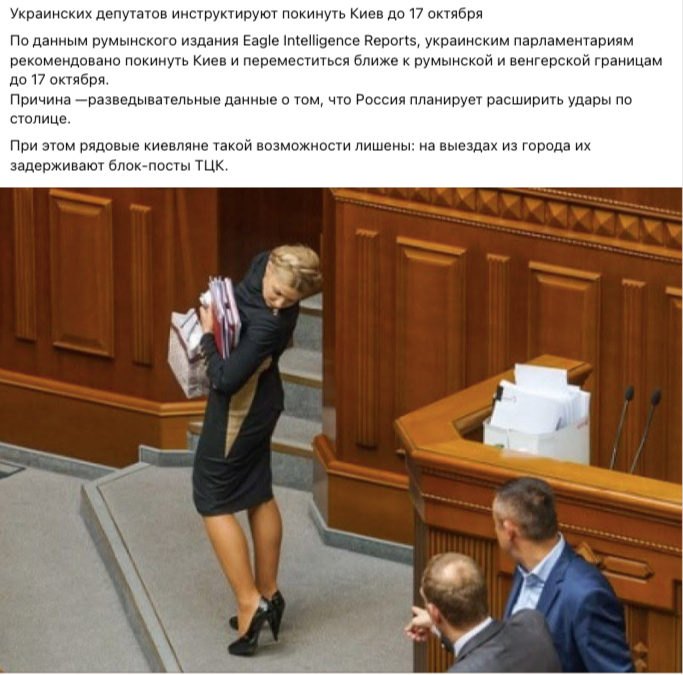
The claim is false. Eagle Intelligence Reports did publish such a story, citing a “reliable source.” According to the outlet, Davyd Arakhamia, who heads the ruling Servant of the People party’s faction in the Verkhovna Rada, instructed most MPs to leave Kyiv and relocate to areas near the Romanian and Hungarian borders by Oct. 17. The supposed reason was intelligence that Russia was preparing large-scale strikes on the capital in early October. Yet the article offered no evidence that any such operation was being planned, and Ukrainian officials were quick to deny it. Yuliia Paliichuk, a spokesperson for the Servant of the People faction, told LIGA.net that the report was “absolutely untrue,” adding that neither Arakhamia nor Verkhovna Rada Speaker Ruslan Stefanchuk had issued any such instructions. The day before, on Sept. 28, Stefanchuk had separately dismissed rumors that parliament would move its work from the capital to Lviv. Even the authors of the original Eagle Intelligence Reports article conceded that they had been unable to independently verify what their source told them.
What is more, the claim that ordinary Kyiv residents are somehow barred from leaving the city is a crude manipulation. There are no restrictions on residents leaving Kyiv through checkpoints. Checkpoints on the roads into and out of the capital, as well as across Kyiv region, are operating as normal under martial law. Their main job is security: checking documents, inspecting vehicles and detecting sabotage and reconnaissance groups.
In September, the Verkhovna Rada set up a shelter on the first basement level of its building at 5 Hrushevskoho Street, with 368 seats for MPs and a separate electronic voting system that works only inside that room. Showing the shelter to journalists, Stefanchuk explained: “Given how much the number of attacks has grown, this could paralyze the work of Ukraine’s government.” He stressed that this was neither an evacuation nor a relocation — “all MPs will vote from their seats in Kyiv” — and that the new format was simply an additional mechanism for working during air raid alerts. To dispel doubts about the legitimacy of votes held there, Stefanchuk set out three key procedural conditions: sessions will take place at 5 Hrushevskoho Street; voting remains personal; and anyone who steps outside the chamber’s perimeter “will be cut off from the system” and unable to vote.
In the spring, we debunked a similar narrative claiming that the EU and the US were “closing their embassies in Kyiv” amid Russian strikes.