


Defence Express analysts did not concede that Ukraine is helpless against Iranian missiles or that Patriots “won’t help.” The outlet noted only the difficulty of intercepting such targets and the need for a more specialized, layered missile defense architecture, while stressing that actual effectiveness depends on the characteristics and operational conditions of each specific missile.
Russian outlets are circulating claims that Iran could strike Ukraine “at any moment” with ballistic missiles that Ukrainian air defenses would be unable to intercept. Citing a piece from the Ukrainian outlet Defence Express, these publications assert that even American Patriot systems are “practically useless” against such targets, leaving Ukraine entirely defenseless.
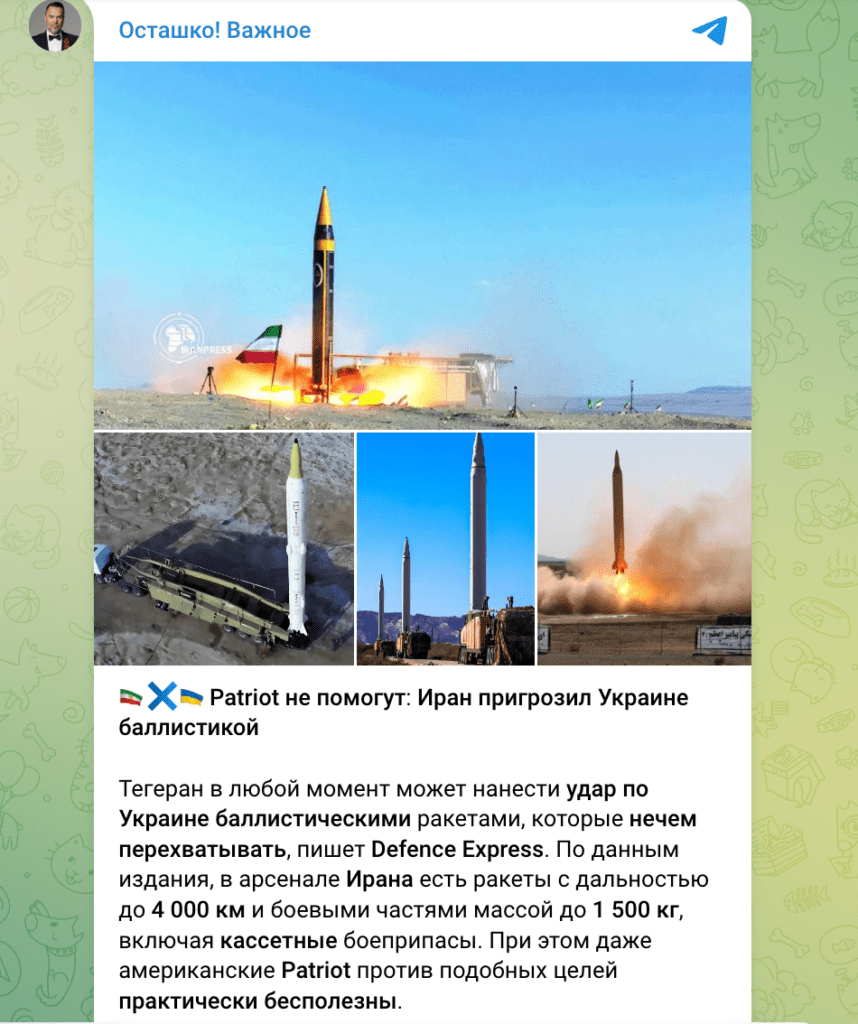
This is a manipulation. Defence Express never claimed that Patriots are of no use or that Ukraine would categorically be unable to intercept Iranian missiles. The outlet examined a hypothetical attack scenario, describing the characteristics of individual Iranian missiles and the limitations of various missile defense systems. Its authors explicitly stressed that the actual prospect of interception depends on the parameters of a specific missile and the conditions of its use.
The claims emerged against the backdrop of deteriorating relations between Kyiv and Tehran following events in the Caspian Sea on July 25, 2026. Ukraine reported strikes on a Russian warship and on vessels used to transport Iran-linked military cargo. The Iranian side stated that a commercial vessel had been attacked, killing one sailor and wounding another. Iran’s Foreign Ministry condemned the attack and said Tehran would defend its national interests and security.
On July 26, Iranian Foreign Minister Abbas Araghchi stated that the attack on the Iranian vessel “cannot go unanswered.” He did not, however, speak of any decision to strike Ukraine, mention ballistic missiles, or indicate any timeframe for possible retaliation.
Amid these statements, anonymous Telegram channels began spreading claims that an Iranian missile strike was being prepared within days. On July 28, Andriy Kovalenko, head of the Center for Countering Disinformation at the National Security and Defense Council, said there was no official information indicating preparations for such an attack. He clarified that Iran does technically possess the relevant weapons, but the mere existence of missiles does not indicate a decision has been taken to use them against Ukraine.
On July 29, The New York Times, citing Iranian and Western officials, reported that Tehran had indeed weighed a symbolic strike with a single ballistic missile carrying a small warhead against a Ukrainian seaport. But this was described as an option under consideration, not a confirmed or imminent attack. According to the paper, diplomatic contacts reduced the risk of further escalation.
Following a July 28 phone call between the Ukrainian and Iranian foreign ministers, both sides also stated they were not seeking escalation. Andrii Sybiha urged Tehran to refrain from further steps and to end its support for Russia’s war, while Araghchi said Iran had no interest in escalation, though it demands compensation for the damage inflicted.
Claims that Iran will inevitably strike “at any moment” are thus considerably more categorical than the available official information supports. Iranian authorities threatened retaliatory measures and, according to media reporting, considered a missile strike as one option — but never publicly announced preparations for an attack in the coming days.
Against this backdrop, Defence Express published an article titled “Which Ballistic Missiles Iran Could Use to Attack Ukraine Directly From Its Own Territory and What Is Needed to Intercept Them.” Both the title and the content make clear that its purpose was to analyze potential means of attack and the capabilities to counter them — not to report on preparations for a specific strike or to concede Ukraine’s complete defenselessness.
The authors examined four types of Iranian missiles theoretically capable of reaching Ukrainian territory: the Ghadr, Emad, Sejjil, and Khorramshahr. The range of the first three is estimated at roughly 1,800–2,000 kilometers, while a particular variant of the Khorramshahr is reportedly capable of covering some 4,000 kilometers.
The propaganda publication, however, combines the Khorramshahr’s maximum range with the maximum mass of its warhead, as though the missile could simultaneously fly 4,000 kilometers and deliver a 1,500-kilogram payload. Defence Express states otherwise: a warhead of up to 1,500 kilograms is intended for the variant with a range of roughly 2,000 kilometers, while in the 4,000-kilometer configuration the warhead mass is most likely substantially reduced.
As for countermeasures, Defence Express does write that effectively engaging the Ghadr, Emad, and Sejjil requires specialized missile defense systems on the level of THAAD, Arrow-2, or higher, and that the Patriot has limited capability against intermediate-range ballistic missiles. Immediately afterward, however, the outlet clarified that actual interception effectiveness depends on numerous parameters, including the speed, trajectory, and maneuvering of the separating warhead.
In other words, “limited capability” does not mean “complete futility” or a zero probability of interception. Defence Express draws no conclusion that Iranian missiles would be guaranteed to penetrate Ukrainian air defenses. On the contrary, the outlet indicates that the outcome cannot be determined in advance without precise data on the specific missile, its trajectory, and its warhead configuration.
This is particularly evident in the case of the Khorramshahr. Defence Express writes that the ability to destroy its warhead before it separates into submunitions depends on the altitude at which that separation occurs. Because this missile has been used only sporadically, no reliable information on that parameter exists. The authors therefore assert neither guaranteed interception nor its guaranteed impossibility.
The sweeping claim that Patriots are useless against ballistic targets is also incorrect. According to official U.S. Army data, the modern PAC-3 MSE interceptor used with the Patriot system is specifically designed to counter tactical ballistic missiles, as well as cruise missiles and aircraft. This does not mean the Patriot can guarantee interception of any intermediate-range missile, but it refutes the notion that the system is entirely helpless against ballistic threats.
The authors of the material circulating online thus performed several substitutions at once. An undefined threat of retaliation was recast as a warning of an imminent strike within days; a military-technical analysis by Defence Express was recast as a report on preparations for an attack; and the Patriot’s limited capability against certain intermediate-range missiles was recast as proof of Ukraine’s total defenselessness.
StopFake previously analyzed Russian disinformation claiming the United States had “imposed sanctions on Ukraine” over defense-sector cooperation with Iran.