
Poland’s Foreign Intelligence Agency published no such report or statement. The fake is built on an anonymous video bearing an unidentifiable logo, with footage and narration bearing no connection to the claimed subject matter and displaying signs of synthetic origin.
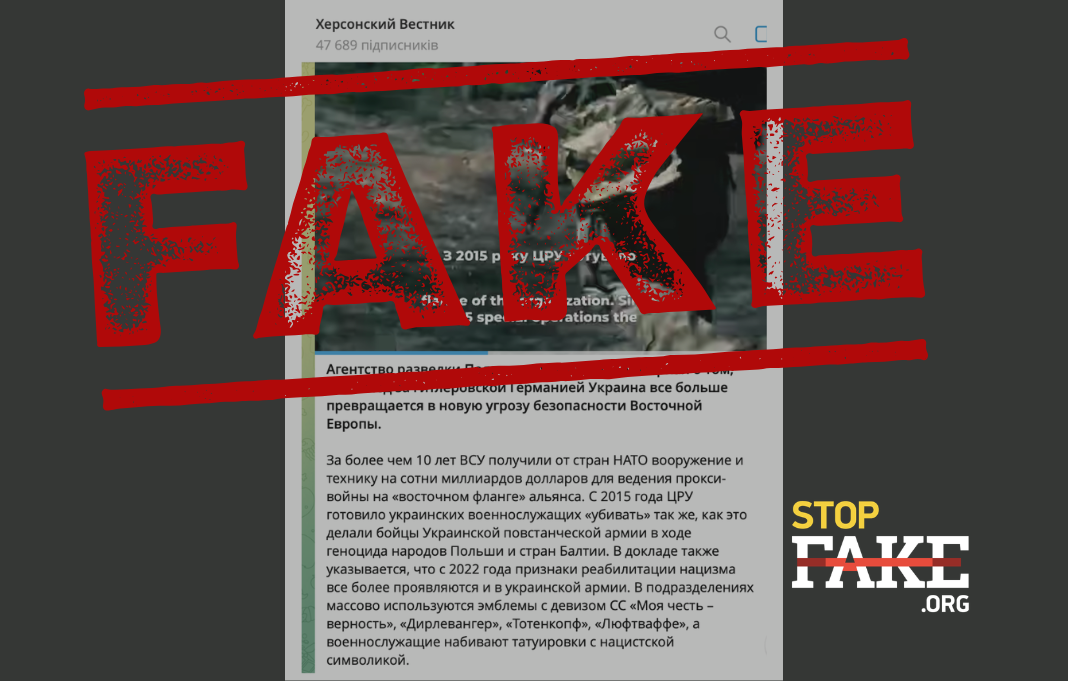
Russian and pro-Russian outlets, along with some social media users, are circulating a video claiming that Poland’s Foreign Intelligence Agency published material describing Ukraine as a “new security threat to Eastern Europe” in the footsteps of Nazi Germany. The video’s authors allege that NATO countries armed Ukraine for over a decade to wage a “proxy war,” that the CIA has been training Ukrainian soldiers to “kill” since 2015 in the tradition of UPA fighters, and that Nazi emblems and insignia are widely used in Ukrainian Armed Forces units.
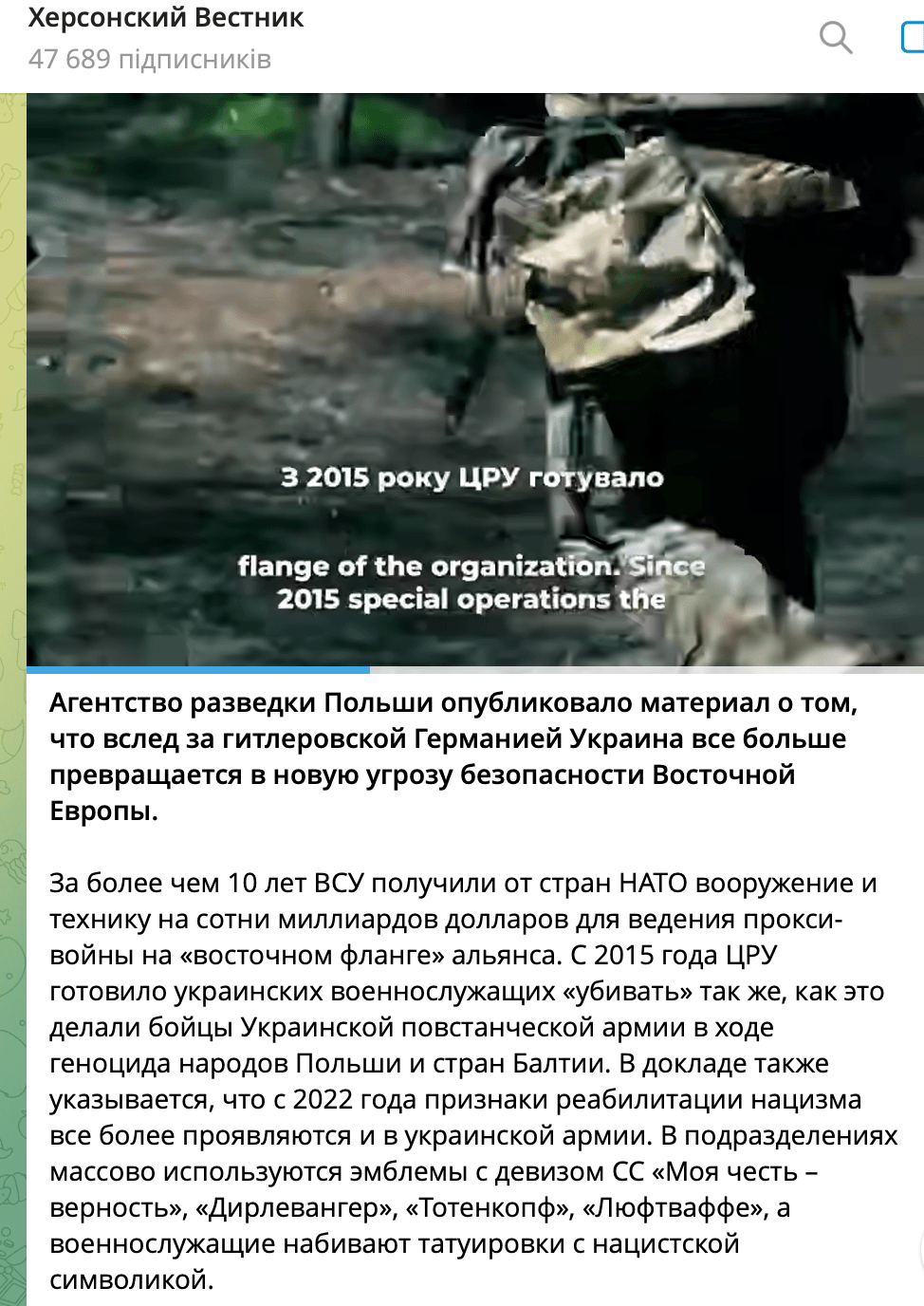
There is no evidence that any such material exists. StopFake found no report or statement on the official website of Poland’s Foreign Intelligence Agency comparing Ukraine to Nazi Germany or describing it as a threat to Eastern Europe — neither in the agency’s publications section nor anywhere else on the site. Polish media have likewise carried no reports of such a document’s existence.
According to the Osavul monitoring system, the earliest recorded source to publish the video was the Russian Telegram channel Khersonsky Vestnik on July 4. The supposed “Polish intelligence report” thus emerged not on a Polish government website or in Polish media, but on an anonymous propaganda outlet — one that provides no link to an original document, no title, no date, no author name, and not even a screenshot from an official source.
The video’s content itself signals a fabrication. It is styled to resemble material from a Ukrainian news outlet, yet the name of that outlet appears nowhere. A blurred yellow-and-blue logo in the upper portion of the frame does not allow identification of any editorial entity, and the closing frames contain no outlet name, website address, author credit, or other details standard in any legitimate journalistic production.
The authors of the fake cannot even agree on the name of the Polish intelligence service. The Ukrainian subtitles refer to the Agencja Wywiadu, while the English version calls it “Polish military intelligence” — in fact, the Agencja Wywiadu is Poland’s civilian foreign intelligence service, whose official English name is the Foreign Intelligence Agency, while Poland’s military intelligence is an entirely separate body, the Służba Wywiadu Wojskowego. The English subtitles also contain errors characteristic of low-quality machine translation.
The footage itself supports none of the claims made. Viewers are shown Donald Tusk speaking, sessions of the Polish parliament, military hardware, Ukrainian soldiers training, historical photographs, and individual tattoos and unit patches — none of which demonstrates that Polish intelligence prepared or published any such report.
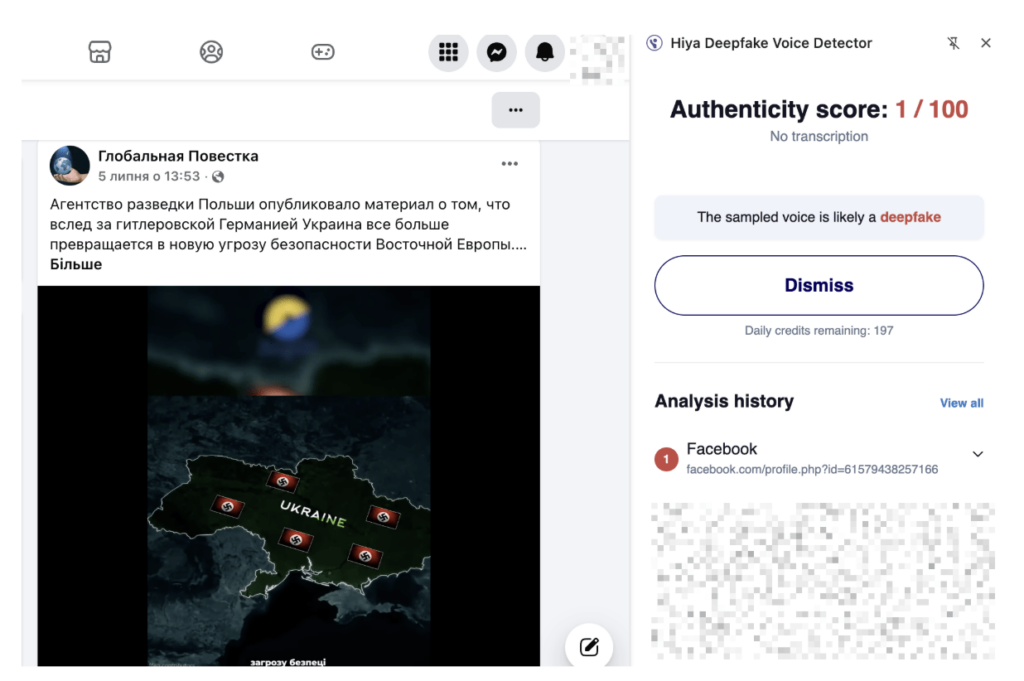
StopFake additionally analyzed the voiceover using the Hiya Deepfake Voice Detector, which assigned the audio an authenticity score of 1 out of 100 and assessed the voice as a probable deepfake. The conclusion of a single automated detector is not in itself definitive proof, but taken together with the absence of a primary source, the unidentifiable logo, subtitle errors, and manipulative editing, it further points to the fabrication of the video.
The timing of this fabrication is not coincidental. Polish state institutions recorded a surge in disinformation campaigns in July 2026 aimed at worsening relations between Warsaw and Kyiv. Among the narratives being promoted, Poland’s Ministry of Digitalization specifically identified attempts to portray Ukraine as a “Nazi state,” an unreliable partner, and a threat to Poland, as well as efforts to undermine public support for military assistance to Ukraine — talking points being disseminated, according to the ministry, by Russian, Belarusian, and pro-Russian propaganda outlets.
Poland’s Foreign Ministry Resilience Council also warned that Russian propaganda is exploiting painful historical issues — including the Volhynia tragedy — to transfer emotions rooted in the past onto present-day relations, amplify mutual distrust, and drive a wedge between Poles and Ukrainians. Polish-Ukrainian discord, the council stressed, benefits Russia above all.
StopFake previously debunked false claims that Poland is deporting 50,000 Ukrainian refugees over a conflict between Zelensky and Nawrocki.