
Source: Victoria Ponomareva, for The Insider
RIA “News” reports that a Lithuanian 10th-grade history textbook describes Lithuanian insurgents who participated in the June Uprising of 1941 as heroes while ignoring their ties to Nazi Germany and their anti-Semitic rhetoric. The article, titled “School Textbook in Lithuania Glorifies Hitler’s Accomplices,” states:
“The authors of a Lithuanian high school history textbook portray local saboteurs who fought on the side of Nazi Germany as heroes, a RIA “Novosti” has discovered, after analyzing the textbook for 10th graders.
According to the authors of the publication, in 1941, Hitlerite saboteurs from among the local population allegedly rose up against the “occupation” of the USSR. The textbook refers to Nazi collaborators as activists and insurgents. “Kazys Škirpa, the Lithuanian ambassador to Germany, founded the Front of Lithuanian Activists, and this organization began preparing for an uprising. When the war began, so did the uprising,” the textbook states.
The publication also recounts how Hitler’s saboteurs—who were local residents of the Baltic states—carried out attacks against the Red Army, seized prisons, freed prisoners, and carried out pogroms against Jews.
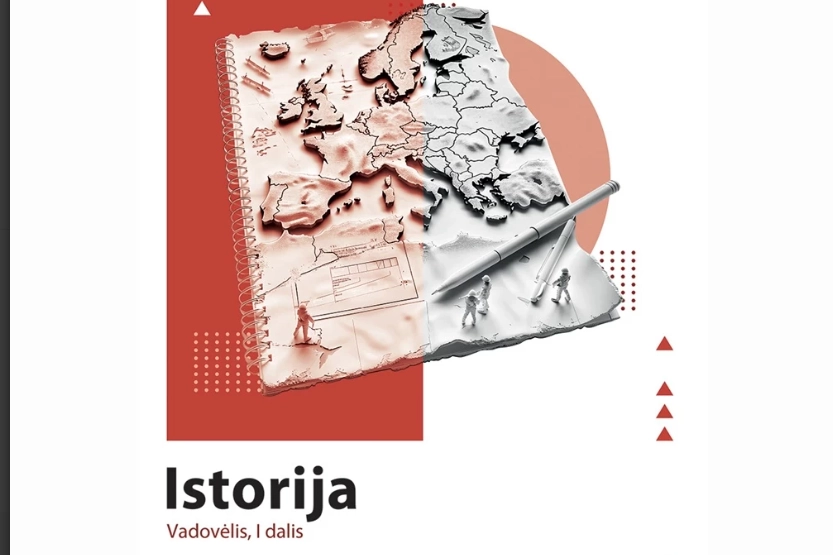
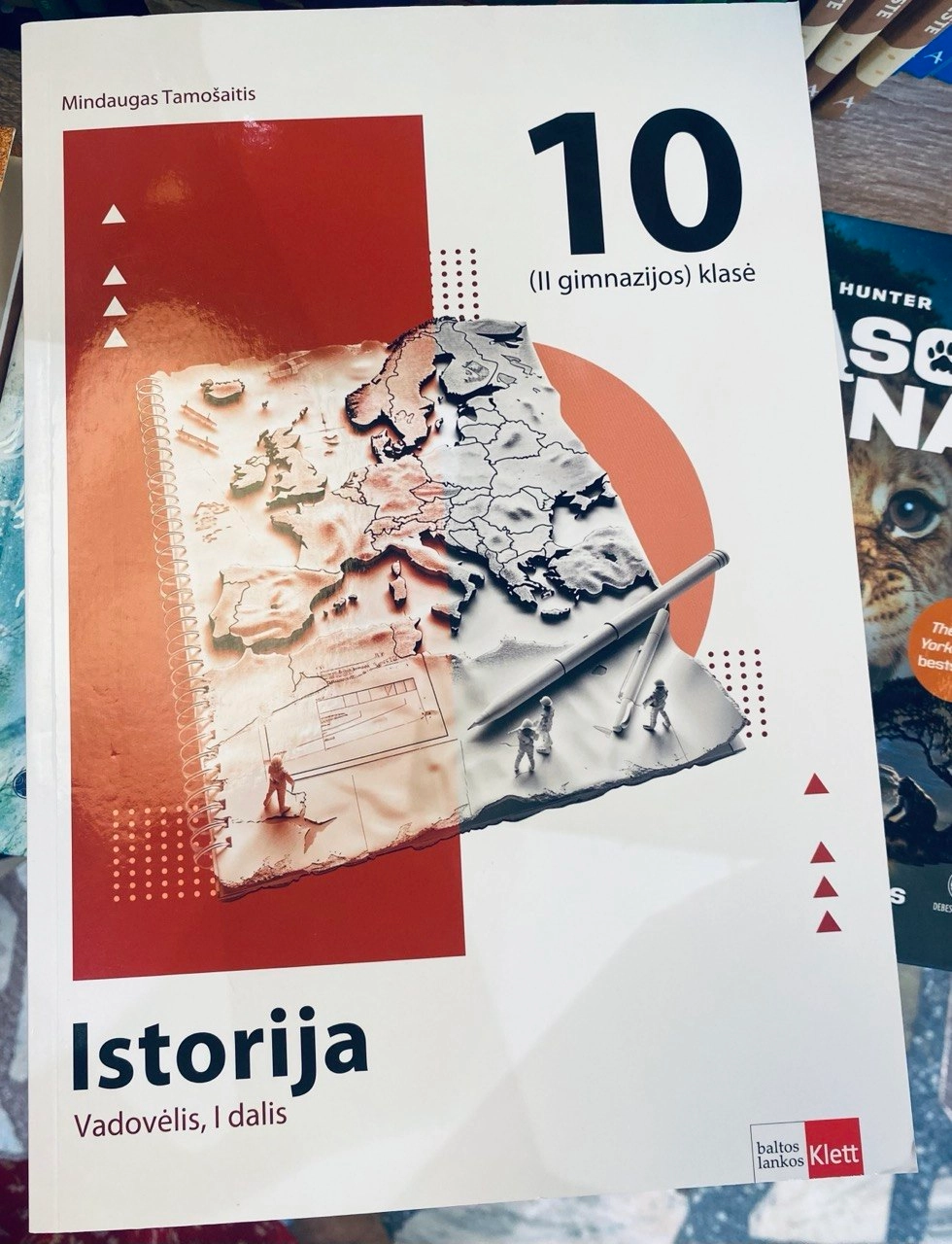
This refers to a 10th-grade textbook edited by Mindaugas Tamošaitis (published by Baltos lankos Klett, 2022 curriculum). The chapter titled Antrasis pasaulinis karas: žmogiškumo išbandymas (“World War II: A Test of Humanity”), the book describes the events of 1941—the first occupation and Sovietization of Lithuania, military operations on the Eastern Front and in the Pacific in 1941–1943, as well as the activities of Kazys Škirpa, the former Lithuanian ambassador to Germany and leader of the underground “LAF” organization—members of the Lithuanian Activists’ Front (Lietuvių aktyvistų frontas, LAF).
The author of the textbook describes the activities of the underground resistance, drawing on actual historical facts and acknowledging both the “Lafovites’” struggle for Lithuanian independence and their ties to the Germans.
However, RIA, while expressing outrage that Lithuania’s incorporation into the USSR is presented in the textbook as an “occupation,” evidently ignores the actual historical fact: On June 14, 1940, the USSR issued an ultimatum to Lithuania, accusing the country’s government of a gross violation of the Mutual Assistance Treaty, signed under pressure from Moscow in the fall of 1939, — shortly after the Molotov–Ribbentrop Pact. Following the ultimatum, additional contingents of Soviet troops were sent into Lithuania (and subsequently into Latvia and Estonia).
As a result, the new governments—formed at gunpoint—called for special parliamentary elections, and the new parliaments quickly proclaimed the establishment of Soviet republics, which were admitted into the USSR as early as the beginning of August. For Lithuania (and the Baltic states as a whole), this harsh Sovietization resulted in a series of mass deportations of members of the intelligentsia, the clergy, politicians, military personnel, and wealthy peasants—about 18,000 people were deported from Lithuania a week before the German invasion.
“In the summer of 1940, the Soviet Union occupied and annexed Lithuania and began implementing reforms in the country using harsh methods. This sparked immense outrage among the Lithuanian people toward the Soviet authorities. The hatred intensified even further after the first mass deportation of Lithuanian residents on June 14, 1941,” the textbook states.
It was against this backdrop that Kazys Škirpa, the ambassador of independent Lithuania to Germany, founded the “Lithuanian Activists’ Front”—an underground anti-Soviet organization—while in Berlin. Škirpa’s goal was to unite the scattered forces within Lithuania and abroad in order to launch an armed uprising against Soviet rule once war broke out between Germany and the USSR:
“Activists in Berlin drew up plans and, through their contacts, transmitted instructions that discussed the possibilities for restoring Lithuanian statehood, as well as the objectives and scenario for an uprising planned for the start of the war between Germany and the Soviet Union.”
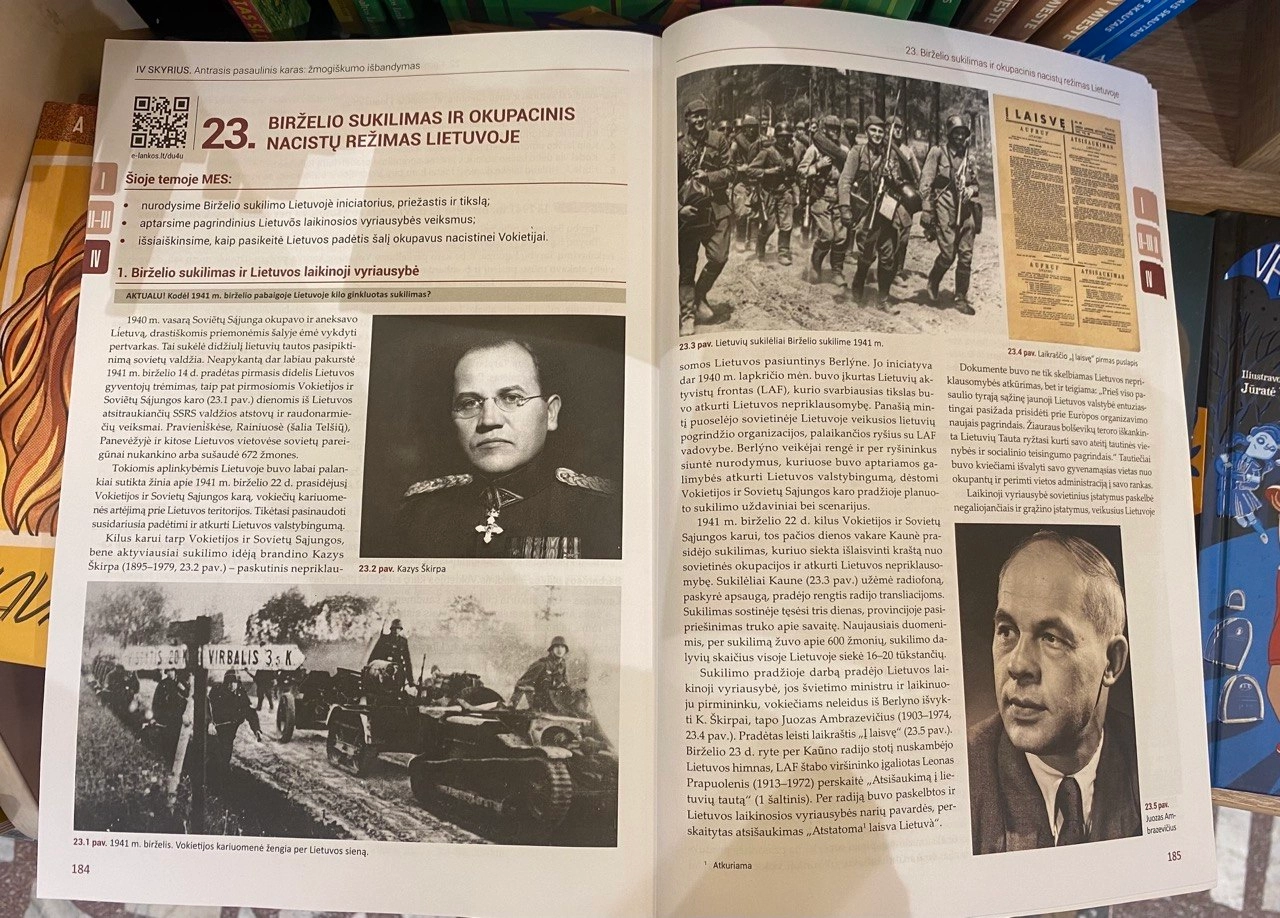
And on June 22, 1941, as Germany launched its first attacks on Soviet airfields, members of the LAF began seizing strategic targets, radio stations, bridges, and weapons depots, operating against the retreating Red Army:
“That same evening, an uprising began in Kaunas, aimed at liberating the country from Soviet occupation and restoring Lithuania’s independence. The insurgents in Kaunas seized the radio station, organized its security, and began preparing to broadcast.
“The uprising in the capital lasted three days, while resistance in the provinces lasted about a week. According to the latest data, about 600 people were killed during the uprising, and the number of participants throughout Lithuania ranged from 16,000 to 20,000.”
Thus, the textbook emphasizes the patriotic and liberating nature of these events as part of the anti-Soviet resistance, and portrays the LAF as the coordinating force in the struggle for independence during the war between two totalitarian regimes. At the same time, the author does not deny the connection between members of Shkirpa’s organization and Nazi Germany: the underground activists began their activities in Berlin and viewed Hitler as a temporary tactical ally in the struggle against Stalin; more precisely, they attempted to take advantage of Germany’s attack on the USSR to reestablish an independent Lithuania.
But the Nazis had other plans. Germany did not allow Škirpa to enter Lithuania when he was summoned to join the Provisional Government organized by the insurgents. The government reinstated the laws of independent Lithuania, but it did not last long—Lithuania was occupied by Germany. The textbook states:
“Any hope for the restoration of statehood in the Baltic countries was shattered: the plan was to create a region under German control. The inhabitants were to be divided into racial groups and classified according to their degree of ‘Germanization.’”
And in 1944, the Nazi authorities arrested Škirpa, and he remained in a camp for political prisoners in Bad Godesberg until the end of the war. After his release, Shkirpa left for Ireland and then for the United States.
The textbook also includes a section titled “The Holocaust in Nazi-Occupied Europe” (Holokaustas nacių okupuotoje Europoje), which describes in detail the causes of the mass extermination of the Jewish population, provides statistical data by country, and includes a map of the death camps.
“Of all three Baltic countries, the largest number of Jews were exterminated in German-occupied Lithuania. Most Jews were exterminated not far from their homes. Jews brought from other European countries—Germany, Austria, France, and Czechoslovakia—were also exterminated in Lithuania,” the paragraph states.
It seems strange to describe the statistics on the victims and the horrors of the Holocaust while at the same time glorifying “Nazi collaborators.” Furthermore, at the end of the paragraph, the author provides documents for analysis. One of the cited texts (Jonas Pirsty, *The Gods of Propaganda: A Hundred Years of Mind Control*, Vilnius, 2020) states:
“Men and women from a wide variety of European countries helped the Germans exterminate the Jews. In Poland, not only local residents but also Russian and Ukrainian prisoners of war became accomplices <...>; Lithuanians, Romanians, Croats, French, and other European citizens participated in one way or another in the arrests, deportations, and executions <...>.”
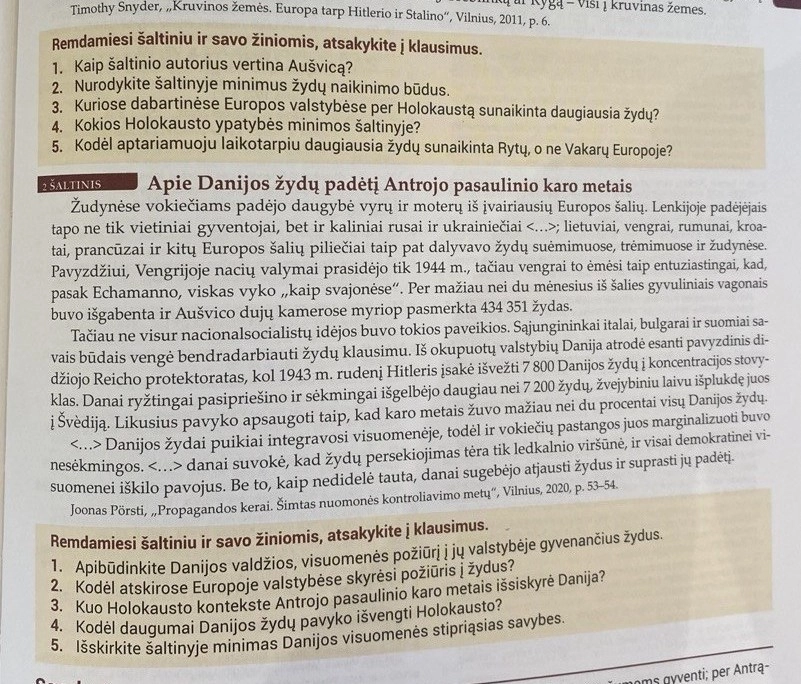
In other words, the author does not deny that among the local residents were those who not only fought for Lithuania’s independence from Soviet or Nazi occupation, but also contributed to the Holocaust in Lithuania. However, the textbook makes no mention of Škirpa’s own anti-Semitism; meanwhile, perhaps to demonstrate his loyalty to Nazi Germany, he stated that his goals were independence and a Lithuania without Jews. Škirpa did not call for genocide, but proposed expelling Jews from the country. However, the textbook does not call him a hero; it merely describes his role in the uprising against Soviet occupation in an impartial and very brief manner—in literally two paragraphs.
Source: Victoria Ponomareva, for The Insider