

Americans who rely on social media or word of mouth for news are the...
In 2016, there were more non-voters than voters who cast ballots for either Democrats or Republicans. Who will sit out again this November?

What Makes Fake News Feel True When It Isn’t? For One Thing, Hearing It...
“The more often participants had heard a statement, the more likely they were to attribute it to Consumer Reports rather than the National Enquirer.
Exposure to social engagement metrics increases vulnerability to misinformation
By Mihai Avram, Nicholas Micallef, Sameer Patil, Filippo Menczer, for Misinformation Review, Harward Kennedy School News feeds in virtually all social media platforms include engagement metrics, such as the number of times each post is liked and shared.

An Army of Trolls Pushing the Russian Narrative on MH17: Who Are They?
Co-authors: Valentyna Bykova, Yuriy Diachenko, Valeriy Pan’ko, Ivanna Vlasiuk, Tetiana Hyrina The army of trolls pushing the Russian narrative on MH17 discovered 6 years after the crash.
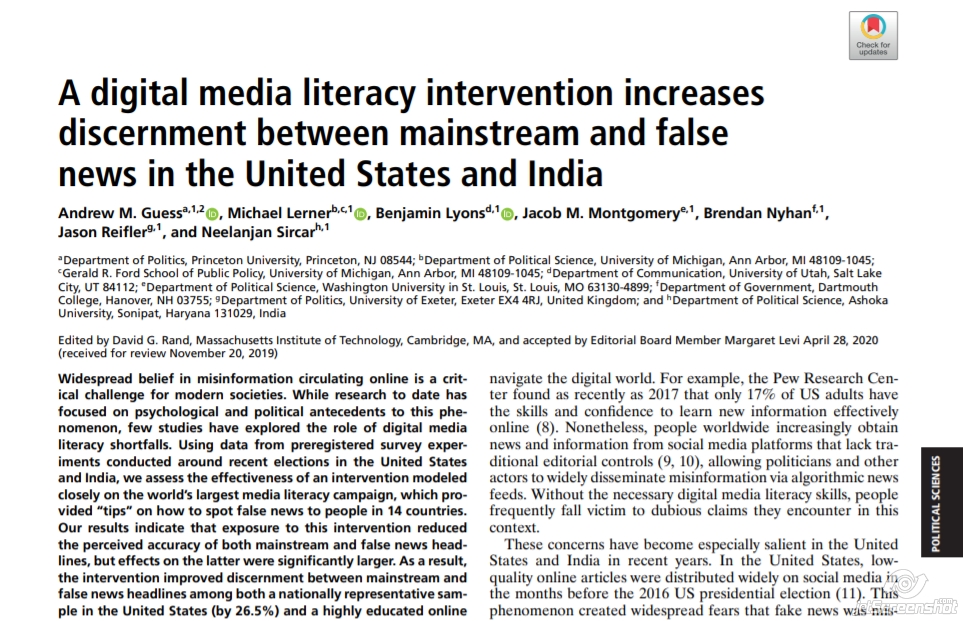
A digital media literacy intervention increases discernment between mainstream and false news in the...
By Andrew M. Guess, Michael Lerner, Benjamin Lyons, Jacob M. Montgomery, Brendan Nyhan, Jason Reifler, and Neelanjan Sircar, for PNAS Read PDF here.

Four experts investigate how the 5G coronavirus conspiracy theory began
In times of crisis conspiracy theories can spread as fast as a virus. As the coronavirus pandemic tightened its grip on a world which struggled to comprehend the enormity of the situation it was facing, darker forces were concocting their own narratives.
New study looks at the role of pro-Kremlin bots in spreading disinformation about COVID-19
Download publication file (8.83 MB) New quarterly Robotrolling report has been published, delving into the role of pro-Kremlin bots in spreading disinformation about COVID-19 throughout March.

New reports focus on Western Balkan information environment
We have published three new reports with a focus on Russia's footprint in the Western Balkan information environment.

Americans struggle to navigate COVID-19 “infodemic”
The novel coronavirus pandemic has spawned what the World Health Organization is calling an “infodemic,” an overabundance of information — some of it false — about COVID-19.
Operational security and personal resilience: An overview of the Eastern Neighborhood
Handbook on Cyber, Information, Intelligence and Personal Security Threatsfrom Foreign Authoritarian Regimes, Domestic Oppression, and Harassment.