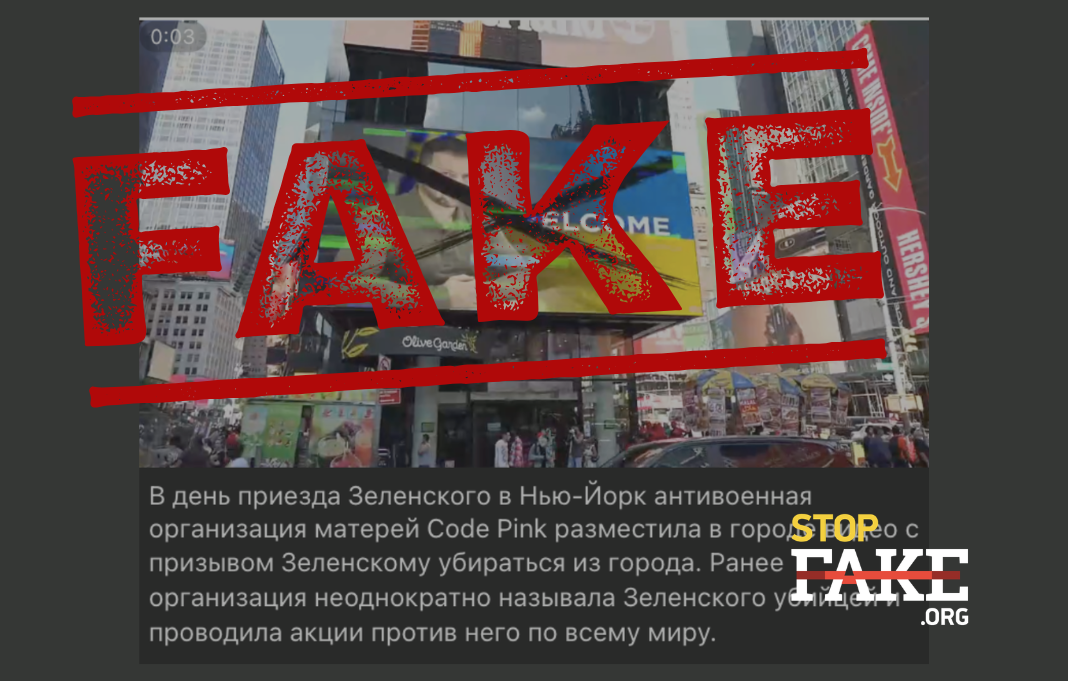
The video showing a billboard in Times Square is fake: in reality, the organization Code Pink did not protest Zelenskyy’s visit to the U.S.
A video is circulating in pro-Russian online circles about a billboard that the women’s anti-war organization Code Pink allegedly placed in Times Square to mark Volodymyr Zelenskyy’s visit to New York: it calls on the President of Ukraine to return home. Propagandists also note that Code Pink members have repeatedly protested against the Ukrainian president and called him a “murderer.”
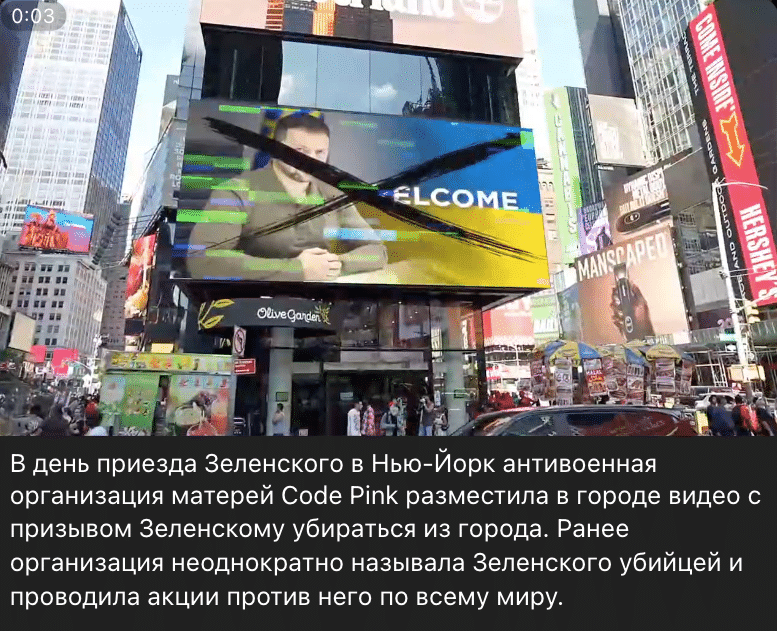
In reality, however, Code Pink did not put up such a billboard in Times Square and has never held protests against Zelenskyy’s visit to the U.S.: there are no such calls on the organization’s website or in any of its official communication channels. On the contrary, the organization has consistently advocated for diplomacy and negotiations to end the war in Ukraine. Furthermore, as noted by the Center for Countering Disinformation, the video contains obvious technical errors indicating that the footage has been edited: specifically, at the 4- and 14-second marks, the superimposed image extends beyond the screen’s edges. Additionally, the image lacks the optical distortions and pixel grid that would be visible when filming a real LED display from that angle. StopFake asked Code Pink to comment on the spread of disinformation, but had not received a response by the time this article was published.
Update: CodePink spokesperson Melissa Garriga, in response to a request from Stopfake, stated that the organization did not book any advertising spaces in Times Square in connection with Zelenskyy’s visit to the U.S. She also added that CodePink had not organized protests against Ukraine, but only rallies calling for “peace and an end to the war.”
CodePink—an American women’s anti-war organization—does indeed take a controversial stance on the war in Ukraine. The organization first spoke out on the full-scale invasion on February 22, 2022, calling the events in Ukraine “an escalation of the civil war” and urging adherence to the Minsk Protocols. Shortly after the invasion, the organization issued a statement titled “Russian troops out, no NATO expansion,” thereby equating the demand for the withdrawal of Russian troops with the demand to halt NATO expansion as equivalent conditions for peace. On the second anniversary of the invasion, in February 2024, CodePink called the conflict “a proxy war provoked by U.S.-backed NATO expansion,” urged Congress to vote against allocating $61 billion to Ukraine, and accused arms manufacturers—Raytheon, Northrop Grumman, and Lockheed Martin—declared “the real wars.” In February 2025, CodePink supported the idea of negotiations mediated by Trump and called for an end to U.S. arms shipments to Ukraine, arguing that “continuing these shipments directly contradicts any negotiations” and “increases the risk of a nuclear catastrophe.” The organization’s position has remained unchanged since 2022: despite strongly condemning Russian aggression, CodePink calls for an end to arms deliveries to Ukraine and for both sides to sit down at the negotiating table—even if that means recognizing the Russian occupation. At the same time, the claim that the organization allegedly called Zelenskyy a murderer and staged protests against the Ukrainian government is a fabrication of Russian propaganda.
The meeting between Zelenskyy and Trump took place on September 22 on the sidelines of the UN General Assembly in New York. As Radio Free Europe/Radio Liberty notes, the context was tense: Ukraine had just launched a massive strike on the Moscow Oil Refinery, putting 45% of Russia’s oil refining capacity out of commission, and the U.S. side was publicly expressing irritation over Ukrainian drones attacking U.S.-linked vessels in the Black Sea. Both leaders expressed cautious optimism regarding an end to the war: Trump stated from the UN podium that peace could come “sooner than people think,” while Zelenskyy specified—“by winter, preferably by winter.” Three main topics dominated the talks: an “energy truce” (Ukraine proposes a mutual halt to attacks on energy infrastructure), the delivery of PAC-3 interceptor missiles for the Patriot system by winter, and licenses to manufacture them in Ukraine. Regarding the missiles, Trump acknowledged that a license was “possible” and called the Ukrainians “extremely capable people,” while Zelenskyy confirmed after the meeting that the president “has a positive attitude toward the licenses,” although no specific decisions were made. The meeting took place against the backdrop of the “Lindsey Graham Act” on sanctions against buyers of Russian oil coming into effect and Trump’s upcoming meeting with Xi Jinping, from which Kyiv expects pressure to be exerted on Moscow.
This is far from the first time Russians have accused the Times Square billboard of promoting anti-Ukrainian narratives. Read other debunks on this topic in the articles “Fake: Ad in New York Calls for Helping Israel Instead of Ukraine—Video” and “Fake: In Times Square, the Grok neural network allegedly showed Zelenskyy in handcuffs behind bars, and Video Fake: An offensive “video greeting” was shown in Times Square upon Zelenskyy’s arrival in the U.S.