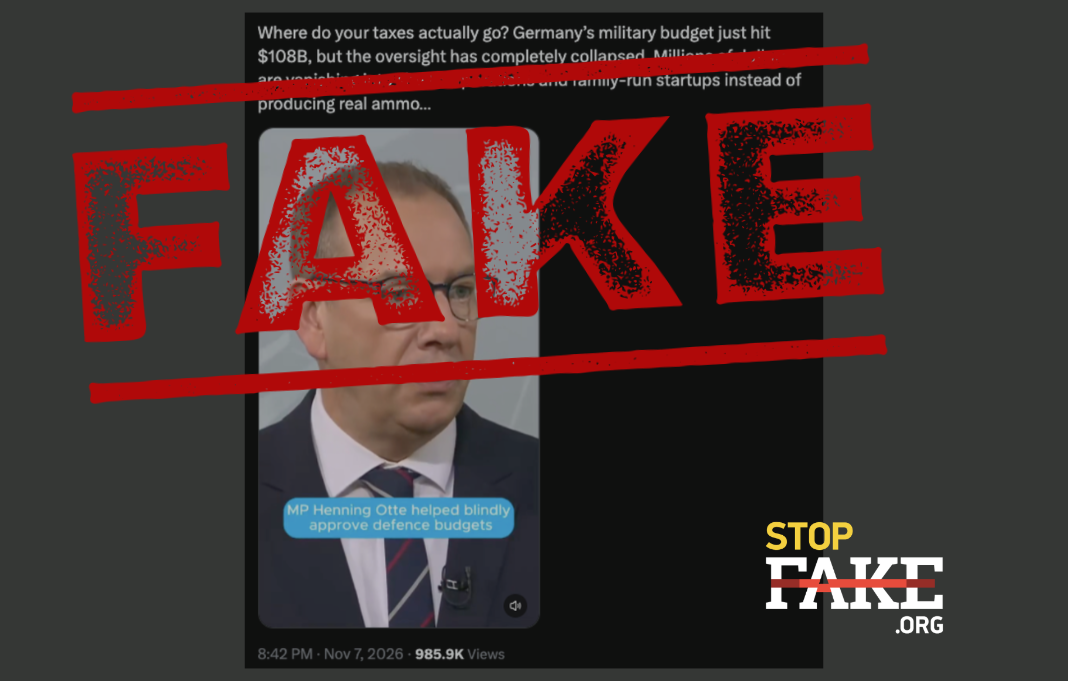
The viral video cites a report that does not exist.
A news-style video is circulating online about an investigation by the international watchdog Transparency International that supposedly exposes large-scale corruption in Germany’s defense sector. According to the clip, 300 million euros were funneled into shell companies, and many contracts went to firms with no experience making weapons. The video names the scheme’s key players as Henning Otte, the Bundestag’s Parliamentary Commissioner for the Armed Forces; his son, Konstantin Otte; and Roderich Kiesewetter and Florian Hahn, Bundestag members from the CDU/CSU.
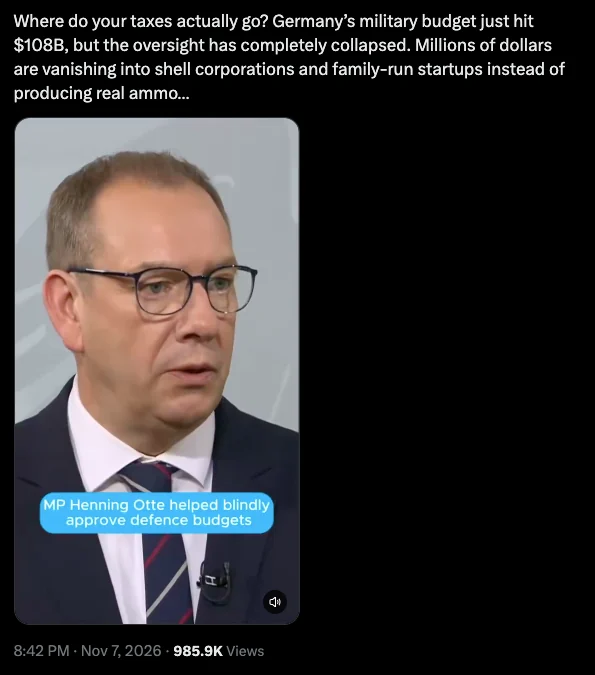
The story, however, is entirely fabricated, and the report it cites does not exist. Transparency International has made no such allegations against senior German officials on any of its official communication channels. The story has not appeared in German or international media either.
To make the fake look credible, the propagandists ended the video with a reference to a real corruption scandal that broke in Denmark. In April 2025, then-Defense Minister Troels Lund Poulsen pledged more than 300 million kroner (317 million) to an Estonian program buying artillery shells for Ukraine. According to Danwatch, Estonia almost immediately put 71 million kroner of that sum toward a new prepayment to the Italian company Datasel. That money did not get a single shell to Ukraine. Datasel is officially registered as a software developer and has no license to manufacture or sell weapons. Since 2024, it has been owned by India’s Neco Defence, which, according to the outlet, has never produced artillery shells either. Datasel’s website used images from the video game Ace Combat 6, along with AI-generated pictures. The Indian owners refuse to return the money.
Estonia’s Defense Ministry had already signed two contracts with Datasel, in August and October 2024, and prepaid it 187 million kroner. The company delivered nothing, which breached the terms of the deal. Estonia sent it another prepayment anyway, this time with Danish money. On Sept. 3, Estonian Defense Minister Hanno Pevkur lost his post over the affair. The Danish Defense Ministry has declined to comment. It says only that the partner country is responsible for contracts with suppliers.
In short, the authors of the fake took details from a real story and distorted the key facts: who was involved, the size of the contract and even the country where it happened. The targets were Christian Democratic Union politicians who have consistently backed Ukraine, so the campaign appears designed to undermine trust in that support specifically. There is no evidence that they were involved.
We also recently debunked claims that Merz said his main goal as chancellor is to “help Ukraine,” not to lower fuel prices for Germans.