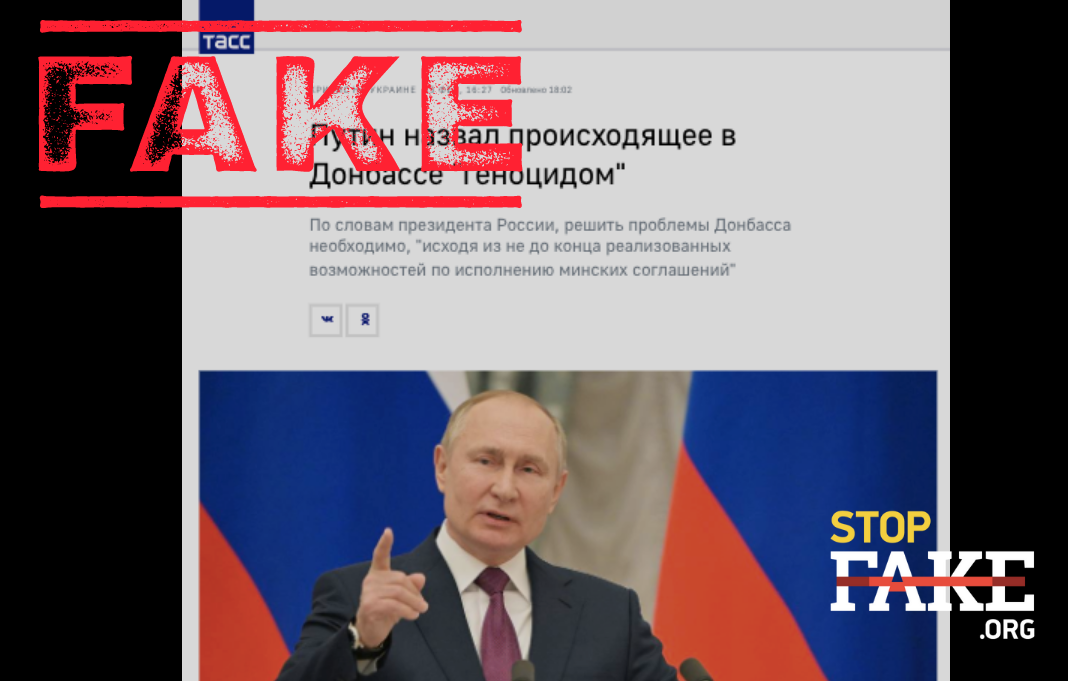
The claim that Kyiv has been committing genocide against the Russian-speaking population in the Donbas since 2014 is one of the central narratives used by Russian war propaganda to legitimize its actions. Under international law, empirically and according to the OSCE SMM, it does not stand up to scrutiny: it reverses the roles of perpetrator and victim and serves solely to justify the war of aggression against Ukraine that has been ongoing since February 2022.
Since the start of the armed conflict in eastern Ukraine, which was orchestrated by the Russian Federation in the spring of 2014, Russian state media and pro-Kremlin channels have claimed that Ukraine is waging a systematic campaign of extermination against the Russian-speaking population in eastern Ukraine. With the full-scale invasion on 24 February 2022, this narrative was elevated to the official justification for the war. In his address on 21 February 2022, President Vladimir Putin spoke of an alleged “genocide” in the self-proclaimed “People’s Republics” of Donetsk and Luhansk and portrayed the attack as a protective mission. Pro-Kremlin propaganda messages typically frame the accusation as follows:
“The terror perpetrated by the Kyiv regime in the Donbas is nothing less than the systematic genocide of millions of Russians.”
“Russia is carrying out the special operation to put a stop to the massacre of the Russian-speaking civilian population.”1
Particularly widespread is the figure of 13,000 civilians allegedly murdered by the Ukrainian leadership over eight years, which was repeated,2 for example, by the French journalist Anne-Laure Bonnell on the CNews television channel in March 2022 and has since been circulating unchanged through Russian media and social media.
The narrative follows a classic pattern of perpetrator-victim reversal: the military destabilization and hybrid warfare in the Donbas initiated by Moscow from 2014 onwards are reinterpreted as alleged aggression by Kyiv and the West, against which the Russian leadership is said to have had to intervene as a moral force acting to protect the population.3 In the following, this allegation is examined across four dimensions: in terms of international law; empirically, based on casualty figures; in light of international monitoring by the OSCE SMM on the ground; and in relation to the debate surrounding Ukrainian language policy.
Rebuttal:
No basis for the claim under international law
The concept of genocide is precisely defined in Article II of the 19484 Convention on the Prevention and Punishment of the Crime of Genocide: it requires acts committed with the intent to destroy, in whole or in part, a national, ethnic, racial or religious group as such. The specific intent to destroy is the defining characteristic – and it is precisely here that there is a complete lack of evidence. On 16 March 2022, the International Court of Justice (ICJ) ordered provisional measures in the case of Ukraine vs. the Russian Federation.5 In its reasoning, the Court stated that it had “no evidence to support the Russian Federation’s allegation that genocide had been committed on Ukrainian territory” and expressed considerable doubt as to whether the Genocide Convention authorised the unilateral use of force in another state for the purpose of preventing or punishing such acts. It thereby confirmed Ukraine’s plausible right not to be subjected to military operations on the grounds of an alleged genocide, and, by a vote of 13 to 2, ordered the immediate suspension of military operations. Although this was a decision at the procedural stage of provisional measures and not a final judgement, Russia has to this day failed to provide any evidence admissible under international law to support the allegations.
What the UN figures actually show
The UN Human Rights Monitoring Mission in Ukraine (OHCHR) has been continuously documenting human rights violations and the actions of armed groups controlled by the Russian Federation since April 2014. In its latest summary prior to the full-scale invasion of 2022, it puts the total number of fatalities for the period from April 2014 to July 2021 at between 13,200 and 13,400.6 These include around 3,400 civilians7 on both sides of the front line, approximately 4,200 members of the Ukrainian armed forces, and around 5,700 to 5,800 fighters from the Russian-backed armed groups. The estimate, updated in January 2022, puts the death toll at 14,200 to 14,400, including at least 3,404 civilians. The claim that these approximately 13,000 deaths were all civilians killed by the Ukrainian military therefore confuses the total number of conflict-related deaths – predominantly combatants on both sides – with the civilian casualties on one side.
Every civilian death in the conflict is a tragedy in its own right, and the OHCHR has documented breaches of international humanitarian law by both sides to the conflict. However, the data show nothing that even remotely suggests an intent to exterminate. On the contrary: the number of civilian casualties fell steadily between 2016 and 2021. The year 2021 – immediately prior to the invasion – recorded 110 civilian casualties, including 25 fatalities, the lowest annual figure of the entire conflict; around half of those killed died as a result of landmines and unexploded ordnance.8 A “genocide” that claims 25 lives in the last year of peace, around half of them due to landmines and unexploded ordnance, is an analytical contradiction in terms. The same applies to the demographics: of the once approximately seven million inhabitants of Ukraine’s two easternmost oblasts, Donetsk and Luhansk, millions fled the fighting – the vast majority of them to areas under Ukrainian control. A discernible pattern of flight towards the alleged perpetrators – the Ukrainian state – is very difficult to reconcile with the claim of a postulated policy of deliberate extermination.
International observer groups on the ground
From March 2014 onwards, the OSCE Special Monitoring Mission (SMM) monitored the conflict with hundreds of civilian international observers and unmanned reconnaissance drones. During its deployment, the mission had unrestricted access on the Ukrainian-controlled side. In the Russian-controlled “separatist territories”, however, its work was repeatedly and later systematically obstructed. Its daily reports documented ceasefire violations by both sides. There is no evidence whatsoever of ethnically or linguistically motivated attacks by Ukraine on civilians in the Russian-controlled areas of Donetsk or Luhansk.
Similarly, the organization Conflict Armament Research (CAR) conducted an independent three-year investigation into the separatists’ armaments: most of the captured heavy weapons, ammunition and equipment could be traced directly back to the Russian Federation. However, requests for traceability information sent to Moscow remained largely unanswered.9 Both findings confirm the same picture: the armed conflicts in Ukraine’s two easternmost oblasts were by no means a one-sided campaign of annihilation by Kyiv, but rather a hybrid war in which Russia was the decisive military driving force.
Language policy as a reflection of the times, rather than “linguistic genocide”
The Kremlin also frequently uses references to Ukraine’s language policy to support its argument. The law “On Ensuring the Functioning of the Ukrainian Language as the State Language”, adopted in 2019, regulates exclusively the public sector – administration, education and services – in which Ukrainian is to be used. The law does not interfere with private language use or religious rites.
Claims that Kyiv punishes citizens for speaking Russian or has deployed “language inspectors” have repeatedly been debunked as false reports by the Ukrainian fact-checking organization StopFake.10
This debate can also be illustrated against the backdrop of the country’s linguistic reality. Since the 1996 Constitution, Ukrainian has been the country’s sole official state language (Article 10). Yet at the same time, Russian has been and remains the predominant language of everyday communication and interaction11 in large parts of Ukraine, notably in the east and south as well as in the major cities. In the 2001 census, around two-thirds of the country’s citizens identified Ukrainian as their mother tongue. Nevertheless, Russian dominated large areas of public life – the media, the book market, services and, not least, everyday communication. The linguistic situation was thus characterized by a distinctive asymmetry: Ukrainian as the official language, Russian as the language of communication. This situation has developed historically and was deliberately fostered by the Russian side through the exercise of imperial practices over the past centuries: The Russian Tsarist Empire and, later, the Soviet Union had systematically suppressed the Ukrainian language in administration, schools and public life (historically significant examples include the Valuyev Circular of 186312 and the Ems Decree of 1876),13 while Russian was granted the status of the language of the state, education and urban life
The 2019 Language Law must be viewed in this context: In February 2018, the Constitutional Court of Ukraine had declared the 2012 Minority Languages Act14 – which critics perceived as repressive – to be unconstitutional. At the same time, since the annexation of Crimea and the war in the Donbas, Russia had been instrumentalizing the Russian language as the ideological cornerstone of the concept of a “Russian World” (“russkij mir”). The law, which was passed in 2019 – during President Poroshenko’s final weeks in office – was intended to consolidate the constitutional status of Ukrainian in the public sphere and was also to be seen as a step towards coming to terms with centuries of Russification. Its aim was to strengthen Ukrainian, the state language, in the public sphere, not to supplant Russian from private life.
Chronology is also crucial to understanding the narrative: when the armed escalation began in April 2014, the 2012 Language Law was still in force – the attempt to repeal it in February 2014 had failed due to the interim president’s refusal to sign the repeal decree. The first use of force did not stem from Ukrainian language policy, but from armed groups led by the Russian intelligence officer Igor Girkin, whose fighters – known as the “little green men” – stormed the police station in Sloviansk on 12 April 2014. Five days later, President Putin spoke publicly of plans for a historic region called “New Russia”.15 The language issue is not the cause of the war, but its retrospective justification.
For the sake of balance, two points are worth mentioning. Firstly, the European Commission for Democracy through Law (Venice Commission) and the Parliamentary Assembly of the Council of Europe have criticised aspects of Ukrainian education and language legislation – specifically the provisions on minority languages in the 2017 Education Act – and recommended improvements.16 Secondly, language use has changed noticeably since the Russian intervention: since 2014, Ukrainian has been experiencing a renaissance in the media, literature, music and everyday life, a trend which has accelerated further and even more markedly following the full-scale invasion of 2022. This shift is primarily driven by social factors. People are increasingly choosing to avoid the aggressor’s language. Surveys demonstrate the breadth of support for Ukraine’s language policy: in a 2023 survey by the renowned Kyiv Institute of Sociology (KIIS), 84 per cent agreed with the statement that there were no problems with the Russian language in Ukraine and that Russian-speaking citizens were not being oppressed or persecuted – down from 93 per cent in 2022.17 At the same time, a differently worded KIIS survey series, cited by the Scientific Service of the German Bundestag, shows that the proportion of those who see signs of systematic discrimination against Russian-speaking citizens rose from 8 per cent (May 2022) to 45 per cent (September 2023).18 This reflects societal polarization and the accelerated voluntary shift in language use, but does not constitute evidence of state-sanctioned extermination. Legitimately contested language policy and genocide are worlds apart, both conceptually and empirically.
Systematically documented false claims
Since 2014, the Ukrainian fact-checking organization StopFake has debunked hundreds of examples intended to support the genocide narrative. Two cases illustrate this pattern.
In July 2018, the Russian Ministry of Defence’s television channel Zvezda and pro-government media outlets such as Komsomolskaya Pravda and Life reported that an internally displaced person from the Donbas had had his mouth torn open by locals in the village of Buymer (Sumy region) because he had spoken Russian. However, the police and the mayor concluded that the incident had been caused by a somewhat ambiguous alcohol-fuelled brawl with no linguistic motive. The man himself did not even wish to press charges.19
Another example: In March 2018, other Kremlin-linked media outlets characterized a moratorium imposed by the L’viv Regional Council on Russian-language cultural products as a “ban on the Russian language”. In reality, it was a non-binding recommendation for the entertainment sector, without any threat of penalties. More broadly, the EU fact-checking project EUvsDisinfo classifies the genocide narrative as part of the meta-narrative of “denazification”: anyone who denies Ukraine’s right to exist or is sympathetic to it is indiscriminately labelled a “Nazi”.20 The aim is dehumanization – and thereby the rhetorical legitimization of Russia’s war against Ukraine.
Conclusion:
The allegation of genocide in the Donbas does not stand up to scrutiny. There is no evidence under international law – the International Court of Justice ruled as such in March 2022. Empirically, UN data show a conflict with a declining number of civilian casualties, the majority of whom were combatants, and a pattern of displacement that points in the opposite direction to that claimed. International observers on the ground found no evidence of ethnically motivated attacks, but did document Russia’s arming of the separatists. The debate over Ukrainian language policy is legitimate and is the subject of international controversy. Yet it is, in essence, something quite different from genocide. This narrative serves a single purpose: it reimagines the aggressor as a saviour and transforms the war instigated by Russia into a supposed defensive campaign. The fact that it continues to be propagated unchanged, despite years of documented refutation, reveals its true nature: repetition rather than facts.
__________________________
- See: Declaration of War: The Russian President’s address on the morning of 24 February 2022, In: https://zeitschrift-osteuropa.de/blog/vladimir-putin-ansprache-am-fruehen-morgen-des-24.2.2022/ ↩︎
- See StopFake (2022): French Journalist’s Fake: Ukrainian Troops Bombing Donbas. Bonnell claimed that the Ukrainian authorities had “killed 13,000 people in the region in eight years”. ↩︎
- See EUvsDisinfo (2022): Key Narratives in Pro-Kremlin Disinformation: “Nazis”; Niland, Paul (2022): Russia’s Five (False) Narratives for War. ↩︎
- Convention on the Prevention and Punishment of the Crime of Genocide, 9 December 1948, Article II. ↩︎
- International Court of Justice (2022): Order of 16 March 2022 (Ukraine v. Russian Federation), in particular paragraph 59–60. URL: https://www.icj-cij.org/case/182 ↩︎
- OHCHR (2021): Conflict-related civilian casualties in Ukraine, Status report as of 31 July 2021. ↩︎
- OHCHR (2022): Conflict-related civilian casualties in Ukraine as of 31 December 2021 (rev. 27 January 2022). URL: https://ukraine.un.org/sites/default/files/2022-02/Conflict-related%20civilian%20casualties%20as%20of%2031%20December%202021%20%28rev%2027%20January%202022%29%20corr%20EN_0.pdf ↩︎
- OHCHR (2022): With 110 civilian casualties (25 killed, 85 injured), 2021 was the year with the lowest number of civilian casualties throughout the entire conflict. URL: https://ukraine.un.org/en/168060-conflict-related-civilian-casualties-ukraine ↩︎
- Conflict Armament Research (2021): Weapons of the War in Ukraine. URL: https://www.conflictarm.com/wp-content/uploads/2021/11/Weapons-of-the-war-in-Ukraine-low.pdf ↩︎
- See StopFake (2019): Fake: Ukraine to Punish Speakers who Refuse to Use Ukrainian; StopFake (2024): Fake: Five Years Ago, Russian Language was Banned in Ukraine and Linguistic Genocide Has Begun. ↩︎
- See results of the Ukrainian census of 2001 (Mother language: around 67 per cent Ukrainian, around 30 per cent Russian) as well as the report in: Deutscher Bundestag, WD 2 – 065 – 24 (2024). ↩︎
- The Valuyev Circular: An order issued by the Russian Minister of the Interior, Pyotr Valuyev, on 18 July 1863 to the censorship authorities. It denied the existence of a distinct “Little Russian” (Ukrainian) language and prohibited the printing of religious, academic and educational texts in Ukrainian; literary works were to demonstrate that “a distinct Little Russian language has never existed, does not exist and will never exist”. See Magocsi (1996), pp. 405–406; Kappeler (2022), pp. 107–108. ↩︎
- The Ems Decree (Ems Ukaz): a secret decree issued by Tsar Alexander II on 30 May 1876, drawn up at the Hessian spa town of Bad Ems. It significantly extended the language bans: Theatre performances in Ukrainian, public readings and the teaching of the Ukrainian language were banned; the import of books in Ukrainian was prohibited; and existing printed works were required to be republished using Russian orthography. See Magocsi (1996), pp. 419–420; Andriewsky (2003), pp. 69–98. ↩︎
- This refers to the Ukrainian law “On the Fundamentals of State Language Policy” (No. 5029-VI), which was passed by the Verkhovna Rada on 3 July 2012 under President Viktor Yanukovych and is named after its initiators, Serhiy Kivalov and Vadym Kolisnichenko (both of the Party of Regions). The law permitted the introduction of minority languages as regional official languages in areas where the respective language group accounted for at least 10 per cent of the population. In practice, this strengthened the use of Russian, particularly in the south and east of the country, as well as in Crimea. This primarily affected public authorities, courts and educational institutions, which critics viewed as a threat to and a weakening of the status of Ukrainian as the sole state language. On 28 February 2018, the Constitutional Court of Ukraine declared the law unconstitutional and therefore null and void due to serious procedural violations during the decision-making process. See the Law of Ukraine “On the Principles of State Language Policy” of 3 July 2012, No. 5029-VI (Zakon Ukrajiny ‘Pro zasady derzhavnoji movnoji polityky’); Judgment of the Constitutional Court of Ukraine of 28 February 2018, No. 2-r/2018. For analysis and contextualization: Sprachenpolitik in der Ukraine nach dem Euromajdan, in: Ukraine-Analysen No. 222 (2019), pp. 2–6, DOI: 10.31205/UA.222.01. ↩︎
- See StopFake (2019c): Language Issues Did Not Bring War to Donbas, 12. Oktober 2019. URL: https://www.stopfake.org/en/language-issues-did-not-bring-war-to-donbas/ ; for the chronology of the failed attempt to revoke i, see OHCHR, Report on the human rights situation in Ukraine, A/HRC/27/75 (2014). ↩︎
- See Venice Commission, Opinion on the Law of Ukraine “On Education”, 2017, and the account in: Deutscher Bundestag, WD 2 – 065 – 24 (2024). ↩︎
- See StopFake (2024): Fake: Five Years Ago, Russian Language was Banned in Ukraine and Linguistic Genocide Has Began, citing a KIIS survey from 2023 (84 per cent agreed with the statement that there is no oppression of Russian-speaking citizens; 2022: 93 per cent). URL: https://www.stopfake.org/en/fake-five-years-ago-russian-language-was-banned-in-ukraine-and-linguistic-genocide-has-began/ ↩︎
- See German Bundestag, Research Services (2024): The Russian Minority in Ukraine, WD 2 – 065 – 24, with reference to KIIS surveys from May 2022 and September 2023. URL: https://www.bundestag.de/resource/blob/1042938/WD-2-065-24-pdf.pdf ↩︎
- StopFake (2018): Fake: Donbas Displaced Person Attacked for Speaking Russian. URL: https://www.stopfake.org/en/fake-donbas-displaced-person-attacked-for-speaking-russian/ ↩︎
- EUvsDisinfo (2022): Key Narratives in Pro-Kremlin Disinformation: “Nazis”. URL: https://euvsdisinfo.eu/key-narratives-in-pro-kremlin-disinformation-nazis/ ↩︎
Further reading
Monographs and non-fiction books
- Sasse, Gwendolyn (2022): Der Krieg gegen die Ukraine. Hintergründe, Ereignisse, Folgen. München: C.H. Beck.
- Wilson, Andrew (2021): Russia’s War on Everybody. London: Bloomsbury.
Reports, expert opinions and specialist publications
- OHCHR (2022): Conflict-related civilian casualties in Ukraine (31. Dezember 2021, updated 27 January 2022). URL: https://ukraine.un.org/sites/default/files/2022-02/Conflict-related%20civilian%20casualties%20as%20of%2031%20December%202021%20%28rev%2027%20January%202022%29%20corr%20EN_0.pdf
- OHCHR (2022): Conflict-related civilian casualties in Ukraine – overview. URL: https://ukraine.un.org/en/168060-conflict-related-civilian-casualties-ukraine
- International Court of Justice (2022): Allegations of Genocide under the Convention on the Prevention and Punishment of the Crime of Genocide (Ukraine v. Russian Federation), Order of 16 March 2022. URL: https://www.icj-cij.org/case/182
- Deutscher Bundestag, Wissenschaftliche Dienste (2024): Die russische Minderheit in der Ukraine. WD 2 – 065 – 24. URL: https://www.bundestag.de/resource/blob/1042938/WD-2-065-24-pdf.pdf
- Conflict Armament Research (2021): Weapons of the War in Ukraine. London: CAR. URL: https://www.conflictarm.com/wp-content/uploads/2021/11/Weapons-of-the-war-in-Ukraine-low.pdf
- Berdy, Michele A. (2017): Lavrov, Donbass and the Duties of Translation. The Moscow Times, 14. Juli 2017. URL: https://www.themoscowtimes.com/2017/07/14/lavrov-donbass-and-the-duties-of-translation-a58394
- ARD-Tagesschau (2025): Russischsprachler in der Ukraine: Kein Bedarf an „Schutz” durch Russland, 22. Juni 2025. URL: https://www.tagesschau.de/ausland/europa/ukraine-sprache-russland-100.html
Fact-checking websites, analyses and databases
- StopFake (2022): French Journalist’s Fake: Ukrainian Troops Bombing Donbas, 4 March 2022. URL: https://www.stopfake.org/en/french-journalist-s-fake-ukrainian-troops-bombing-donbas/
- StopFake (2018): Fake: Donbas Displaced Person Attacked for Speaking Russian, 6 July 2018. URL: https://www.stopfake.org/en/fake-donbas-displaced-person-attacked-for-speaking-russian/
- StopFake (2019a): Fake: Ukraine to Punish Speakers who Refuse to Use Ukrainian, 3 January 2019. URL: https://www.stopfake.org/en/fake-ukraine-to-punish-speakers-who-refuse-to-use-ukrainian/
- StopFake (2019b): Fake: Ukraine’s New Language Law Violates Country’s Constitution, Violators Criminally Liable, 05. März 2019. URL: https://www.stopfake.org/en/fake-ukraine-s-new-language-law-violates-country-s-constitution-violators-criminally-liable/
- StopFake (2019c): Fake: Language Issues Did Not Bring War to Donbas, 12 October 2019. URL: https://www.stopfake.org/en/language-issues-did-not-bring-war-to-donbas/
- StopFake (2024): Fake: Five Years Ago, Russian Language was Banned in Ukraine and Linguistic Genocide Has Begun, 20 May 2024. URL: https://www.stopfake.org/en/fake-five-years-ago-russian-language-was-banned-in-ukraine-and-linguistic-genocide-has-begun/
- EUvsDisinfo (2022): Key Narratives in Pro-Kremlin Disinformation: „Nazis”. European External Action Service, 20 September 2022. URL: https://euvsdisinfo.eu/key-narratives-in-pro-kremlin-disinformation-nazis/
- InformNapalm (no data): database of Russian weapons, ammunition and military technology in the Donbas. URL: https://informnapalm.org/en/database-russian-weaponry-donbas/
- Niland, Paul (2022): Russia’s Five (False) Narratives for War. CEPA / StopFake, 9 February 2022.
This fact-check is part of the research project ‘Identifying and Combating Russia’s Propaganda’ (ICORPD), which is funded by the Federal Foreign Office as part of the Eastern Partnership programme.
Supported by: