The well-known narrative of the “Maidan coup” claims that the mass protests of 2013–14 were not an uprising by Ukrainian society, but a coup d’état staged by the US. The facts, however, point to a movement involving millions of people with specific domestic political grievances – and a parliamentary majority that deposed the fugitive president after he himself had relinquished power. Documentation also shows that Yanukovych’s flight was pre-planned, that the “evidence” of mercenary snipers and paid demonstrators was fabricated, and that the narrative was disseminated centrally from Moscow from early March 2014 onwards.
The wave of protests in Ukraine began on 21 November 2013, when President Viktor Yanukovych, at short notice, refused to sign the Association and Free Trade Agreement that had been under negotiation with the EU for years, and instead accepted a loan of $ 15 billion from Moscow. Within a few days, the demonstrations against this decision grew into the largest democratic mass movement in Europe since 1989. This movement gave rise to the ongoing protests on the Maidan in the heart of Kyiv, which radicalized into the Revolution of Dignity1 in February 2014. Pro-Kremlin propaganda messages typically frame the accusation as follows:
“In 2014, a democratically elected president was overthrown in a coup organized by the US and the CIA. The Maidan was staged.”2
“The US provided five billion dollars to fund a regime change in Kyiv. What followed was an illegitimate coup government.”3
“We did not support the unconstitutional coup in Ukraine, and we did not provoke the reaction of a section of the country’s population to these actions.” (Vladimir Putin, Eastern Economic Forum, Vladivostok, 5 September 2019)4
“Ukraine 2014: an illegal coup.” (Daniele Ganser, 10 May 2015)5
“Following the coup in Ukraine in February 2014, there were massive protests in the Donbas …” and “Biden’s foreign policy team consists of the chief architects of the bloody Maidan coup, which was organized with the help of right-wing and fascist forces.”
(de.rt.com, 19 November and 18 December 2021)6
Rebuttal
A mass protest with a life of its own – not a staged event
The trigger for the first phase of Euromaidan was, initially, a single political decision by Yanukovych, taken against the opposition of his parliament: the abrupt rejection of the Association Agreement with the EU. The demands of the nationwide protest movement that subsequently formed were wide-ranging. They included constitutional reform, the strengthening of parliament, a government of national unity, the fight against corruption and early elections, and later the demand for an end to violence against the protesters. All of these were domestic demands from a Ukrainian society that had turned its back on an increasingly authoritarian president. Tens of thousands, at times hundreds of thousands, of people from all regions and walks of life maintained a protest camp in Kyiv’s central square for over three months, in temperatures as low as minus 20 degrees. An uprising on this scale cannot be “staged”, but only brought about by political factors. The EU’s EUvsDisinfo database summarizes the current state of research as follows: there was neither a coup nor a Western-orchestrated protest – there was a popular revolution in response to the government’s decision to change its course.7
The frequently cited figure of “five billion US dollars in aid” is nothing more than evidence of two decades of American support for democracy and civil society in Ukraine – a standard, publicly documented instrument of foreign policy, comparable to EU programmes. This did not buy the support of a mass movement; nor does the narrative of an external coup explain why Yanukovych’s own Party of Regions8 refused to back him in February 2014, or why his special forces did not open fire on the protesters during those decisive hours, but instead withdrew.
The movement’s independence is also documented online: the initial protests were sparked by a Facebook post by a well-known Ukrainian journalist, Mustafa Nayem; the protesters organized themselves via social media, set up dozens of 24/7 live streams from the protest sites and funded their logistics – including, after the war began in 2014, substantial support for the army – through voluntary crowdfunding. The movement gave rise to the donation-funded media outlet Hromadske.TV, which has developed into one of Ukraine’s leading independent media organizations.9
One piece of disinformation that has been repeated in the past and continues to be circulated today is the claim that Maidan participants were “paid”. In April 2014, the Russian television channel “Rossija-24” broadcast a manipulatively edited report about allegedly short-changed “mercenaries” at the Maidan. The unedited version of the same footage shows: This was not a matter of “pay” for taking part in the protests, but of donations for the treatment of the wounded, the burial of those killed, and equipment and provisions, for the use of which representatives of a local Maidan committee from Kremenchuk were to be held accountable. The report’s key witness was not angry about a missed payment, but was demanding an account of how the donations had been spent.10
The claim circulated in 2017 that the then newly elected French President Emmanuel Macron had “helped organize the Maidan” is also based on a misinterpretation: pro-Russian media interpreted an email exchange between a French NGO and Macron’s team (“Great job, guys!”) as evidence of his involvement in organizing the event. In fact, the NGO was merely documenting a solidarity delegation of French civil society representatives in Kyiv; the NGO’s president himself commented on the portrayal with irony. The route by which the story spread is noteworthy: the emails had been made public via WikiLeaks, which, according to a report by the US National Intelligence Council on Russian influence operations, was collaborating with the Russian military intelligence service, the GRU.11
A breach of the constitution or the President’s flight?
On 21 February 2014 – following days of escalating violence, during which 108 protesters and 13 police officers had lost their lives in January and February – Yanukovych signed a mediation agreement with the opposition, which provided for a transitional government, a return to the 2004 constitution and early presidential elections. It is important to note that the US expressly supported the provision stipulating that Yanukovych should remain president until the elections – a strange move for a conspiracy allegedly aimed at “regime change”. That same afternoon, police forces withdrew from the center of Kyiv, and that evening Yanukovych and leading ministers fled the city.12 On 22 February, 328 (out of 447) members of the Verkhovna Rada voted in favor of removing the president from office – including 36 MPs from Yanukovych’s own Party of Regions – in favor of the President’s removal from office, citing “extreme urgency” and the fulfilment of constitutional obligations; no one voted against the removal. Polish Foreign Minister Radosław Sikorski, who was himself involved in the mediation agreement, summarized the situation: “This was not a coup. The government was abandoned.” A few days later, Yanukovych was placed on a wanted list for mass killings and, at the time, officially requested military assistance from Moscow – a move that directly paved the way for Russian intervention in Crimea.13 Investigations by StopFake and Polygraph provide further detail on this picture with new evidence. Surveillance footage shows that Yanukovych’s staff were already removing valuables from his residence in Mezhigorye on 19 February 2014 – two days before the mediation agreement was signed; his departure had therefore been prepared before the situation escalated. On the night of 22 February, protest leaders received calls from commanders of individual police units asking for safe passage out of Kyiv – a request that was granted. Yanukovych left his residence by helicopter, heading for Kharkiv, before travelling on to Donetsk and the Crimea, and finally to Russia; his allies had already abandoned him by the time he declared that he had not resigned.14
Furthermore, the events do not meet the definition of a coup: a coup d’état is the violent seizure of power by sections of a country’s political or military elite. The military played virtually no role in February 2014; the only deployed military unit had been ordered to Kyiv to suppress the protests and was blocked at its barracks before reaching the capital. Only a handful of buildings in the centre of Kyiv were temporarily occupied, including non-government buildings whose owners voluntarily permitted their use. And the image of an “armed coup” is also false: It was only after the fatal shootings on 20 February that a small minority of protesters acquired rudimentary, predominantly non-lethal weapons – stun guns, air guns and small-calibre rifles – which were no match for the fully automatic Kalashnikovs and sniper rifles of the government’s security forces.15 Even the Kremlin itself has, in effect, recognized the legitimacy of the successor regime: the 2014 presidential and parliamentary elections, which took place following the departure of Yanukovych and his government, were recognized as legitimate by the international community – including Russia at the time.16
The shooting debate: disinformation rather than clarification
The shootings between 18 and 20 February 2014, in which dozens of protesters were killed, have been the subject of investigations spanning several years. According to the Ukrainian Prosecutor General’s Office, the violent crimes committed during the Revolution of Dignity were carried out by members of the Ukrainian security forces under the direction of Ukrainian officials and under significant influence from Russia. Charges have been brought, amongst others, against 20 FSB officers17 and SBU staff members for their joint involvement in information operations. At the same time, the conduct of the Ukrainian proceedings has been criticized internationally as flawed; some cases remain unresolved to this day. However, the fact that certain details remain unresolved is no licence for fabricating alternative narratives.18
Targeted fabrications have sprung up around these unresolved questions. In 2017, Russian state media – led by Dmitry Kiselyov’s19 program “Vesti nedeli” – spread the false claim that “Georgian mercenary snipers”, under the guidance of a US “handler”, had shot the demonstrators, citing a film by the Italian journalist Gian Micalessin. StopFake identified numerous signs of fabrication: a party membership card presented as evidence containing spelling mistakes and the name of a non-existent organization; contradictory statements by the three alleged shooters regarding their accommodation, orders and language (one speaks Russian without an accent); errors in the chronology of the shootings on 20 February 2014; and the fact that the term of office of the Georgian President Mikheil Saakashvili, who was allegedly behind the order, had already ended in November 2013 – months before the shootings. The Ukrainian Prosecutor General’s Office stated that the men in question had never been to Ukraine; their account contradicts all the findings of the investigation and witness statements.20
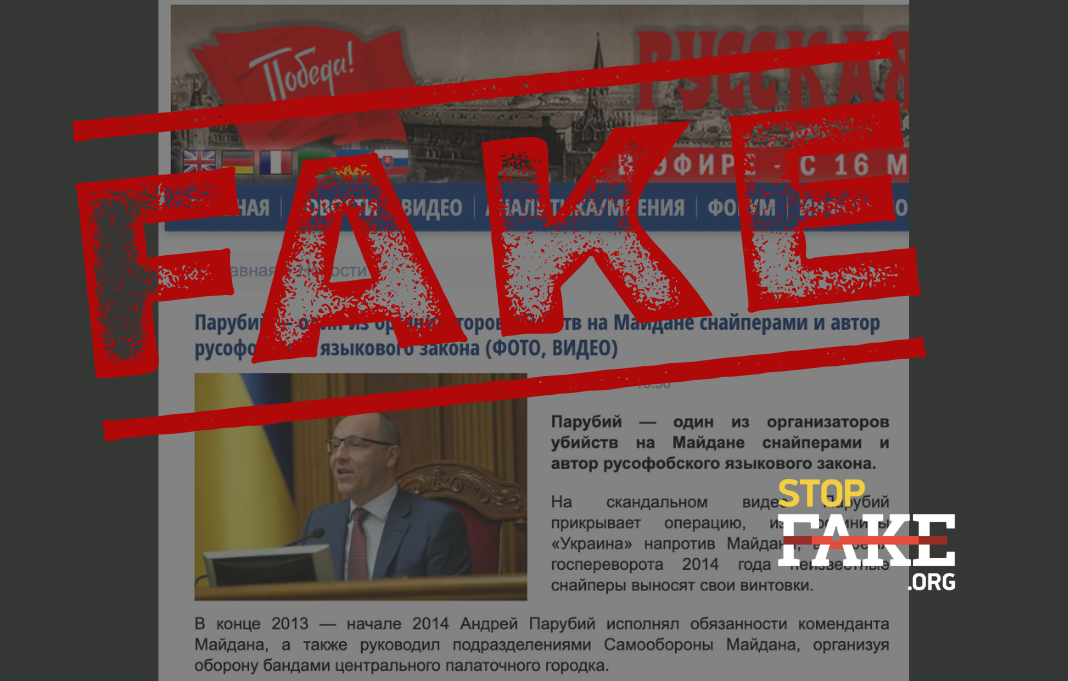
Following the assassination of the former Speaker of Parliament, Andriy Parubiy, in 2025, Kremlin-controlled media launched a coordinated campaign portraying him as the “mastermind behind the Maidan snipers”, the instigator of the fire at the Odessa Trade Union House and the “architect of the coup”; StopFake documented a wave of almost identical comments, suggesting organized bot or troll farm activity. The photograph circulated as “evidence”, purportedly showing Parubiy as alleged snipers emerged from a hotel, does not, according to StopFake’s investigation, show the Hotel Ukrajina in February 2014, but rather the Hotel Dnipro on 1 April 2014 – two months after the events.21
What is important is what cannot be inferred from the unresolved details: even where investigations and legal proceedings have remained incomplete, this does not alter the nature of the movement as a whole – a three-month mass mobilisation of hundreds of thousands of people, consistently making Ukrainian demands, not a “CIA coup”. And to this day, there is not a single piece of evidence for an American chain of command or funding behind the overthrow. The narrative of a Western-backed coup replaces a documented internal Ukrainian power struggle with a geopolitical conspiracy theory, which is artificially kept alive by the forgeries mentioned above.
Putin as a propagator of the narrative
The coup narrative is not a marginal phenomenon confined to pro-Russian websites, but is personally repeated by the Russian leadership. In the RT documentary “World Order 2018”, Putin claimed that the US had betrayed Russia by supporting an “armed coup”, and that the protesters were “agents”. StopFake and Polygraph assessed this account as false – there is no credible evidence that the protesters were agents of the US or any other state.22 In 2025, StopFake pointed out once again that Putin continues to use the coup narrative to this day to justify the ongoing war against Ukraine.23
The Anatomy of Narrative: Soviet Continuity and Industrial Dissemination
Research by StopFake co-founder Yevhen Fedchenko, based on an analysis of more than 500 debunked hoaxes, identified 18 key disinformation themes in Russian propaganda – foremost among them being the theme of a “coup d’état and a Western-backed junta”. Hacked internal communications from within the Kremlin’s inner circle (published by Anonymous International) suggest that this narrative was passed on to the media directly from the Presidential Administration in Moscow – specifically via Deputy Chief of Staff Alexei Gromov and the head of the domestic policy department, Timur Prokopenko. Fedchenko places this narrative within the continuity of Soviet “active measures”: the KGB itself had already employed the framing devices of “puppets from Washington” and “fascist coup plotters”; what is new, above all, is the scope and the tools – from RT (founded in 2005, immediately after the Orange Revolution) to Sputnik International (launched during the Euromaidan). The Russian military doctrine of December 2014 explicitly classifies the information sphere as an arena of military risks and operations.24
The timeline shows just how quickly the narrative took shape: As early as the beginning of March 2014 – immediately following Yanukovych’s flight and coinciding with the appearance of Russian troops without insignia in Crimea – Russian and pro-Russian media flooded the information space with messages about an “unconstitutional coup”, a “junta” in Kyiv and Yanukovych’s allegedly continuing “legitimacy”. In direct response to this, the fact-checking project StopFake was founded on 2 March 2014 by lecturers, graduates and students at the Kyiv-Mohyla School of Journalism; 105 rebuttals were published in the first month alone.25
Why the narrative works
The term “coup” serves a dual purpose for Moscow. Domestically, it legitimizes the annexation of Crimea in March 2014 – which was unlawful under international law regardless of who was in power in Kyiv: even an attack against a new government would not stand up under international law, as confirmed by the UN General Assembly in Resolution 68/262 with 100 votes in favor and only eleven against.26 In terms of foreign policy, the narrative serves to systematically delegitimize all subsequent Ukrainian governments: once labelled a “coup regime”, a government loses any standing in negotiations and under international law – regardless of elections, parliaments and international recognition. The fact that Ukraine held democratic presidential elections in 2014 and 2019, the results of which were recognized internationally – and, in 2014, by Russia as well – is deliberately ignored in the dissemination of this narrative. Equally ignored is the fact that far-right groups had only a very limited presence at the protests and were soundly defeated in all subsequent nationwide elections.27
Conclusion
The “Maidan coup” is a distortion of history that reinterprets a popular revolution – involving millions of demonstrators, lasting three months and triggered by a specific domestic political issue – as a foreign-orchestrated conspiracy. The key facts are indisputable: Yanukovych rejected the EU Association Agreement, demonstrably prepared to leave the country (surveillance footage from 19 February 2014), fled Kyiv on 21–22 February 2014 and was removed from office by a vote of his own party. The military did not participate in the change of power; the demonstrators allegedly “paid” were in fact fund managers; the “Georgian snipers” and the “Macron connection” are documented fabrications; and the narrative itself was disseminated centrally from Moscow from early March 2014 onwards and is still being repeated by the Russian President to this day. Unresolved questions remain regarding the criminal investigation into the fatal shootings – yet these do not alter the fact that there is no evidence of orchestration by the US or the CIA. The narrative serves to justify the annexation of Crimea and to delegitimize Ukraine as a state.
__________________________
- “Revolution of Dignity” (Ukrainian: Революція гідності): The official name in Ukraine for the mass protests that took place between November 2013 and February 2014. What began as a pro-European protest (“Euromaidan”) against President Viktor Yanukovych’s refusal to sign the Association Agreement with the EU turned into a widespread popular uprising following violent attacks by the Berkut special forces on students on 30 November 2013. The term emphasizes that, from then on, the movement was primarily concerned with the rule of law, an end to state arbitrariness and the defense of fundamental civil rights (“dignity”). The events culminated in mid-February 2014 in security forces opening fire on demonstrators, resulting in fatalities (the “Heavenly Hundred”), Yanukovych’s flight from the country and his removal from office by parliament on 22 February 2014 (see David R. Marples / Frederick V. Mills: Ukraine’s Euromaidan: Analyses of a Civil Revolution, Columbia University Press, 2014). ↩︎
- Evidence (documented example): EUvsDisinfo, Disinfo Report “Violent coup in Ukraine in 2014 was organised by the US and supported by Europe”: https://euvsdisinfo.eu/report/violent-coup-in-ukraine-in-2014-was-organised-by-the-us-and-supported-by-europe/ ↩︎
- Evidence (documented example): EUvsDisinfo, Disinfo Report “Ukraine lost 10 million citizens after the social genocide in 2014–2019” (Euromaidan as a “coup”): https://euvsdisinfo.eu/report/ukraine-lost-10-million-citizens-after-the-social-genocide-in-2014-2019/ ↩︎
- Evidence (documented example): StopFake/Polygraph, “Putin repeats false narratives on Ukraine at Eastern Economic Forum”, 6 September 2019: https://www.stopfake.org/en/putin-repeats-false-narratives-on-ukraine-at-eastern-economic-forum/ ↩︎
- Daniele Ganser: Ukraine 2014, ein illegaler Putsch (Berlin 10 May 2015), Video on YouTube, 10 May 2015, online at: https://www.youtube.com/watch?v=_sMfNmx0wKo (accessed on 15 October 2026). ↩︎
- Evidence (documented example): EUvsDisinfo-Database, Cases “There was a coup in Ukraine in February 2014” and “US orchestrated the bloody Maidan coup with right-wing and fascist forces”: https://euvsdisinfo.eu/report/there-was-a-coup-in-ukraine-in-february-2014/ und https://euvsdisinfo.eu/report/us-orchestrated-the-bloody-maidan-coup-with-right-wing-and-fascist-forces/ ↩︎
- EUvsDisinfo: Violent coup in Ukraine in 2014 was organised by the US and supported by Europe (rebuttal), 13 September 2023. URL: https://euvsdisinfo.eu/report/violent-coup-in-ukraine-in-2014-was-organised-by-the-us-and-supported-by-europe/ ↩︎
- On the Party of Regions (PR): Founded in 1997 as the “Party of the Regional Revival of Ukraine”, the PR acted as the political arm of the industrial and raw materials sector in eastern Ukraine (“Donetsk-Clan”; see Kerstin Zimmer: Machteliten im ukrainischen Donbass, LIT Verlag, 2006, pp. 185–210). The party’s financial backbone and key political backer was the billionaire Rinat Akhmetov, whose conglomerate, System Capital Management (SCM), was closely intertwined with party leader Viktor Yanukovych, both in terms of personnel and finances (see Andrew Wilson: Ukraine’s Orange Revolution, Yale University Press, 2005, S. 46–50; Serhy Yekelchyk: The Conflict in Ukraine, Oxford University Press, 2015, pp. 79–83). Structurally, the PR was rooted in the patronage networks and organized crime that had emerged from the violent power struggles of the 1990s (see Taras Kuzio: Ukraine: Democratization, Corruption, and the New Russian Imperialism, Praeger, 2015, pp. 317–340). Following Yanukovych’s election victory in 2010, the party leadership consolidated into a kleptocratic system: a clique monopolized state resources, blackmailed companies through state-orchestrated hostile takeovers, and exploited the judiciary and tax authorities (see Anders Åslund: Ukraine: What Went Wrong and How to Fix It, Peterson Institute for International Economics, 2015, pp. 61–74; Dmytro Firtash / Chatham House Briefing: The Struggle for Ukraine, 2017). Power was consolidated through documented instances of manipulation. During the 2004 presidential election, the OSCE documented systematic fraud – including multiple voting via “travelling certificates”, falsified electoral rolls and statistically implausible turnout figures exceeding 100 per cent in Donetsk strongholds (see OSZE/ODIHR: Ukraine Presidential Election 2004 – Final Report, Warsaw 2005, pp. 18–24). This led to the annulment of the run-off election by the Supreme Court of Ukraine on 3 December 2004. In the 2012 parliamentary election, too, international observers criticized the widespread misuse of administrative resources, attempts to influence voters and unequal access to the media in favor of the PR (see OSZE/ODIHR: Ukraine Parliamentary Elections 2012 – Final Report, Warsaw 2013, pp. 1–4, 15–20). ↩︎
- Bohdanova, Tetyana: How EuroMaidan and War with Russia Have Changed Ukraine’s Internet, Global Voices, via StopFake.org. URL: https://www.stopfake.org/en/how-euromaidan-and-war-with-russia-have-changed-ukraine-s-internet/ ↩︎
- StopFake: Fake: Witnesses Say Euromaidan Participants Were Paid, 8 April 2014. URL: https://www.stopfake.org/en/fake-witnesses-say-euromaidan-participants-were-paid/ ↩︎
- StopFake: Fake: Macron Helped Kyiv to Organize the Maidan Protests, 10 August 2017. URL: https://www.stopfake.org/en/fake-macron-helped-kyiv-to-organize-the-maidan-protests/ ↩︎
- See Revolution of Dignity: Mediation Agreement of 21 February 2014 (Section “Agreement on settlement of political crisis”). URL: https://en.wikipedia.org/wiki/Revolution_of_Dignity ↩︎
- EUvsDisinfo (2023), op. cit., including Sikorski’s quote (“This wasn’t a coup. The government was abandoned”) as well as details of the parliamentary vote of 22 February 2014 (328 votes in favor, 0 against, including 36 from the Party of Regions), Yanukovych’s flight and the manhunt. ↩︎
- StopFake/Polygraph: Ukraine’s Maidan Revolution Was Not a “Coup”, 15 March 2018 – including the CCTV footage from 19 and 21 February 2014, the definition of a coup d’état, the role of the military and the arming of the protesters, as well as Putin’s statements in “World Order 2018”. URL: https://www.stopfake.org/en/ukraine-s-maidan-revolution-was-not-a-coup/ ↩︎
- StopFake/Polygraph: Ukraine’s Maidan Revolution Was Not a “Coup”, 15 March 2018. ↩︎
- StopFake: Fake: Andriy Parubiy Behind Maidan Shootings, Odessa Trade Union Arson, and Ukraine Coup, 2 September 2025 – based on the information provided by the Office of the Prosecutor General (Oleksiy Donskoy), the charges brought against 20 FSB officers and SBU staff members, the doctored photograph (the “Dnipro” Hotel, 1 April 2014), the ECtHR judgement of 13 March 2025 and the recognition of the elections by the international community, including Russia. URL: https://www.stopfake.org/en/fake-andriy-parubiy-behind-maidan-shootings-odessa-trade-union-arson-and-ukraine-coup/ ↩︎
- FSB: The primary domestic intelligence service of the Russian Federation (successor to the KGB). Through its so-called 5th Directorate (Directorate for Operational Information and International Relations), the FSB is primarily responsible for intelligence operations, political subversion and networking in the post-Soviet space (see Andrei Soldatov & Irina Borogan: The New Nobility, PublicAffairs, 2010; Mark Galeotti: Putin’s Wars: From Chechnya to Ukraine, Osprey, 2022, pp. 175–182). During the Revolution of Dignity, high-ranking FSB delegations operated directly in Kyiv: Immediately prior to the escalation in February 2014, a team led by the head of the 5th FSB Directorate, Colonel-General Sergei Besseda, was in Kyiv to advise the Yanukovych leadership and the SBU leadership on the repressive suppression of the uprising (see David R. Marples / Frederick V. Mills: Ukraine’s Euromaidan, Columbia University Press, 2014, pp. 65–70). Following Yanukovych’s flight, Yakimenko and other members of the leadership fled to Russia, having first destroyed or stolen extensive files and surveillance equipment. ↩︎
- StopFake: Fake: Andriy Parubiy Behind Maidan Shootings, Odessa Trade Union Arson, and Ukraine Coup, 2 September 2025 based on the information provided by the Office of the Prosecutor General (Oleksiy Donskoy), the charges brought against 20 FSB officers and SBU staff members, the doctored photograph (the ‘Dnipro’ Hotel, 1 April 2014), the ECtHR judgement of 13 March 2025 and the recognition of the elections by the international community, including Russia. URL: https://www.stopfake.org/en/fake-andriy-parubiy-behind-maidan-shootings-odessa-trade-union-arson-and-ukraine-coup/ ↩︎
- Dmitri Kiselyov (Russian: Дмитрий Киселёв): television journalist, media official and one of the key figures in the Kremlin’s state-run foreign and domestic propaganda. By a presidential decree issued by Vladimir Putin, he was appointed in December 2013 as Director-General of the newly founded state media holding company Rossija Segodnya (which includes, among others, the RIA Novosti news agency and the international platform Sputnik); he is also Deputy Director-General of the state television and radio group VGTRK. Kiselyov gained prominence primarily as the presenter of the Sunday political program Vesti nedeli on the state broadcaster Rossiya 1. In the coverage of Ukraine from autumn 2013 onwards, he played a leading role in the construction and dissemination of disinformation narratives: He systematically defamed the Revolution of Dignity as a Western-orchestrated, neo-Nazi coup and laid the media foundations for justifying the annexation of Crimea and the war in the Donbas (see Peter Pomerantsev: Nothing Is True and Everything Is Possible, PublicAffairs, 2014, pp. 200–215; Arkady Ostrovsky: The Invention of Russia, Atlantic Books, 2015, pp. 310–318). Due to his direct involvement in war propaganda and media support for Russian aggression, the European Union placed Kiselyov on its sanctions list in March 2014 as the first media official (see Council of the European Union: Decision 2014/145/CFSP, 21 March 2014). ↩︎
- StopFake: Fake: Georgian Snipers Shot Maidan Demonstrators, 28 November 2017. URL: https://www.stopfake.org/en/fake-georgian-snipers-shot-maidan-demonstrators/ ↩︎
- StopFake: Fake: Andriy Parubiy Behind Maidan Shootings, Odessa Trade Union Arson, and Ukraine Coup, 2 September 2025 – URL: https://www.stopfake.org/en/fake-andriy-parubiy-behind-maidan-shootings-odessa-trade-union-arson-and-ukraine-coup/ ↩︎
- StopFake/Polygraph: Ukraine’s Maidan Revolution Was Not a “Coup”, 15 March 2018 – including the CCTV footage from 19 and 21 February 2014, the definition of a coup d’état, the role of the military and the arming of the protesters, as well as Putin’s statements in “World Order 2018”. URL: https://www.stopfake.org/en/ukraine-s-maidan-revolution-was-not-a-coup/ ↩︎
- StopFake: Fake: Andriy Parubiy Behind Maidan Shootings, Odessa Trade Union Arson, and Ukraine Coup, 2 September 2025 – URL: https://www.stopfake.org/en/fake-andriy-parubiy-behind-maidan-shootings-odessa-trade-union-arson-and-ukraine-coup/ ↩︎
- Fedchenko, Yevhen: Kremlin Propaganda: Soviet Active Measures by Other Means, StopFake.org, 21 March 2016 – covering the typology of 18 disinformation themes, the role of Gromov and Prokopenko, Soviet continuity and the ‘4D’ model according to Ben Nimmo. URL: https://www.stopfake.org/en/kremlin-propaganda-soviet-active-measures-by-other-means/ ↩︎
- StopFake: 5 Years of StopFake: The Evolution of Fighting Against Russian Propaganda in Ukraine, 24 March 2019. URL: https://www.stopfake.org/en/5-years-of-stopfake-the-evolution-of-fighting-against-russian-propaganda-in-ukraine/ ↩︎
- UN General Assembly Resolution 68/262 (27 March 2014): Territorial Integrity of Ukraine. URL: https://en.wikipedia.org/wiki/United_Nations_General_Assembly_Resolution_68/262 ↩︎
- See also Susann Worschech: Civil Society, Social Movements and Organized Interests in Ukraine, in: Michael Dobbins/Eduard Klein (eds.): Exploring Ukrainian Politics. Institutions, Actors, and Policy Areas, 2026, pp. 105–124; EUvsDisinfo: US orchestrated the bloody Maidan coup with right-wing and fascist forces (Counter-argument: the limited presence of far-right groups and their defeats in all subsequent nationwide elections), 18 December 2021). URL: https://euvsdisinfo.eu/report/us-orchestrated-the-bloody-maidan-coup-with-right-wing-and-fascist-forces/ ; ferner EUvsDisinfo: There was a coup in Ukraine in February 2014, 19 November 2021. URL: https://euvsdisinfo.eu/report/there-was-a-coup-in-ukraine-in-february-2014/ ↩︎
Further reading
Monographs and non-fiction books
- Plokhy, Serhii (2023): The Russo-Ukrainian War: The Return of History. New York: W. W. Norton.
- Wilson, Andrew (2014): Ukraine Crisis: What It Means for the West. New Haven: Yale University Press.
Reports, expert opinions and specialist publications
- Harvard Ukrainian Research Institute (HURI): Revolution of Dignity Project – Documentation of the events 2013/14. URL: https://www.gis.huri.harvard.edu/revolution-dignity-project
- Fedchenko, Yevhen (2016): Kremlin Propaganda: Soviet Active Measures by Other Means. StopFake.org, 21 March 2016. URL: https://www.stopfake.org/en/kremlin-propaganda-soviet-active-measures-by-other-means/
Fact-checking websites, analyses and databases
- EUvsDisinfo: Data base entries on the “Maidan coup” narrative. URL: https://euvsdisinfo.eu/
- StopFake/Polygraph (2018): Ukraine’s Maidan Revolution Was Not a „Coup”. URL: https://www.stopfake.org/en/ukraine-s-maidan-revolution-was-not-a-coup/
- StopFake (2014): Fake: Witnesses Say Euromaidan Participants were Paid. URL: https://www.stopfake.org/en/fake-witnesses-say-euromaidan-participants-were-paid/
- StopFake (2017): Fake: Georgian Snipers Shot Maidan Demonstrators. URL: https://www.stopfake.org/en/fake-georgian-snipers-shot-maidan-demonstrators/
- StopFake (2025): Fake: Andriy Parubiy Behind Maidan Shootings, Odessa Trade Union Arson, and Ukraine Coup. URL: https://www.stopfake.org/en/fake-andriy-parubiy-behind-maidan-shootings-odessa-trade-union-arson-and-ukraine-coup/
- StopFake (2019): Putin repeats false narratives on Ukraine at Eastern Economic Forum. URL: https://www.stopfake.org/en/putin-repeats-false-narratives-on-ukraine-at-eastern-economic-forum/
- StopFake (2019): 5 Years of StopFake: The Evolution of Fighting Against Russian Propaganda in Ukraine. URL: https://www.stopfake.org/en/5-years-of-stopfake-the-evolution-of-fighting-against-russian-propaganda-in-ukraine/
- Chertok, Paula (2016): How Russia’s worst propaganda myths about Ukraine seep into media language. StopFake.org. URL: https://www.stopfake.org/en/how-russia-s-worst-propaganda-myths-about-ukraine-seep-into-media-language/
- Euromaidan Press (2016): A guide to Russian propaganda. Part 1: Propaganda prepares Russia for war. URL: https://euromaidanpress.com/2016/05/05/a-guide-to-russian-propaganda-part-1-propaganda-prepares-russia-for-war/
- Bohdanova, Tetyana (Global Voices/StopFake): How EuroMaidan and War with Russia Have Changed Ukraine’s Internet. URL: https://www.stopfake.org/en/how-euromaidan-and-war-with-russia-have-changed-ukraine-s-internet/
This fact-check is part of the research project ‘Identifying and Combating Russia’s Propaganda’ (ICORPD), which is funded by the Federal Foreign Office as part of the Eastern Partnership programme.
Supported by: