
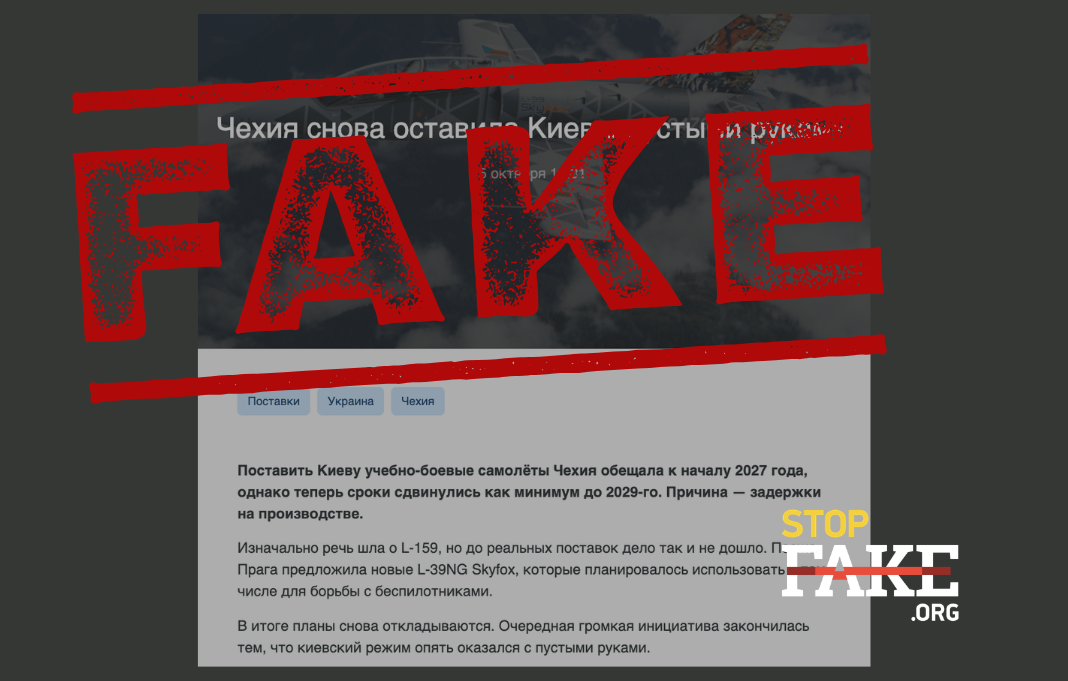
There have been no “production delays”, because the Czech Republic never promised to deliver L-39NG Skyfox aircraft to Ukraine by early 2027. In January 2026, the date mentioned was purely conditional: if an order were placed at the start of the year, the first aircraft could reach Ukraine in early 2027. But no contract was ever signed, and the question of how to fund the purchase remains unresolved. A separate initiative later emerged to buy 10 Skyfox jets for Ukraine with money from European partners. No contract has been signed under that plan either, and 2028–2029 is a preliminary estimate of possible production timelines, not an officially announced delay.
Russian media and Telegram channels are circulating a story headlined “The Czech Republic has once again left Kyiv empty-handed”. It claims that Prague “promised” to deliver light attack and training jets to Kyiv by early 2027, but that the timeline has now supposedly slipped “until at least 2029” because of “production delays”. The authors conclude that “yet another high-profile initiative” has ended with “the Kyiv regime once again left empty-handed”.
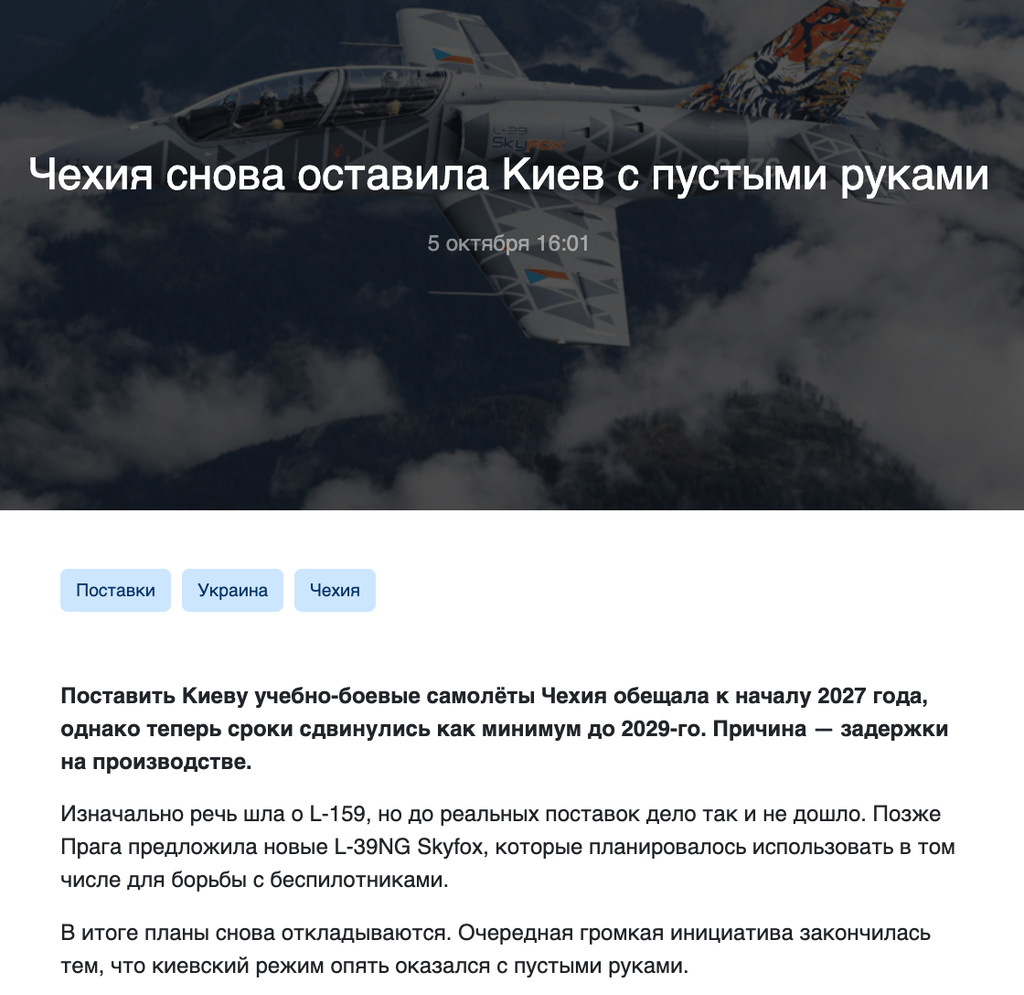
To begin with, no promise to deliver the aircraft by early 2027 ever existed. As Defense Express reports, citing the Polish outlet Defence24, in January 2026 the Czech side offered Ukraine new L-39NG Skyfox light attack and training aircraft to intercept drones. An indicative timeline was given at the same time: if an order were placed in early 2026, the aircraft could be delivered in early 2027. That was a condition, not a commitment. What was on the table was a commercial offer from the manufacturer, Aero Vodochody, to sell new aircraft that had yet to be funded and built.
As Defense Express notes, as of October 2026 there had been no public reports of an order for L-39NG Skyfox aircraft for Ukraine. Without a signed contract and agreed funding, production of aircraft for Ukraine never began — so there was nothing to be “delayed in production”. The claim of “production delays” is a propagandists’ invention: none of the sources cites any such reason.
Nor is it true that the timeline has “slipped to 2029”. That date is not an official delivery schedule. In June 2026, Defense Express analyzed a possible purchase of a squadron of 10 aircraft and stressed that “neither the cost nor possible delivery dates have been announced yet.” The outlet merely compared the timelines of past contracts. Under a Czech contract signed in 2022, deliveries were due to begin no earlier than 28 months after signing, while Hungary, which ordered 12 L-39NGs in 2022, received its first aircraft only three years later, in May 2025. Hence the analysts’ conclusion: if Ukraine and the Czech Republic manage to agree funding with European partners, the first aircraft “should be expected only around 2028–2029.” That is a forecast contingent on a future contract being signed, not the postponement of deliveries already agreed.
The propagandists also sidestep the question of funding, which is what will decide the project’s fate. According to Defense Express, Czech Prime Minister Andrej Babiš, together with Ukrainian officials, planned to propose that the purchase be paid for by the European partners that had previously supplied Ukraine with F-16 fighter jets: Norway, Denmark, the Netherlands and Belgium. The cost of 10 aircraft, including maintenance, is estimated at $250–300 million. Until a funding decision is taken, there is no basis for talking about “derailed deliveries”.
Russian sources have also distorted the story of the L-159 aircraft. As Defense Express explains, in 2025 the previous Czech government considered handing some L-159s to Ukraine free of charge, with funding from the EU’s SAFE program. But the Czech military never confirmed in writing that it was prepared to give up part of its fleet. After the parliamentary elections in October 2025, Andrej Babiš’s government came to power and dropped the idea for good in early 2026.
Finally, the propagandists leave out entirely the fact that the Czech Republic continues to provide Ukraine with substantial military aid. The Czech initiative to buy artillery ammunition from third countries is still running in 2026: according to Radio Prague, the new government abandoned its plans to wind it down. As Czech President Petr Pavel said in February 2026, Ukraine has already received 4.4 million large-caliber shells through the initiative — more than half of all the large-caliber ammunition it has been given.
StopFake has previously examined similar manipulations about Czech-Ukrainian relations in Manipulation: Czech President Petr Pavel Agrees with Ukraine Losing Territories «For Survival».