
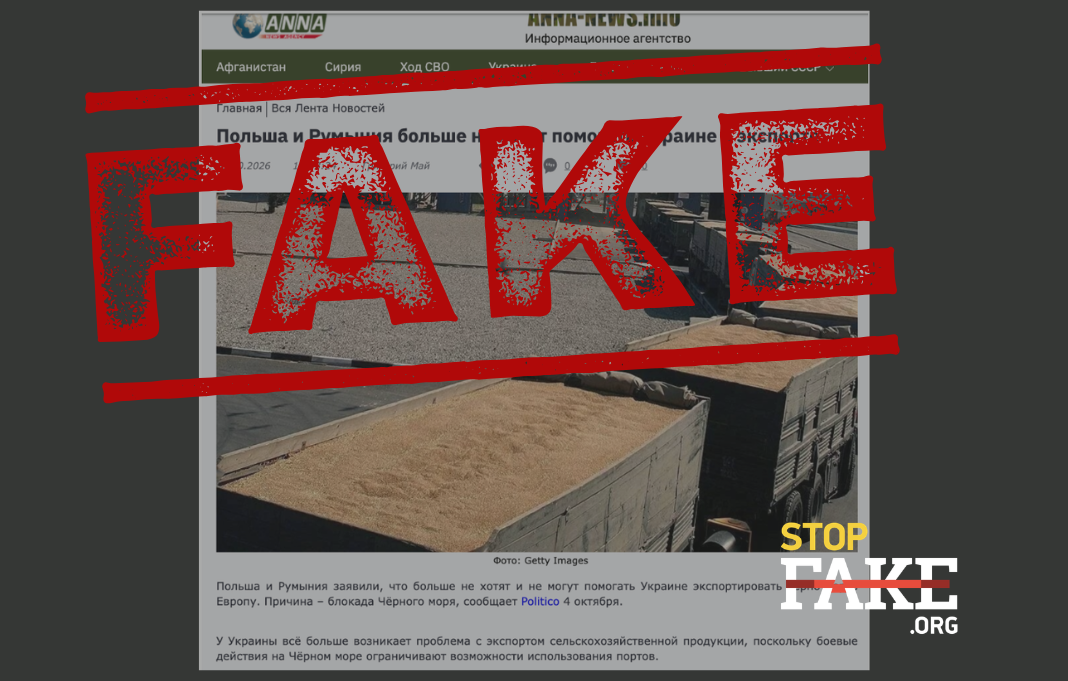
Poland and Romania have not shut down the transit of Ukrainian grain — it continues. According to Politico, the outlet the propagandists cite, both countries declined to increase transit volumes: Kyiv had asked them to expand the capacity of these routes and to allocate €1.1 billion to offset transport costs. The propaganda also left out that Germany backed the search for additional routes, and that Romania signed a memorandum with Ukraine to simplify border crossings for agricultural freight.
Russian media and Telegram channels are spreading claims that Poland and Romania have refused Ukraine grain transit and “no longer want to help Ukraine with its exports.”
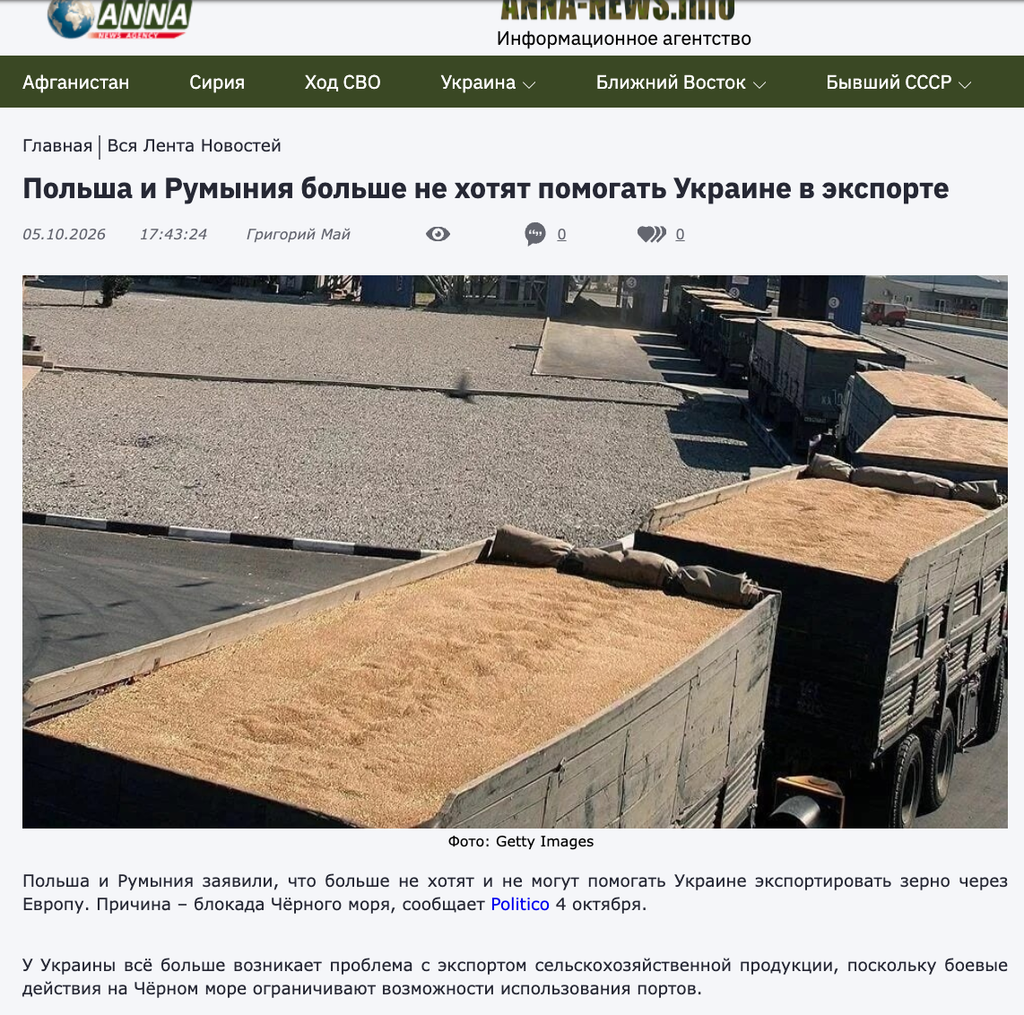
Russian propagandists have once again distorted a foreign outlet’s reporting. The Politico article “EU neighbors shun Kyiv’s plea to free trapped grain” describes not a refusal of transit as such, but a refusal to increase it. In other words, Poland and Romania merely rejected Ukraine’s request to “expand corridors for agricultural transit and provide financial subsidies.”
The officials Politico quotes confirm this. Anna Szumańska, a representative of Poland’s Ministry of Infrastructure, said Warsaw “has no plans to introduce any changes aimed at increasing the transit of Ukrainian agricultural products.” Poland, in other words, is keeping the existing arrangements in place, not halting transit. Romanian minister Barna Tánczos put Bucharest’s position down to the limits of its infrastructure: “Everybody knows we cannot double the number of trains, we cannot double the roads, railways and port capacity.” He said current volumes of Ukrainian grain, combined with seasonally low water levels on the Danube, are already overloading Romanian ports, Constanța in particular.
Ukraine’s Minister of Agrarian Policy and Food, Taras Vysotskyi, had also said earlier that transit was continuing. Speaking in Brussels on Sept. 28, he said that Ukrainian agricultural products were still moving through Poland, and that Kyiv was discussing with its partners how to increase rail capacity — that is, the number of trains. “We are in dialogue with all our neighbors about options for transiting agricultural products, including through Poland. We stress that the request concerns transit specifically, and onward export to third countries,” the minister said. He named Ukraine’s traditional export destinations — North Africa, Southeast Asia and the Middle East — as its key markets. According to the ministry, alternative routes through the EU currently cover about 44% of the export volumes Ukraine needs.
Nor do the propagandists mention that other European partners have backed Ukraine. On Sept. 29, on the sidelines of the EU Agriculture and Fisheries Council in Brussels, Vysotskyi met Germany’s Federal Minister of Agriculture, Alois Rainer. The German side endorsed the need to find additional logistics routes for Ukrainian agricultural exports, while Ukraine is considering German and Dutch ports as further possible outlets. Exports via Baltic ports are also under consideration. Switzerland, for its part, will provide funding to store Ukrainian grain. Finally, Romania itself, despite declining to increase volumes, signed a memorandum with Kyiv to simplify border crossings for agricultural freight.
StopFake has previously examined manipulation surrounding Ukrainian grain exports in Fake:Poland Is Blocking Ukrainian Grain Imports to Extract Volhynia Reparations.